Review
doi: 10.3121/cmr.2007.683.
Plastic biliary stent occlusion: factors involved and possible preventive approaches
Affiliations
- PMID: 17456835
- PMCID: PMC1855334
- DOI: 10.3121/cmr.2007.683
Item in Clipboard
Review
Plastic biliary stent occlusion: factors involved and possible preventive approaches
Clin Med Res.
2007 Mar.
Abstract
Endoscopic biliary stenting is today the most common palliative treatment for patients suffering from obstructive jaundice associated with malignant hepatobiliary tumors or benign strictures. However, recurrent jaundice, with or without cholangitis, is a major complication of a biliary endoprosthesis insertion. Thus, stent removal and replacement with a new one frequently occurs as a consequence of device blockage caused by microbial biofilm growth and biliary sludge accumulation in the lumen. Factors and mechanisms involved in plastic stent clogging arising from epidemiological, clinical and experimental data, as well as the possible strategies to prevent biliary stent failure, will be reviewed and discussed.
Figures
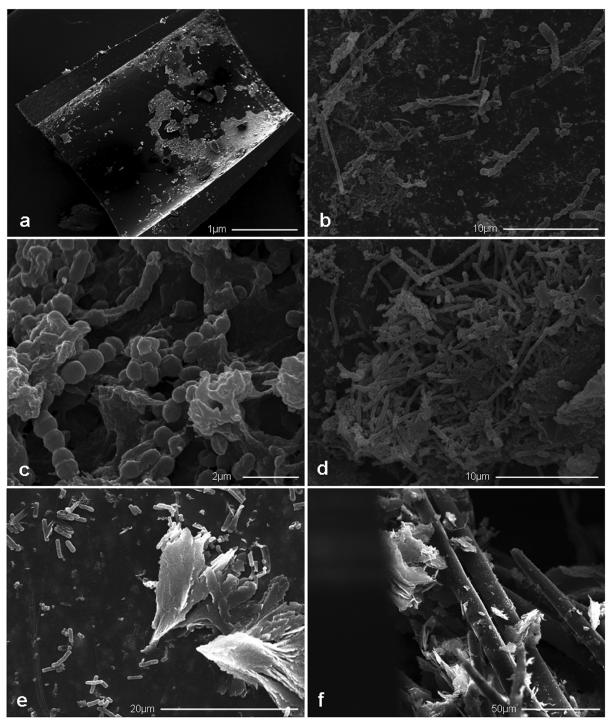
Scanning electron micrographs of clogged polyethylene stents showing (a) fragments of a protein conditioning film layered on the inner surface of a blocked stent, as visible after removal of the sludge material, (b) different bacterial and fungal species colonizing the inner surface of the stent, (c) a mature biofilm of Enterococcus spp., (d) a Candida spp. mature biofilm exhibiting different stages of fungal growth, (e) typical flock-shaped cholesterol crystals, as well as numerous bacilli and (f) plant fibers found in the biliary sludge.
References
-
- Soehendra N, Reynders-Frederix V. Palliative bile duct drainage - a new endoscopic method of introducing a transpapillary drain. Endoscopy 1980;12:8–11. - PubMed
-
- Dowidar N, Kolmos HJ, Matzen P. Experimental clogging of biliary endoprostheses. Role of bacteria, endoprosthesis material, and design. Scand J Gastroenterol 1992;27:77–80. - PubMed
-
- McAllister EW, Carey LC, Brady PG, Heller R, Kovacs SG. The role of polymeric surface smoothness of biliary stents in bacterial adherence, biofilm deposition, and stent occlusion. Gastrointest Endosc 1993;39:422–425. - PubMed
-
- Weickert U, Venzke T, Konig J, Janssen J, Remberger K, Greiner L. Why do bilioduodenal plastic stents become occluded? A clinical and pathological investigation on 100 consecutive patients. Endoscopy 2001;33:786–790. - PubMed
Publication types
MeSH terms
Substances
LinkOut - more resources
Full Text Sources
Other Literature Sources
Medical