


Association of -318 C/T and +49 A/G cytotoxic T lymphocyte antigen-4 (CTLA-4) gene polymorphisms with a clinical subset of Italian patients with systemic sclerosis
- PMID: 17459075
- PMCID: PMC1942023
- DOI: 10.1111/j.1365-2249.2007.03394.x
Association of -318 C/T and +49 A/G cytotoxic T lymphocyte antigen-4 (CTLA-4) gene polymorphisms with a clinical subset of Italian patients with systemic sclerosis
Abstract
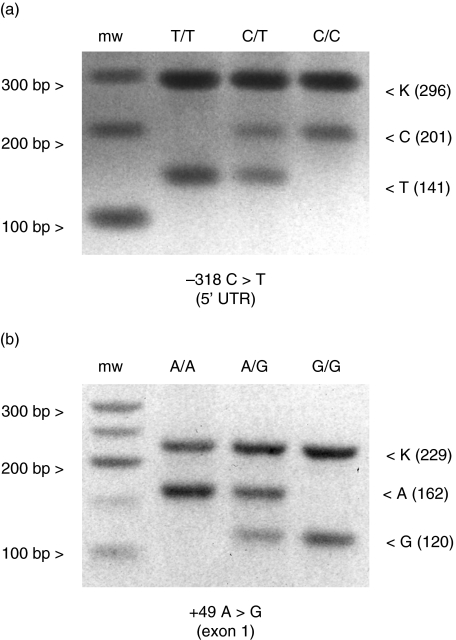
Systemic sclerosis (SSc) is a complex and heterogeneous autoimmune disorder with a multi-factorial pathogenesis. Like other autoimmune disorders, the possible role of specific cytotoxic T lymphocyte antigen-4 (CTLA-4) gene polymorphisms in predisposing to SSc has been hypothesized, but it remains controversial. CTLA-4 promoter (-318C/T) and exon 1 (+49 A/G) polymorphisms have been analysed in 43 Italian females with SSc and in 93 unrelated matched healthy controls by a newly designed tetra-primer amplification refractory mutation system-polymerase chain reaction (T-ARMS-PCR) method. No significant association has been found with either polymorphisms.Nevertheless, SSc patients without concomitant Hashimoto's thyroiditis (HT) were carrying both the -318T allele (P = 0.031) and the +49 G allele (P = 0.076) more frequently than SSc patients with HT [defined by positivity for anti-thyroperoxidase (TPO) and anti-thyroglobulin (TGA) autoantibodies] than controls. Haplotype analysis confirms this association (P = 0.028), and suggests the predominant role of the -318T, whereas that of the +49 G, if any, seems weak. Thus, in Italian SSc patients the CTLA-4 -318C/T promoter polymorphism appears to be associated with the susceptibility to develop SSc without thyroid involvement. Larger studies are needed to confirm these findings and to clarify whether the -318C/T polymorphism is the functional responsible or whether it reflects the presence of another linked genetic element in the same chromosomal region.
Figures
References
-
- Derk CT, Jimenez SA. Systemic sclerosis: current views of its pathogenesis. Autoimmun Rev. 2003;2:181–91. - PubMed
-
- Jimenez SA, Derk CT. Following the molecular pathways toward an understanding of the pathogenesis of systemic sclerosis. Ann Intern Med. 2004;140:37–50. - PubMed
-
- Mayes MD. Scleroderma epidemiology. Rheum Dis Clin North Am. 2003;29:239–54. - PubMed
-
- Tan FK. Systemic sclerosis: the susceptible host (genetics and environment) Rheum Dis Clin North Am. 2003;29:211–37. - PubMed
-
- Johnson RW, Tew MB, Arnett FC. The genetics of systemic sclerosis. Curr Rheumatol Rep. 2002;4:99–107. - PubMed
Publication types
MeSH terms
Substances
LinkOut - more resources
Full Text Sources
Medical
