Comparative Study
. 2007 Apr;9(4):349-57.
doi: 10.1593/neo.07133.

Tumor vesicle-associated CD147 modulates the angiogenic capability of endothelial cells

Affiliations
Comparative Study

Tumor vesicle-associated CD147 modulates the angiogenic capability of endothelial cells

Danilo Millimaggi et al. Neoplasia. 2007 Apr.

Abstract

Matrix metalloproteinase (MMP) degradation of extracellular matrix is thought to play an important role in invasion, angiogenesis, tumor growth, and metastasis. Several studies have demonstrated that CD147/extracellular MMP inducer, a membrane-spanning molecule highly expressed in tumor cells, may be involved in the progression of malignancies by regulating expression of MMP in peritumoral stromal cells. In the present study we show that CD147 is expressed in microvesicles derived from epithelial ovarian cancer cells and that CD147-positive vesicles may promote an angiogenic phenotype in endothelial cells in vitro. Vesicles shed by human ovarian carcinoma cell lines OVCAR3, SKOV3, and A2780 expressed different levels of CD147 and stimulated proangiogenic activities of human umbilical vein endothelial cells (HUVECs) in a CD147-dependent fashion (OVCAR3 > SKOV3 > A2780). Moreover, vesicles shed by ovarian carcinoma cell line CABA I with low CD147 expression had no significant effect on the development of angiogenic phenotype in HUVECs. The treatment of OVCAR3 cells with small interfering RNA against CD147 suppressed the angiogenic potential of OVCAR3-derived microvesicles. However, transfection of CD147 cDNA into the CABA I cell line enabled CABA I-derived vesicles to induce angiogenesis and to promote MMP genes expression in HUVECs. We therefore conclude that vesicles shed by ovarian cancer cells may induce proangiogenic activities of HUVECs by a CD147-mediated mechanism.


Figures
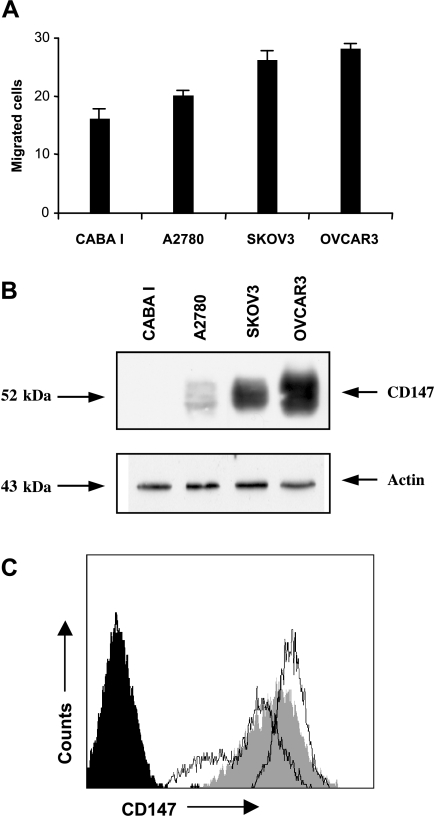
Figure 1
Figure 1
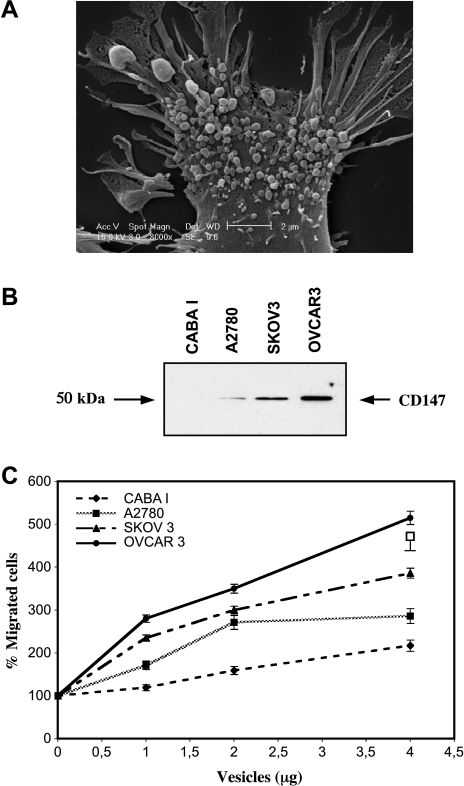
(A) Comparison of the invasive potential of three ovarian cancer cell lines. Migration activity (representative of three experiments) was calculated as the mean number of migrated cells observed in ten high-power fields (mean ± SD of triplicates). (B) Western blot analysis of CD147. (C) Flow cytometric analysis of CD147. Right profile, white area, OVACR3; gray profile, SKOV3; central profile, white area, A2780; black profile, CABA I.
Figure 2
Figure 2
(A) Western blot analysis of microvesicle-associated CD147. (B) Effect of microvesicles derived from tumor cells on endothelial cell invasiveness. HUVECs were stimulated by microvesicles shed by ovarian cancer cells (1, 2, and 4 µg protein). Migration activity (representative of three experiments) was calculated as the mean number of migrated cells observed in 10 high-power fields (mean ± SD of triplicates). Supernatant of NIH-3T3, used as a reference attractant, stimulated invasion with a value of 480%.
Figure 3
Figure 3
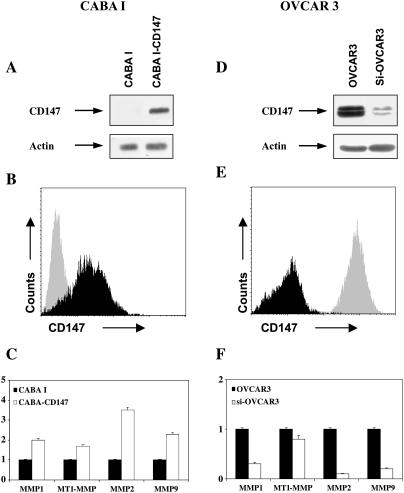
(A, D) Western blot analysis of CD147 in CABA I and OVAR3 ovarian cancer cell lines. (B) Flow cytometry analysis of CD147 in CABA I: gray profile indicates control cells, whereas black profile indicates CD147-transfected cells. (E) Flow cytometry analysis of CD147 in OVCAR3 cells. Gray profile indicates control cells, whereas black profile indicates cells with silenced CD147 expression. (C, F) RT-PCR analysis of ovarian cancer cell lines for MMP-1, -2, and -9 and MT1-MMP mRNA expression. Control cells were arbitrarily set at 1.
Figure 4
Figure 4
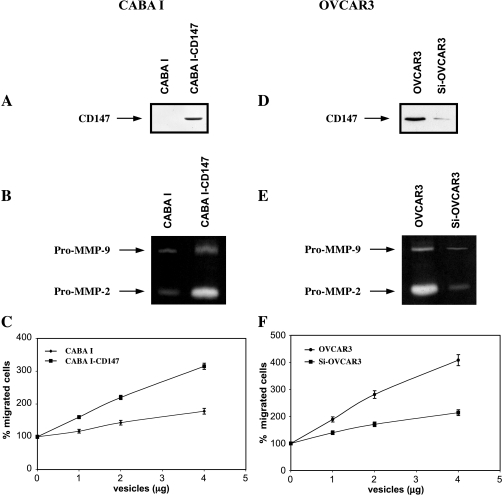
(A, D) Western blot analysis of microvesicle-associated CD147 in ovarian cancer cells. (B, E) Zymographic analysis of tumor microvesicle-associated MMP-2 and MMP-9. (C, F) Effect of tumor cell-shed microvesicles on invasiveness of cultured endothelial cells. HUVECs were stimulated by microvesicles shed by CABA I cells with and without transfection with CD147 cDNA (C) as well as by vesicle shed by OVCAR3 cells with and without silenced CD147 expression (D) (1, 2, and 4 µg protein). Migration activity (representative of three experiments) was calculated as the mean number of migrated cells observed in 10 high-power fields (mean ± SD of triplicates).
Figure 5
Figure 5
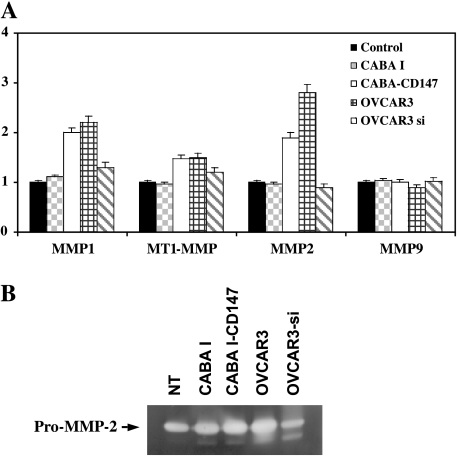
(A) RT-PCR analysis of MMP expression in HUVECs after exposure to tumor-derived microvesicles. MMP mRNA expression of vesicleuntreated HUVECs was arbitrarily set at 1. (B) Gelatin zymography of HUVEC-conditioned medium after addition of microvesicles.
Figure 6
Figure 6
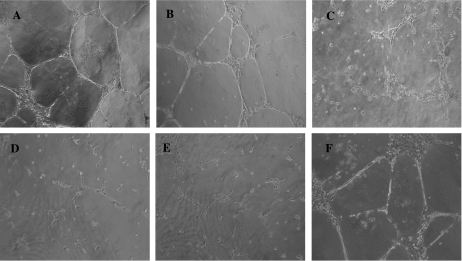
Effect of microvesicles on the formation of capillary-like structures by endothelial cells. HUVECs were plated on Matrigel in complete medium containing 10% serum (A), medium with 5% serum (D), medium with 5% serum containing OVCAR3-derived microvesicles (B), medium with 5% serum containing microvesicles derived from OVCAR3 with silenced CD147 expression (E), medium with 5% serum containing microvesicles shed by CABA I cells (C), and medium with 5% serum containing microvesicles shed by CABA I cells transfected with CD147 cDNA (F). The photographs were taken after 24 hours of incubation (original magnification, x100).

References

    1. Biswas C, Zhang Y, DeCastro R, Guo H, Nakamura T, Kataoka H, Nabeshima K. The human tumor cell-derived collagenase stimulatory factor (renamed EMMPRIN) is a member of the immunoglobulin superfamily. Cancer Res. 1995;55:434–439. - PubMed
    1. Toole BP. Emmprin (CD147), a cell surface regulator of matrix metalloproteinase production and function. Curr Top Dev Biol. 2003;54:371–389. - PubMed
    1. Davidson B, Goldberg I, Berner A, Kristensen GB, Reich R. EMMPRIN (extracellular matrix metalloproteinase inducer) is a novel marker of poor outcome in serous ovarian carcinoma. Clin Exp Metastasis. 2003;20:161–169. - PubMed
    1. Tang Y, Kesavan P, Nakada MT, Yan L. Tumor-stroma interaction: positive feedback regulation of extracellular matrix metalloproteinase inducer (EMMPRIN) expression and matrix metalloproteinase-dependent generation of soluble EMMPRIN. Mol Cancer Res. 2004;2:73–80. - PubMed
    1. Sun J, Hemler ME. Regulation of MMP-1 and MMP-2 production through CD147/extracellular matrix metalloproteinase inducer interactions. Cancer Res. 2001;61:2276–2281. - PubMed

Publication types

MeSH terms

LinkOut - more resources