


High-throughput killer cell immunoglobulin-like receptor genotyping by MALDI-TOF mass spectrometry with discovery of novel alleles
- PMID: 17464504
- PMCID: PMC2881672
- DOI: 10.1007/s00251-007-0222-x
High-throughput killer cell immunoglobulin-like receptor genotyping by MALDI-TOF mass spectrometry with discovery of novel alleles
Abstract
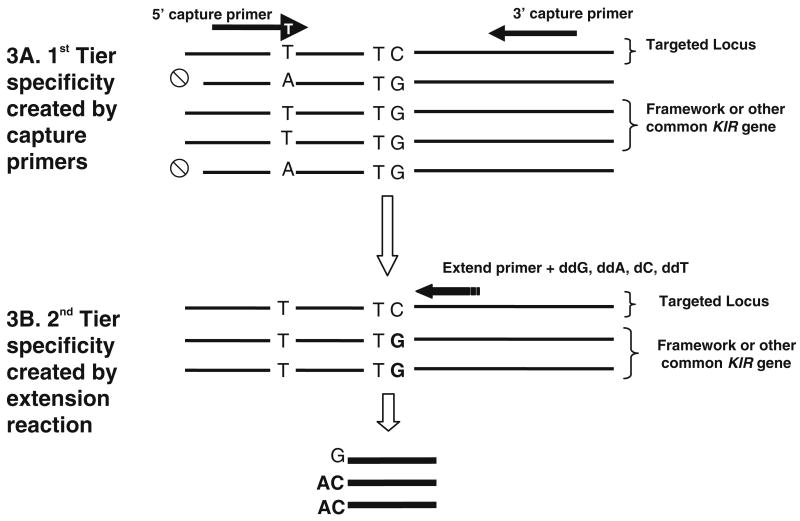
The killer cell immunoglobulin-like receptors (KIR) interact with major histocompatibility complex (MHC) class I ligands to regulate the functions of natural killer cells and T cells. Like human leukocyte antigens class I, human KIR are highly variable and correlated with infection, autoimmunity, pregnancy syndromes, and transplantation outcome. Limiting the scope of KIR analysis is the low resolution, sensitivity, and speed of the established methods of KIR typing. In this study, we describe a first-generation single nucleotide polymorphism (SNP)-based method for typing the 17 human KIR genes and pseudogenes that uses analysis by matrix-assisted laser desorption/ionization time-of-flight (MALDI-TOF) mass spectrometry. It is a high-throughput method that requires minute amounts of genomic DNA for discrimination of KIR genes with some allelic resolution. A study of 233 individuals shows that the results obtained by the SNP-based KIR/MALDI-TOF method are consistent with those obtained with the established sequence-specific oligonucleotide probe or sequence-specific polymerase chain reaction methods. The added sensitivity of the KIR/MALDI-TOF method allowed putative novel alleles of the KIR2DL1, KIR3DL1, KIR2DS5, and KIR2DL5 genes to be identified. Sequencing the KIR2DL5 variant proved it was a newly discovered allele, one that appears associated with Hispanic and Native American populations. This KIR/MALDI-TOF method of KIR typing should facilitate population and disease-association studies that improve knowledge of the immunological functions of KIR-MHC class I interactions.
Figures


References
-
- Bottino C, Castriconi R, Moretta L, Moretta A. Cellular ligands of activating NK receptors. Trends Immunol. 2005;26:221–226. - PubMed
-
- Carrington M, Norman PJ. NCBI Bookshelf. 2003. The KIR gene cluster.
-
- Christiansen FT, Gaudieri S, De Santis D, Moore CB, Witt CS, James IR. NK Receptor genes are predictors of HIV progression. Hum Immunol. 2003;64(Suppl 1):S12.
-
- Cook MA, Norman PJ, Curran MD, Maxwell LD, Briggs DC, Middleton D, Vaughan RW. A multi-laboratory characterization of the KIR genotypes of 10th International Histocompatibility Workshop cell lines. Hum Immunol. 2003;64:567–571. - PubMed
-
- Cook MA, Milligan DW, Fegan CD, Darbyshire PJ, Mahendra P, Craddock CF, Moss PA, Briggs DC. The impact of donor KIR and patient HLA-C genotypes on outcome following HLA-identical sibling hematopoietic stem cell transplantation for myeloid leukemia. Blood. 2004;103:1521–1526. - PubMed
Publication types
MeSH terms
Substances
Associated data
- Actions
Grants and funding
LinkOut - more resources
Full Text Sources
Other Literature Sources
Research Materials
