


Expansion of the calcium hypothesis of brain aging and Alzheimer's disease: minding the store
- PMID: 17465978
- PMCID: PMC1974776
- DOI: 10.1111/j.1474-9726.2007.00295.x
Expansion of the calcium hypothesis of brain aging and Alzheimer's disease: minding the store
Abstract
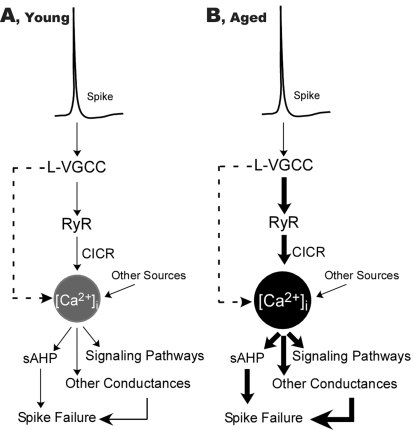
Evidence accumulated over more than two decades has implicated Ca2+ dysregulation in brain aging and Alzheimer's disease (AD), giving rise to the Ca2+ hypothesis of brain aging and dementia. Electrophysiological, imaging, and behavioral studies in hippocampal or cortical neurons of rodents and rabbits have revealed aging-related increases in the slow afterhyperpolarization, Ca2+ spikes and currents, Ca2+transients, and L-type voltage-gated Ca2+ channel (L-VGCC) activity. Several of these changes have been associated with age-related deficits in learning or memory. Consequently, one version of the Ca2+ hypothesis has been that increased L-VGCC activity drives many of the other Ca2+-related biomarkers of hippocampal aging. In addition, other studies have reported aging- or AD model-related alterations in Ca2+ release from ryanodine receptors (RyR) on intracellular stores. The Ca2+-sensitive RyR channels amplify plasmalemmal Ca2+ influx by the mechanism of Ca2+-induced Ca2+ release (CICR). Considerable evidence indicates that a preferred functional link is present between L-VGCCs and RyRs which operate in series in heart and some brain cells. Here, we review studies implicating RyRs in altered Ca+ regulation in cell toxicity, aging, and AD. A recent study from our laboratory showed that increased CICR plays a necessary role in the emergence of Ca2+-related biomarkers of aging. Consequently, we propose an expanded L-VGCC/Ca2+ hypothesis, in which aging/pathological changes occur in both L-type Ca2+ channels and RyRs, and interact to abnormally amplify Ca2+ transients. In turn, the increased transients result in dysregulation of multiple Ca2+-dependent processes and, through somewhat different pathways, in accelerated functional decline during aging and AD.
Figures
References
-
- Aley PK, Murray HJ, Boyle JP, Pearson HA, Peers C. Hypoxia stimulates Ca2+ release from intracellular stores in astrocytes via cyclic ADP ribose-mediated activation of ryanodine receptors. Cell Calcium. 2006;39:95–100. - PubMed
-
- Alonso MT, Barrero MJ, Carnicero E, Montero M, Garcia-Sancho J, Alvarez J. Functional measurements of [Ca2+] in the endoplasmic reticulum using a herpes virus to deliver targeted aequorin. Cell Calcium. 1998;24:87–96. - PubMed
-
- Alshuaib WB, Cherian SP, Hasan MY, Fahim MA. Modulation of neuronal [Ca2+]i by caffeine is altered with aging. Int. J. Dev. Neurosci. 2006;24:389–394. - PubMed
-
- Ankarcrona M, Hultenby K. Presenilin-1 is located in rat mitochondria. Biochem. Biophys. Res. Commun. 2002;295:766–770. - PubMed
Publication types
MeSH terms
Substances
Grants and funding
LinkOut - more resources
Full Text Sources
Other Literature Sources
Medical
Miscellaneous
