


Nitrogen fixation associated with Suillus tomentosus tuberculate ectomycorrhizae on Pinus contorta var. latifolia
- PMID: 17468111
- PMCID: PMC3243579
- DOI: 10.1093/aob/mcm061
Nitrogen fixation associated with Suillus tomentosus tuberculate ectomycorrhizae on Pinus contorta var. latifolia
Abstract
Background and aims: Tuberculate ectomycorrhizae are a unique form of ectomycorrhiza where densely packed clusters of mycorrhizal root tips are enveloped by a thick hyphal sheath to form a tubercle. The functional significance of such a unique structure has not previously been established. The purpose of the present study was to investigate and measure the potential nitrogenase activity associated with Suillus tomentosus/Pinus contorta tuberculate ectomycorrhizae in two stand ages, young and old, and across a range of nitrogen-poor soil conditions.
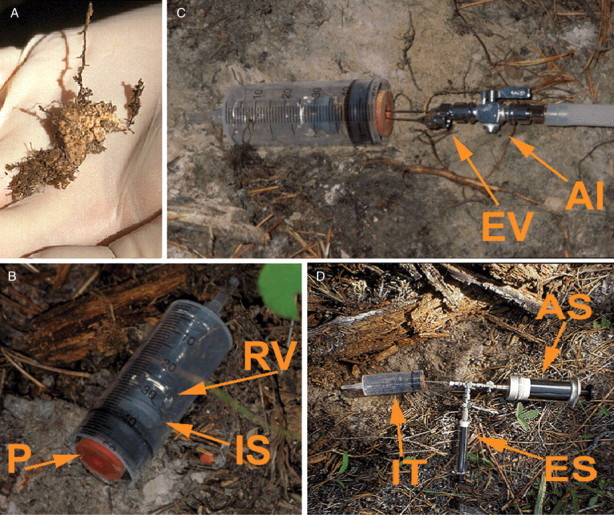
Methods: Short roots were compared with other mycorrhizae and non-mycorrhizal secondary roots using tuberculate ectomycorrhizae. Assessment of nitrogenase activity was determined and quantitative measurements were taken on tuberculate ectomycorrhizae in situ in a variety of different circumstances, by using an adaptation of the acetylene reduction assay.
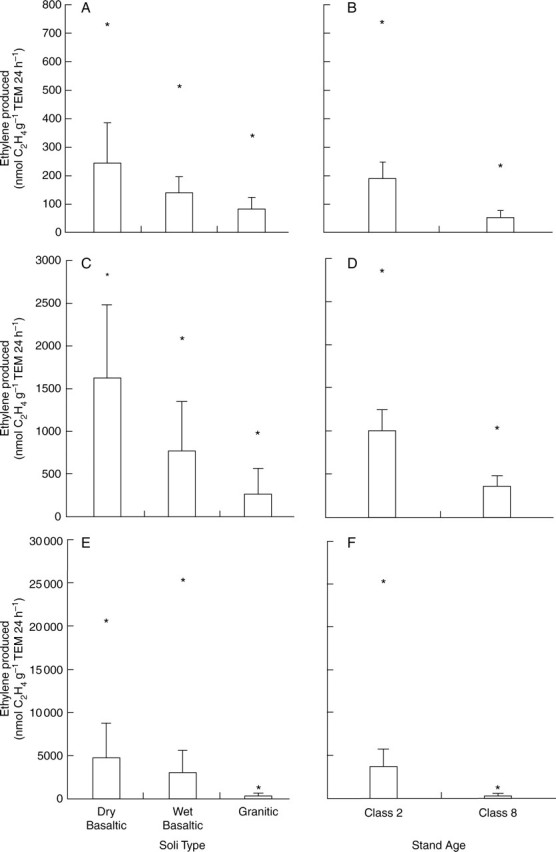
Key results: Significant nitrogenase activity was measured associated with S. tomentosus/P. contorta tuberculate ectomycorrhizae whereas no nitrogenase activity was measured with non-tuberculate mycorrhizae or secondary roots without mycorrhizae. Average nitrogenase activity ranged from undetectable to 5696.7 nmol C2H4 g(-1) tubercle 24 h(-1). Maximum nitrogenase activity was 25,098.8 nmol C2H4 g(-1) tubercle 24 h(-1). Nitrogenase activity was significantly higher in young stands than in old stands of P. contorta. Season or some covariate also seemed to affect nitrogenase activity and there was suggestion of a site effect.
Conclusions: Suillus tomentosus/P. contorta tuberculate ectomycorrhizae are sites of significant nitrogenase activity. The nitrogenase activity measured could be an important contribution to the nitrogen budget of P. contorta stands. Season and stand age affect levels of nitrogenase activity.
Figures
References
-
- Aho PE, Seidler RJ, Evans HJ, Rajau PN. Distribution, enumeration and identification of nitrogen-fixing bacteria associated with decay in living white fir trees. Phytopathology. 1974;64:1413–1420.
-
- Amaranthus MP, Li CY, Perry DA. Influence of vegetation type and madrone soil inoculum on associative nitrogen fixation in Douglas-fir rhizospheres. Canadian Journal of Forest Research. 1990;20:368–371.
-
- Azcón R, Rubio R, Barea JM. Selective interactions between different species of mycorrhizal fungi and Rhizobium meliloti strains, and their effects on growth, N2-fixation (15N) and nutrition of Medicago sativa L. New Pythologist. 1991;117:399–404. - PubMed
-
- Barea JM, Toro M, Orozco MO, Campos E, Azcón R. The application of isotopic 32P and 15 N-dilution techniques to evaluate the interactive effect of phosphate-solubilizing rhizobacteria, mycorrhizal fungi and Rhizobium to improve the agronomic efficiency or roch phosphate for legume crops. Nutrient Cycling in Agroecosystems. 2002;63:35–42.
-
- Barea JM, Azcón R, Azcón-Aguilar C. Microorganisms in soils: roles in genesis and functions. Heidelberg: Springer-Verlag; 2005. Interactions between mycorrhizal fungi and bacteria to improve plant nutrient cycling and soil structure; pp. 195–212.
