


Hexadecane and Tween 80 stimulate lipase production in Burkholderia glumae by different mechanisms
- PMID: 17468265
- PMCID: PMC1932709
- DOI: 10.1128/AEM.00097-07
Hexadecane and Tween 80 stimulate lipase production in Burkholderia glumae by different mechanisms
Abstract
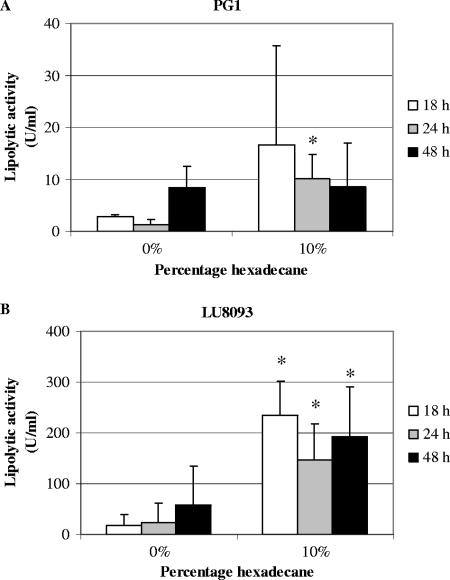
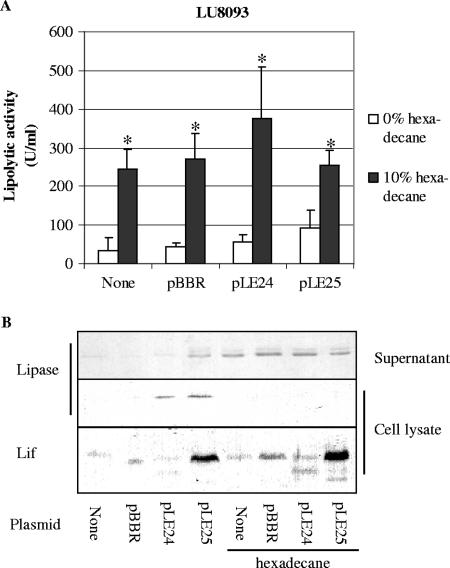
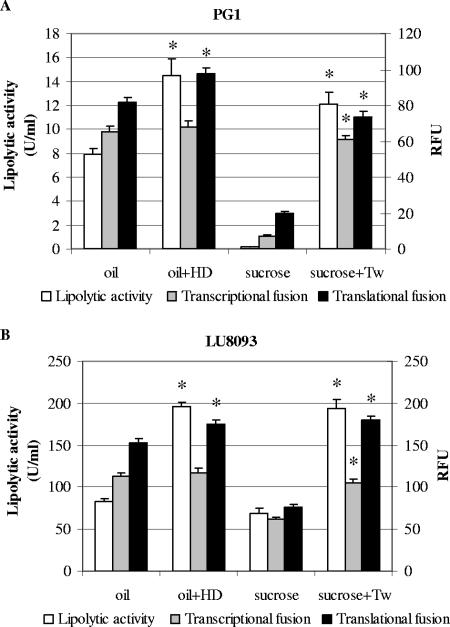
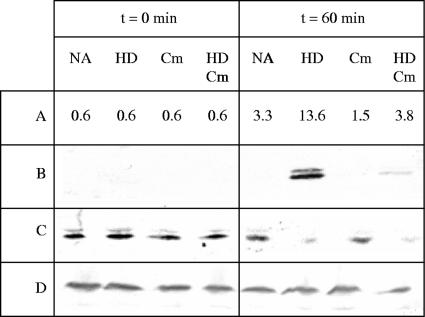
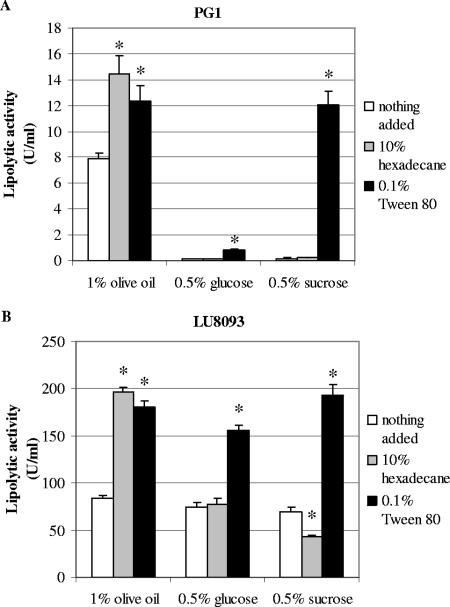
Burkholderia glumae strain PG1 produces a lipase of biotechnological relevance. Lipase production by this strain and its derivative LU8093, which was obtained through classical strain improvement, was investigated under different conditions. When 10% hexadecane was included in the growth medium, lipolytic activity in both strains could be increased approximately 7-fold after 24 h of growth. Hexadecane also stimulated lipase production in a strain containing the lipase gene fused to the tac promoter, indicating that hexadecane did not affect lipase gene expression at the transcriptional level, which was confirmed using lipA-gfp reporter constructs. Instead, hexadecane appeared to enhance lipase secretion, since the amounts of lipase in the culture supernatant increased in the presence of hexadecane, with a concomitant decrease in the cells, even when protein synthesis was inhibited with chloramphenicol. In the presence of olive oil as a carbon source, nonionic detergents, such as Tween 80, increased extracellular lipase activity twofold. Like hexadecane, Tween 80 appeared to stimulate lipase secretion, although in a more disruptive manner, since other, normally nonsecreted proteins were found in the culture supernatant. Additionally, like olive oil, Tween 80 was found to induce lipase gene expression in strain PG1 in medium containing sucrose as a carbon source but not in glucose-containing medium, suggesting that lipase gene expression is prone to catabolite repression. In contrast, lipase production in the lipase-overproducing strain LU8093 was independent of the presence of an inducer and was not inhibited by glucose. In conclusion, hexadecane and Tween 80 enhance lipase production in B. glumae, and they act via different mechanisms.
Figures
References
-
- Balkenhohl, F., K. Ditrich, B. Hauer, and W. Ladner. 1997. Optisch aktive Amine durch Lipase-katalysierte Methoxyacetylierung. J. Prakt. Chem. 339:381-384.
-
- Baneyx, F., and M. Mujacic. 2004. Recombinant protein folding and misfolding in Escherichia coli. Nat. Biotechnol. 22:1399-1408. - PubMed
-
- Bredholt, H., P. Bruheim, M. Potocky, and K. Eimhjellen. 2002. Hydrophobicity development, alkane oxidation, and crude-oil emulsification in a Rhodococcus species. Can. J. Microbiol. 48:295-304. - PubMed
-
- Churms, S. C., E. H. Merrifield, and A. M. Stephen. 1983. Some new aspects of the molecular structure of Acacia senegal gum (gum arabic). Carbohydr. Res. 123:267-279.
-
- Coster, H. G. L., and D. R. Laver. 1986. The effect of temperature on lipid-n-alkane interactions in lipid bilayers. Biochim. Biophys. Acta 857:95-104. - PubMed
Publication types
MeSH terms
Substances
LinkOut - more resources
Full Text Sources
Other Literature Sources
