


Real-time PCR investigation of potential vectors, reservoirs, and shedding patterns of feline hemotropic mycoplasmas
- PMID: 17468284
- PMCID: PMC1932730
- DOI: 10.1128/AEM.02977-06
Real-time PCR investigation of potential vectors, reservoirs, and shedding patterns of feline hemotropic mycoplasmas
Abstract
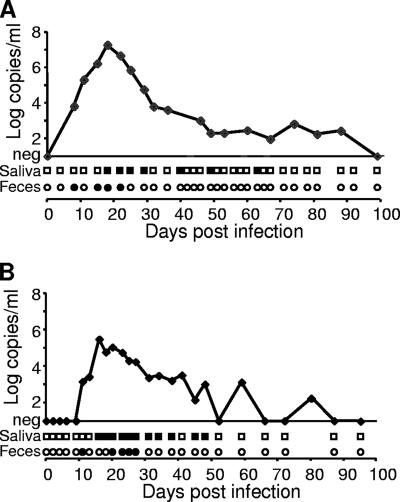
Three hemotropic mycoplasmas have been identified in pet cats: Mycoplasma haemofelis, "Candidatus Mycoplasma haemominutum," and "Candidatus Mycoplasma turicensis." The way in which these agents are transmitted is largely unknown. Thus, this study aimed to investigate fleas, ticks, and rodents as well as saliva and feces from infected cats for the presence of hemotropic mycoplasmas, to gain insight into potential transmission routes for these agents. DNA was extracted from arthropods and from rodent blood or tissue samples from Switzerland and from salivary and fecal swabs from two experimentally infected and six naturally infected cats. All samples were analyzed with real-time PCR, and some positive samples were confirmed by sequencing. Feline hemotropic mycoplasmas were detected in cat fleas and in a few Ixodes sp. and Rhipicephalus sp. ticks collected from animals but not in ticks collected from vegetation or from rodent samples, although the latter were frequently Mycoplasma coccoides PCR positive. When shedding patterns of feline hemotropic mycoplasmas were investigated, "Ca. Mycoplasma turicensis" DNA was detected in saliva and feces at the early but not at the late phase of infection. M. haemofelis and "Ca. Mycoplasma haemominutum" DNA was not amplified from saliva and feces of naturally infected cats, despite high hemotropic mycoplasma blood loads. Our results suggest that besides an ostensibly indirect transmission by fleas, direct transmission through saliva and feces at the early phase of infection could play a role in the epizootiology of feline hemotropic mycoplasmas. Neither the investigated tick nor the rodent population seems to represent a major reservoir for feline hemotropic mycoplasmas in Switzerland.
Figures
References
-
- Aeschlimann, A. 1972. [Ixodes ricinus, Limmeus, 1758 (Ixodoidea: Ixodidae). Preliminary study of the biology of the species in Switzerland.] Acta Trop. 29:321-340. - PubMed
-
- Berent, L. M., J. B. Messick, and S. K. Cooper. 1998. Detection of Haemobartonella felis in cats with experimentally induced acute and chronic infections, using a polymerase chain reaction assay. Am. J. Vet. Res. 59:1215-1220. - PubMed
-
- Bernasconi, M. V., S. Casati, O. Peter, and J. C. Piffaretti. 2002. Rhipicephalus ticks infected with Rickettsia and Coxiella in Southern Switzerland (Canton Ticino). Infect. Genet. Evol 2:111-120. - PubMed
-
- Clamp, M., J. Cuff, S. M. Searle, and G. J. Barton. 2004. The Jalview Java alignment editor. Bioinformatics 20:426-427. - PubMed
-
- Cotty, A. 1985. Clé de determination des Ixodidae et Amblyommidae de Suisse. Institut de Zoologie, Université de Neuchâtel, Neuchâtel, Switzerland.
Publication types
MeSH terms
Substances
Associated data
- Actions
- Actions
- Actions
LinkOut - more resources
Full Text Sources
Miscellaneous
