


Fondaparinux prevents venous thromboembolism after joint replacement surgery in Japanese patients
- PMID: 17468868
- PMCID: PMC2532275
- DOI: 10.1007/s00264-007-0360-7
Fondaparinux prevents venous thromboembolism after joint replacement surgery in Japanese patients
Abstract
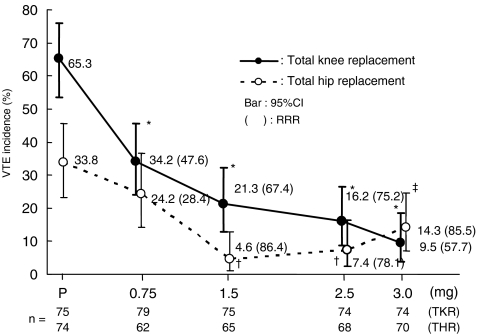
Venous thromboembolism (VTE) is an important complication of major orthopaedic surgery of the lower limbs. Fondaparinux, a synthetic pentasaccharide and highly selective inhibitor of activated Factor Xa, is the first in a new class of antithrombotic agents. To determine the optimal dose in Japanese patients, double-blind, placebo-controlled, dose-ranging studies of fondaparinux were conducted in patients undergoing total knee replacement (TKR) or total hip replacement (THR) surgery. Patients were randomly assigned to receive a once-daily subcutaneous injection of fondaparinux (0.75, 1.5, 2.5, or 3.0 mg) or placebo in Study 1 (TKR) and Study 2 (THR). In Study 1, the incidence of VTE was 65.3% in the placebo group and was 34.2%, 21.3%, 16.2%, and 9.5% in the groups receiving 0.75, 1.5, 2.5, and 3.0 mg fondaparinux respectively. In Study 2, the incidence of VTE was 33.8% in the placebo group and was 24.2%, 4.6%, 7.4%, and 14.4% in the 0.75, 1.5, 2.5, and 3.0 mg fondaparinux groups respectively. Dose-response effects were observed in both studies; however, no statistically significant differences in major bleeding events were found among any groups. Fondaparinux proved to be a potent anticoagulant with a favourable benefit-to-risk ratio in the prevention of VTE in these study patients.
Les complications thromboemboliques sont nombreuses dans la plupart des interventions de chirurgie orthopédique au niveau des membres inférieurs. Le fondaparinux (pentas saccharide synthétique) est un élément important parmi tous les agents anti-thrombotiques. De façon à déterminer la dose optimale de ce produit, une étude en double aveugle avec placebo a été conduite chez des patients devant bénéficier d’une prothèse totale du genou ou d’une prothèse totale de hanche. Les patients ont été randomisés de façon à recevoir une fois par jour une injection sous cutanée de fondaparinux (0.75, 1.5, 2.5, ou 3 mg) ou de placebo. L’incidence de la thrombose veineuse a été de 65.3% dans le groupe placebo et de 34.2%, 21.3%, 16.2% et 9.5% dans les groupes recevant respectivement 0.75, 1.5, 2.5 et 3 mg de fondaparinux, pour le groupe prothèse du genou. Pour le groupe prothèse de hanche l’incidence des complications thromboemboliques a été de 33.8% dans le groupe placebo et a été respectivement de 24.2%, 4.6%, 7.4% et 14.4% dans les groupes ayant reçu 0.75, 1.5, 2.5 et 3 mg de fondaparinux. Il n’y a pas de différence significatives en terme de saignement, dans chaque groupe. le fondaparinux est un anti-coagulant actif avec un bénéfice/risque important dans la prévention des thromboses veineuses et des accidents thromboemboliques dans cette étude de patients.
Figures
References
-
- Boneu B, Necciari J, Cariou R et al (1995) Pharmacokinetics and tolerance of the natural pentasaccharide (SR90107/ORG31540) with high affinity to antithrombin III in man. Thromb Haemost 74(6):1468–1473 - PubMed
-
- Eriksson BI, Lassen MR, PENTasaccharide in HIp-FRActure Surgery Plus Investigators (2003) Duration of prophylaxis against venous thromboembolism with fondaparinux after hip fracture surgery: a multicenter, randomized, placebo-controlled, double-blind study. Arch Intern Med 163(11):1337–1342 - DOI - PubMed
Publication types
MeSH terms
Substances
LinkOut - more resources
Full Text Sources
Medical
