


Factors associated with medical knowledge acquisition during internal medicine residency
- PMID: 17468889
- PMCID: PMC2219722
- DOI: 10.1007/s11606-007-0206-4
Factors associated with medical knowledge acquisition during internal medicine residency
Abstract
Background: Knowledge acquisition is a goal of residency and is measurable by in-training exams. Little is known about factors associated with medical knowledge acquisition.
Objective: To examine associations of learning habits on medical knowledge acquisition.
Design, participants: Cohort study of all 195 residents who took the Internal Medicine In-Training Examination (IM-ITE) 421 times over 4 years while enrolled in the Internal Medicine Residency, Mayo Clinic, Rochester, MN.
Measurements: Score (percent questions correct) on the IM-ITE adjusted for variables known or hypothesized to be associated with score using a random effects model.
Results: When adjusting for demographic, training, and prior achievement variables, yearly advancement within residency was associated with an IM-ITE score increase of 5.1% per year (95%CI 4.1%, 6.2%; p < .001). In the year before examination, comparable increases in IM-ITE score were associated with attendance at two curricular conferences per week, score increase of 3.9% (95%CI 2.1%, 5.7%; p < .001), or self-directed reading of an electronic knowledge resource 20 minutes each day, score increase of 4.5% (95%CI 1.2%, 7.8%; p = .008). Other factors significantly associated with IM-ITE performance included: age at start of residency, score decrease per year of increasing age, -0.2% (95%CI -0.36%, -0.042%; p = .01), and graduation from a US medical school, score decrease compared to international medical school graduation, -3.4% (95%CI -6.5%, -0.36%; p = .03).
Conclusions: Conference attendance and self-directed reading of an electronic knowledge resource had statistically and educationally significant independent associations with knowledge acquisition that were comparable to the benefit of a year in residency training.
Figures
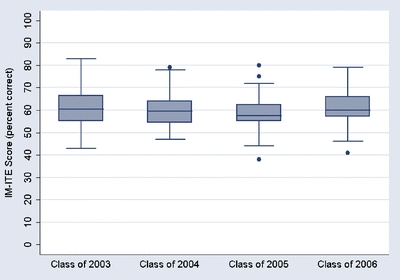
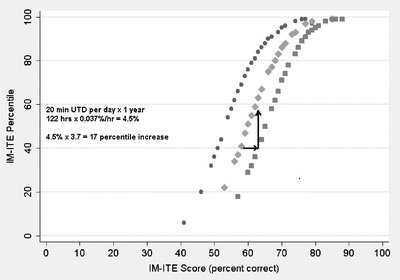
Comment in
-
Fostering educational innovation through measuring outcomes.J Gen Intern Med. 2011 Nov;26(11):1241-2. doi: 10.1007/s11606-011-1844-0. J Gen Intern Med. 2011. PMID: 21901495 Free PMC article. No abstract available.
References
-
- ACGME Outcome Project. ACGME General Competencies Vers. 1.3 (9.28.99) Available at: http://www.acgme.org/outcome/comp/compFull.asp#2. Accessed May 1, 2006.
-
- Internal Medicine In-Training Examination®. Last update February 7, 2006, available at: http://www.acponline.org/cme/itelg.htm?idxt. Accessed May 1, 2006.
-
- {'text': '', 'ref_index': 1, 'ids': [{'type': 'PubMed', 'value': '12230352', 'is_inner': True, 'url': 'https://pubmed.ncbi.nlm.nih.gov/12230352/'}]}
- Garibaldi RA, Subhiyah R, Moore ME, Waxman H. The in-training examination in internal medicine: an analysis of resident performance over time. Ann Intern Med. 2002;137(6):505–10. - PubMed
-
- {'text': '', 'ref_index': 1, 'ids': [{'type': 'PubMed', 'value': '8357133', 'is_inner': True, 'url': 'https://pubmed.ncbi.nlm.nih.gov/8357133/'}]}
- Cantwell JD. The Mendoza line and in-training examination scores. Ann Intern Med. 1993;119(6):541. - PubMed
-
- {'text': '', 'ref_index': 1, 'ids': [{'type': 'PubMed', 'value': '1548550', 'is_inner': True, 'url': 'https://pubmed.ncbi.nlm.nih.gov/1548550/'}]}
- Grossman RS, Fincher RM, Layne RD, Seelig CB, Berkowitz LR, Levine MA. Validity of the in-training examination for predicting American Board of Internal Medicine certifying examination scores. J Gen Intern Med. 1992;7(1):63–7. - PubMed
MeSH terms
LinkOut - more resources
Full Text Sources
