Comparative Study
. 2007 May 14;204(5):971-7.
doi: 10.1084/jem.20052078. Epub 2007 Apr 30.

NF90 regulates inducible IL-2 gene expression in T cells

Affiliations
Comparative Study

NF90 regulates inducible IL-2 gene expression in T cells

Lingfang Shi et al. J Exp Med. .

Abstract

Activation of T cells induces the production of T cell growth and survival factor interleukin (IL) 2. Regulatory T cells intrinsically fail to induce IL-2 expression upon activation and can suppress IL-2 production in conventional T cells. Thus, the control of IL-2 expression is critically important to T cell immune responses, yet the mechanisms remain incompletely understood. Nuclear factor (NF) 90 is a zinc-finger DNA- and double-stranded RNA-binding protein subunit that binds specifically to the antigen receptor response element (ARRE)/NF of activated T cells target sequence in the IL-2 proximal promoter. Inducible binding of NF90 to the IL-2 promoter in vivo is shown by chromatin immunoprecipitation. NF90 gene-targeted mice exhibit perinatal lethality. Compared with newborn NF90(+/+) mice, newborn NF90(-/-) mice demonstrate severe impairment of IL-2 expression. Compared with wild-type cells, T cells deficient in NF90 are impaired in ARRE and IL-2 transcriptional activation and IL-2 mRNA stabilization. Fetal liver cells from NF90 gene-targeted mice were transplanted into irradiated adult recombination activating gene (RAG)-2(-/-) and IL-2Rgamma(-/-) mice deficient in T cells, B cells, and natural killer cells. NF90(+/+)- and NF90(-/-)-RAG chimeric mice showed grossly normal repopulation of the thymus and spleen, but only NF90(-/-) T cells were severely impaired in IL-2 gene expression. Compared with littermates, NF90(-/-) RAG chimeric mice exhibited profound T cell lymphocytopenia in the peripheral circulation. Thus, NF90 regulates inducible IL-2 transcription, mRNA stability, and gene expression in T cells and represents a novel therapeutic target for the modulation of T cell immune responses.


Figures

Figure 1.
Figure 1.
NF90 binds specifically to the IL-2 promoter in vivo in activated T cells. Spleen cells were nonstimulated (lanes 1, 3, and 5; N) or stimulated for 4 h with PMA/Iono (lanes 2, 4, and 6; S), and nuclear proteins were cross-linked to chromatin in vivo with 1% formaldehyde. (A) Sheared and restricted chromatin was used as a template for PCR amplifications of IL-2 proximal promoter (lanes 1 and 2), IL-2 intron 3 (lanes 3 and 4), and ADA origin of replication sequences (lanes 5 and 6). (B) NF90 ChIP. (C) HA epitope ChIP.
Figure 2.
Figure 2.
Targeted disruption of NF90 impairs T cell IL-2 gene expression and T cell homeostasis. (A) Thymocytes and splenocytes were isolated from adult NF90+/+ and NF90+/− littermate mice and stimulated with for 6–18 h with PMA/Iono, and secreted IL-2 was measured by ELISA. The data are representative of two independent pairs of littermates. NF90+/− IL-2 reduction was significant (P < 0.05). (B) Thymocytes and splenocytes were isolated from two newborn NF90+/+, two NF90+/−, and one NF90−/− littermate mice and stimulated for 6 h with PMA/Iono, and IL-2 was measured. IL-2 reduction was significant (P < 0.001). Nonstimulated cells produced no detectable IL-2. (C) Immune reconstitution analysis of NF90-RAGγ mice. Representative flow cytometry of CD4+ and CD8+ lymphocytes in the thymus and spleen of NF90−/−- and NF90+/+-RAG−/−/IL-2Rγ−/− chimeric mice. NF90−/−-RAGγ chimera yielded 107 thymocytes, 4.2 × 10⁸ splenocytes, and 1,666 peripheral lymphocytes per mm3, and NF90+/+-RAGγ chimera yielded 107 thymocytes, 4.5 × 10⁸ splenocytes, and 3,455 peripheral lymphocytes per mm3. Recipient mice received 900 rads conditioning radiation and were killed at 14 wk after transplantation with NF90 E14 fetal liver cells. Peripheral blood lymphocyte subset analyses of the same mice at 9 wk after transplantation demonstrated a nearly complete absence of circulating CD4+ and CD8+ T cells associated with the NF90−/− genotype (row 3). Spleen cells were gated on CD3 and analyzed for expression of CD4 and CD25 in nonstimulated conditions (row 4) and after 24 h of stimulation with anti-CD3 (row 5). The percentage of cells in each quadrant is shown. (D) Impaired IL-2 secretion in NF90−/−-RAGγ compared with NF90+/−- or NF90+/+-RAGγ chimeric mice. Single-cell suspensions of thymocytes, splenocytes, and CD4+ T cells from individually numbered chimeras were stimulated with PMA/Iono or anti-CD3 + CD28. After 16 h, secreted IL-2 was measured. IL-2 reduction in the NF90−/−-RAGγ chimeric T cells was significant (P < 0.02). Data in A, B, and D represent the mean ± SD.
Figure 3.
Figure 3.
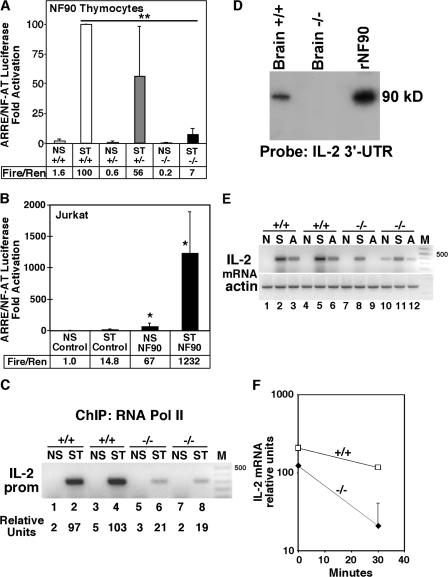
NF90 regulates ARRE/NFAT and IL-2 transcriptional activation and binds to and regulates IL-2 mRNA stability. (A) Primary cultured thymocytes from NF90+/+, NF90+/−, and NF90−/− littermates were nucleofected with 3× ARRE/NFAT firefly luciferase and EF-1α Renilla luciferase reporter plasmids. Lysates were prepared from nonstimulated (NS) and 6-h PMA/Iono-stimulated (ST) cells and analyzed for the ratio of firefly/Renilla luciferase activities. Data represent the mean ± SD. (B) Jurkat T cells stably expressing NF90 cDNA were established. Control and NF90 T cells were transiently cotransfected with 3× ARRE/NFAT firefly luciferase and EF-1α Renilla luciferase. Lysates prepared from NS and ST cells were analyzed for luciferase activities. *, P < 0.05 for NF90 versus control (n = 4). (C) IL-2 promoter ChIP using mAB 8WG16 to RNA polymerase II. Thymocytes from newborn NF90+/+ or NF90−/− mice (two littermate animals for each genotype) were nonstimulated (NS) or stimulated (ST) for 6 h with anti-CD3/CD28, and RNA pol II ChIP was performed. (D) Northwestern analysis. Mouse brain extracts and recombinant NF90 protein were fractionated by SDS-PAGE, transferred to nitrocellulose, and hybridized with 32P-labeled mouse IL-2 3′ UTR RNA probe (558–939 nt). (E) RT-PCR analysis of IL-2 mRNA induction and stability in NF90+/+ and NF90−/− splenocytes nonstimulated (N) or stimulated (S) for 6 h with anti-CD3/CD28. At 6 h, actinomycin D (A) was added, and the remaining IL-2 mRNA after 30 min was determined. (F) Semilog plot of IL-2 mRNA present at 0 and 30 min after addition of actinomycin D. The data shown are the mean and SD of two replicates.

References

    1. Kao, P.N., L. Chen, G. Brock, J. Ng, J. Kenny, A.J. Smith, and B. Corthesy. 1994. Cloning and expression of cyclosporin A- and FK506-sensitive nuclear factor of activated T-cells: NF45 and NF90. J. Biol. Chem. 269:20691–20699. - PubMed
    1. Corthesy, B., and P.N. Kao. 1994. Purification by DNA affinity chromatography of two polypeptides that contact the NF-AT DNA binding site in the interleukin 2 promoter. J. Biol. Chem. 269:20682–20690. - PubMed
    1. Shim, J., H. Lim, J.R. Yates, and M. Karin. 2002. Nuclear export of NF90 is required for interleukin-2 mRNA stabilization. Mol. Cell. 10:1331–1344. - PubMed
    1. Xu, Y.H., and G.A. Grabowski. 1999. Molecular cloning and characterization of a translational inhibitory protein that binds to coding sequences of human acid beta-glucosidase and other mRNAs. Mol. Genet. Metab. 68:441–454. - PubMed
    1. Shi, L., G. Zhao, D. Qiu, W.R. Godfrey, H. Vogel, T.A. Rando, H. Hu, and P.N. Kao. 2005. NF90 regulates cell cycle exit and terminal myogenic differentiation by direct binding to the 3′-untranslated region of MyoD and p21WAF1/CIP1 mRNAs. J. Biol. Chem. 280:18981–18989. - PubMed

Publication types

Associated data