


Contriving transitive conditioned establishing operations to establish derived manding skills in adults with severe developmental disabilities
- PMID: 17471796
- PMCID: PMC1868825
- DOI: 10.1901/jaba.2007.117-05
Contriving transitive conditioned establishing operations to establish derived manding skills in adults with severe developmental disabilities
Abstract
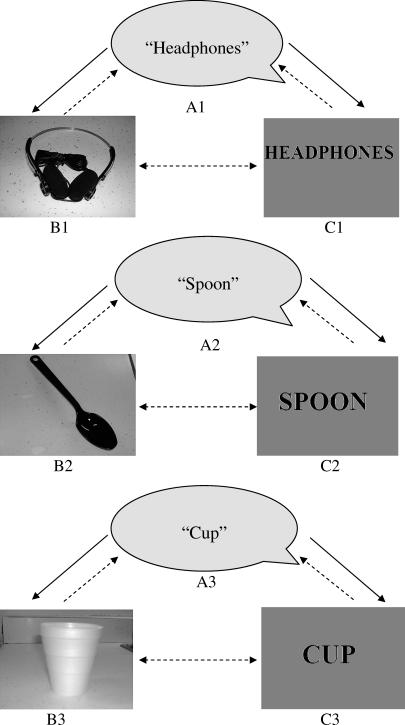
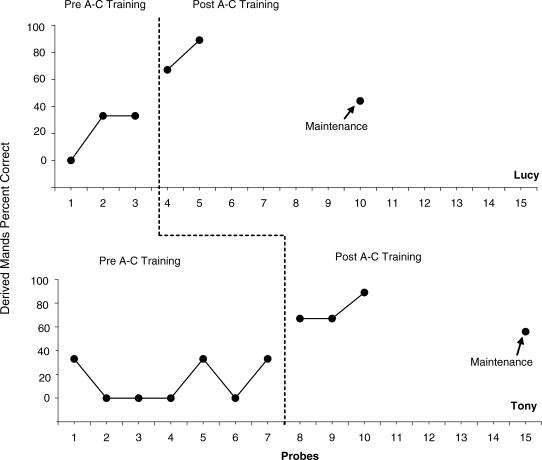
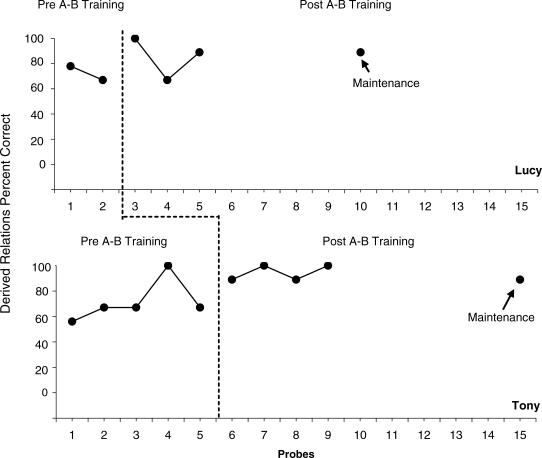
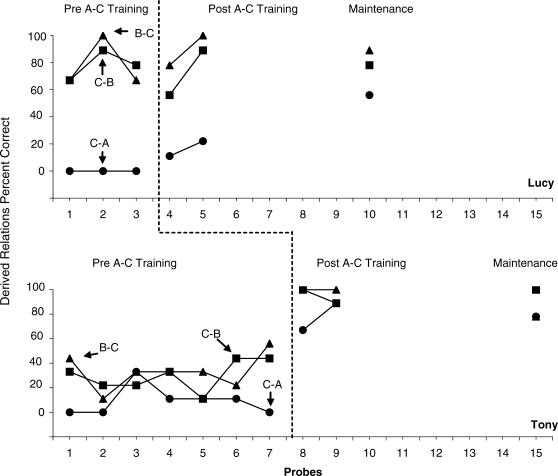
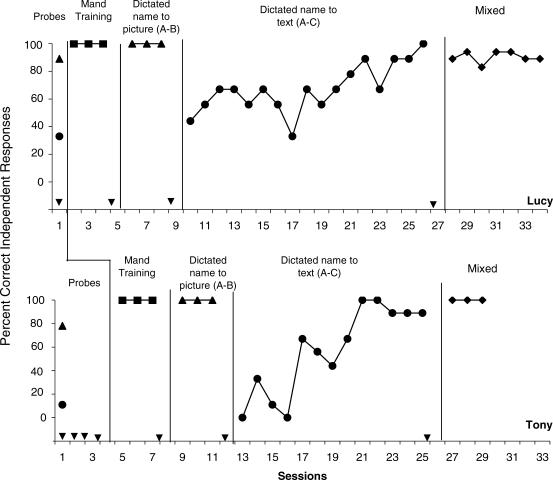
The purpose of this study was to demonstrate derived manding skills in 2 adults with severe developmental disabilities and language deficits by contriving transitive conditioned establishing operations. Specifically, we evaluated whether a history of reinforced conditional discrimination learning would ultimately result in a derived mand repertoire, in which participants manded for items that were needed to complete chained tasks. After mastering the first three phases of the picture exchange communication system (PECS), participants were taught to mand for the needed items by exchanging pictures of the items for the items themselves. They were then taught to conditionally relate the dictated names of the items to the corresponding pictures of the items and to relate the dictated names to the corresponding printed words. We then tested, in the absence of reinforcement, whether participants would mand for the items needed to complete the chained tasks using text rather than pictures. Both participants showed the emergence of derived mands and some derived stimulus relations as a result of this instruction. Some of the derived relations were shown to be intact at 1-month follow-up, and scores on derived mand probes were higher at follow-up than before training. In addition, the 2 participants vocally requested the needed items on maintenance test probes, a skill that was never trained and was not previously in their repertoires. These results suggest that a history of reinforced relational responding may facilitate the expansion of a number of verbal skills and emphasize the possibility of a synthesis of Skinner's (1957) analysis of verbal behavior and derived stimulus relations into language-training efforts for persons with significant disabilities.
Figures
References
-
- Bondy A.S, Frost L.A. The picture exchange communication system. Focus on Autistic Behavior. 1994;9((3)):1–17.
-
- Charlop-Christy M.H, Carpenter M, Le L, LeBlanc L.A, Kellet K. Using the picture exchange communication system (PECS) with children with autism: Assessment of PECS acquisition, speech, social-communicative behavior, and problem behavior. Journal of Applied Behavior Analysis. 2002;35:213–231. - PMC - PubMed
MeSH terms
LinkOut - more resources
Full Text Sources
