


doi: 10.1021/ar600060t.
Epub 2007 May 2.
O2 and N2O activation by Bi-, Tri-, and tetranuclear Cu clusters in biology
Affiliations
- PMID: 17472331
- PMCID: PMC2532530
- DOI: 10.1021/ar600060t
Item in Clipboard
O2 and N2O activation by Bi-, Tri-, and tetranuclear Cu clusters in biology
Acc Chem Res.
2007 Jul.
Abstract
Copper-cluster sites in biology exhibit unique spectroscopic features reflecting exchange coupling between oxidized Cu's and e (-) delocalization in mixed valent sites. These novel electronic structures play critical roles in O 2 binding and activation for electrophilic aromatic attack and H-atom abstraction, the 4e (-)/4H (+) reduction of O 2 to H 2O, and in the 2e (-)/2H (+) reduction of N 2O. These electronic structure/reactivity correlations are summarized below.
Figures
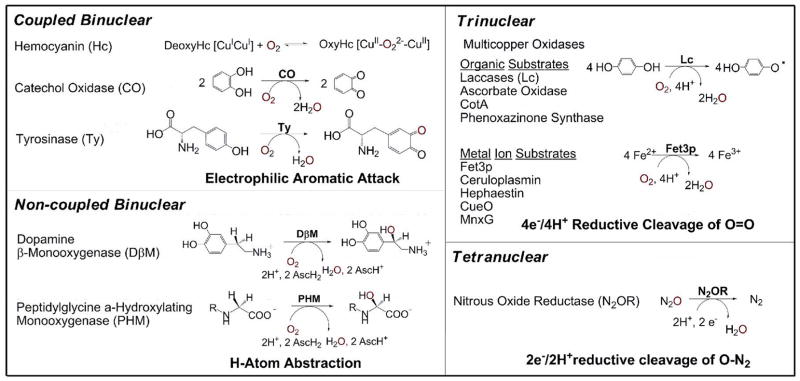
Multinuclear Cu Sites in Biology
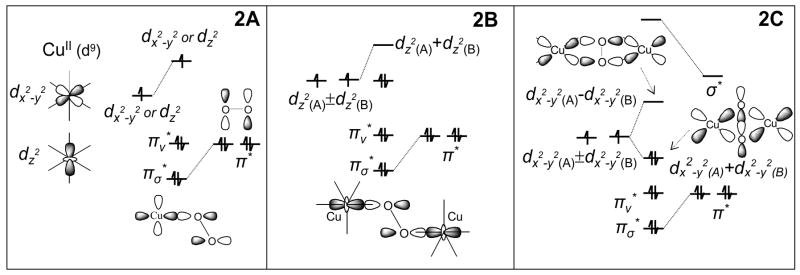
Electronic structure of (A) End-on Cu-O22− complex (B) End-on bridged [Cu2-O22−] complex and (C) Side-on bridged OxyHc.
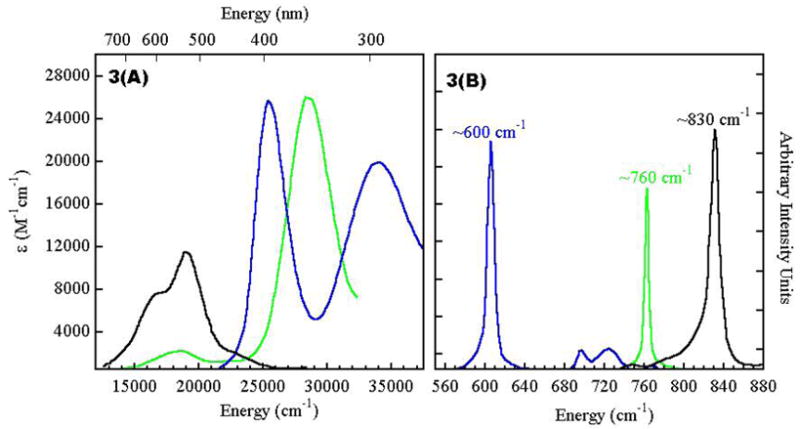
(A) Absorption and (B) Resonance Raman spectra of {[(TMPA)Cu]2O2}2+ (end-on) (—), Cu[HB(3,5-i-Pr2pz)3]2(O2) (side-on) (
 ) and {[LTMCHDCu]2O2} (bis-μ-oxo (
 )
)
) and {[LTMCHDCu]2O2} (bis-μ-oxo (
)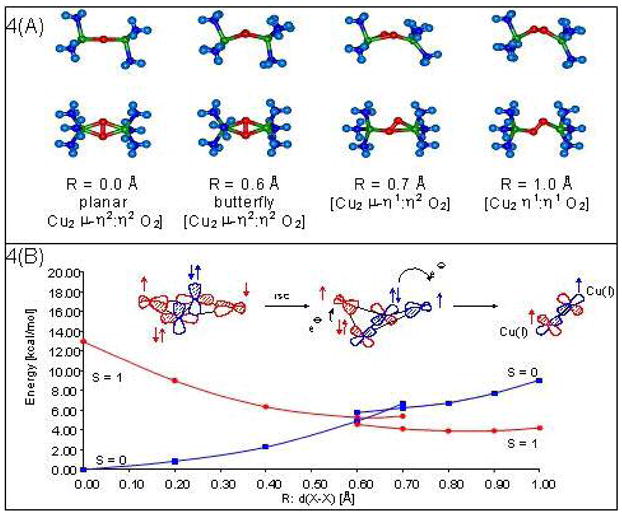
(A)The reaction coordinate of O2 binding by Hc. View along the O-O (Top) and perpendicular to initial Cu2O2 plane (bottom). (B) Potential-energy surfaces for the interconversion of OxyHc and DeoxyHc in triplet and Singlet state. R:d(X-X) is the distance between the center of the O-O and Cu-Cu vectors. R:d(X-X) <~0.6 and >~0.6 represents symmetric and non-symmetric O2 coordination, respectively.
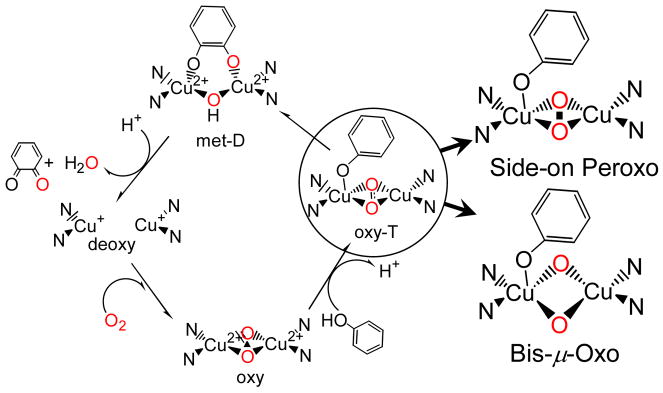
Molecular mechanism of Ty catalysis. The two possible structures of substrate bound oxy-T are expanded.
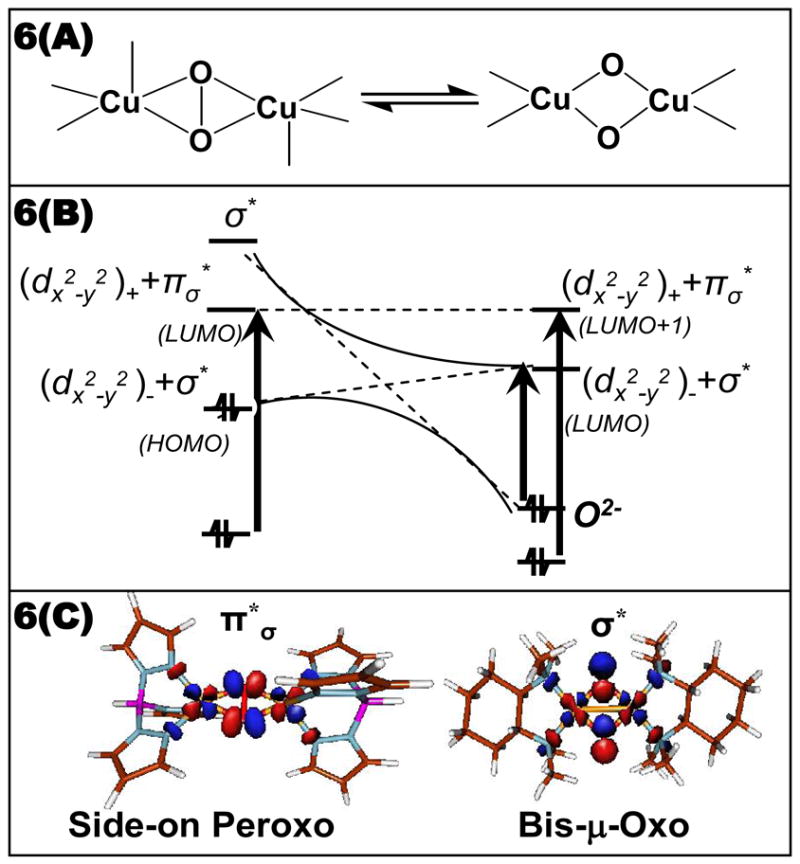
(A) Side-on peroxo (left), Bis-μ-Oxo (right) correlation (B) electronic structure correlation (C) FMO’s (ie. LUMO’s).
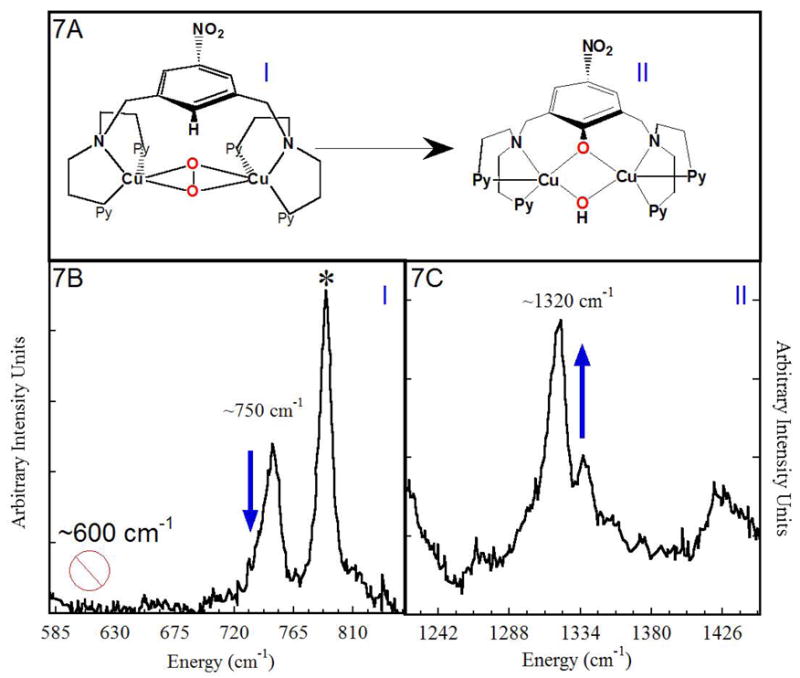
(A) Conversion of the side-on peroxide intermediate [Cu2(NO2-XYL)(O2)]2+ to [CuII2(NO2-XYL-O−)(OH)]2+. (B) & (C) Change in rR with time: loss of side-on peroxo stretch correlates with increase of C-O stretch.
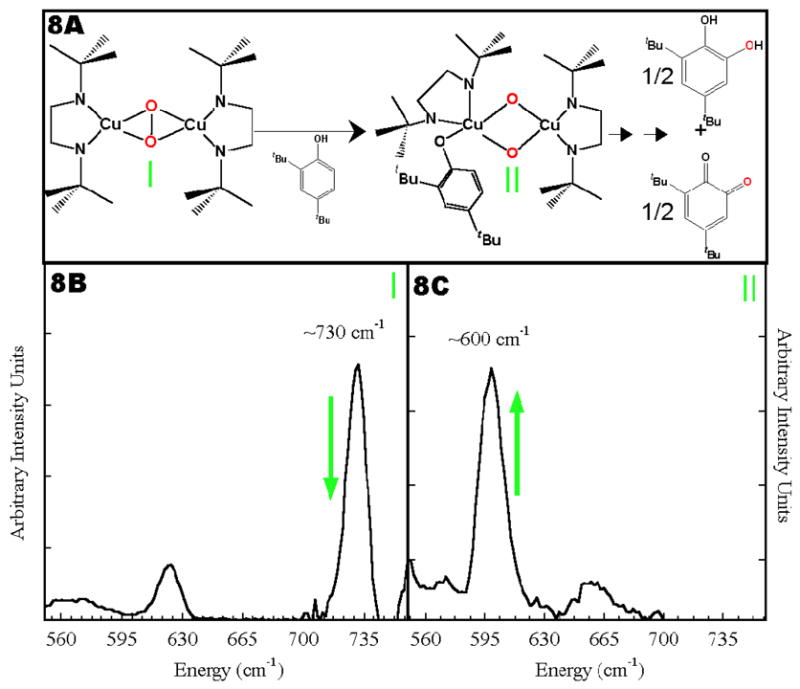
(A) Reaction of Side-on peroxo {[(DBED)Cu]2O2}2+.(B) & (C) Change in rR with (tBu)2Ph(O)− coordination.
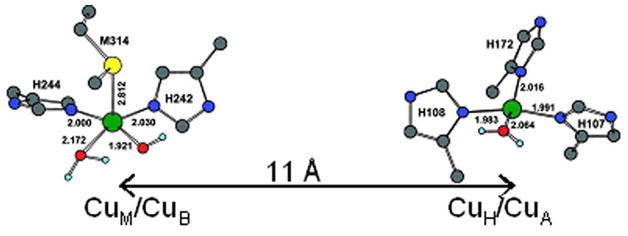
Geometry-optimized structures of the resting oxidized CuM and CuH sites in PHM.
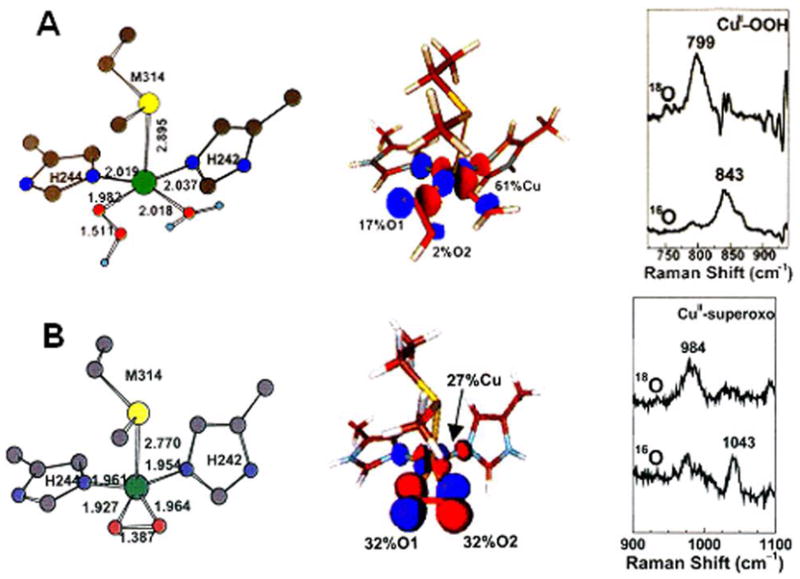
Electronic structure of the CuIIM-OOH (A) and CuIIM-superoxo (B) species. Geometry-optimized structure (left), acceptor FMO (LUMO) (middle), rR spectra in νo-o region (right).
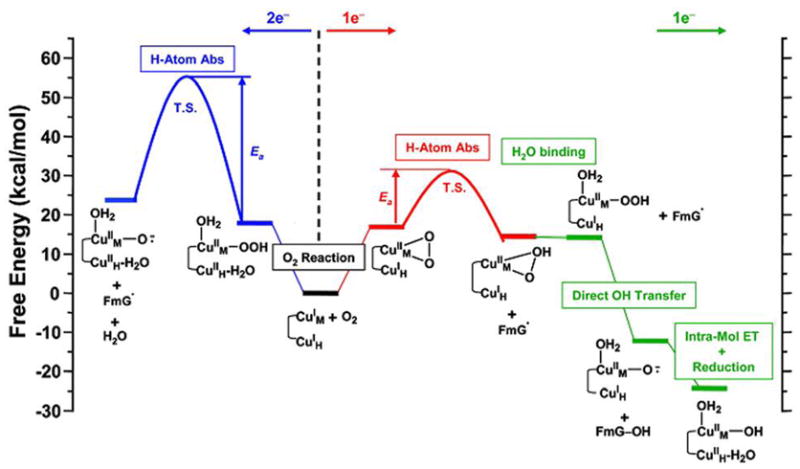
Summary of the 2e− (blue) and 1e− (red, green) reaction coordinates for the non-coupled binuclear Cu enzymes.
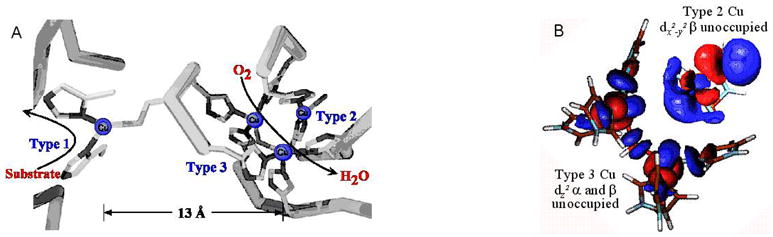
(A) Active site of the MCO’s (AO is shown here) (B) electronic structure of the TNC.
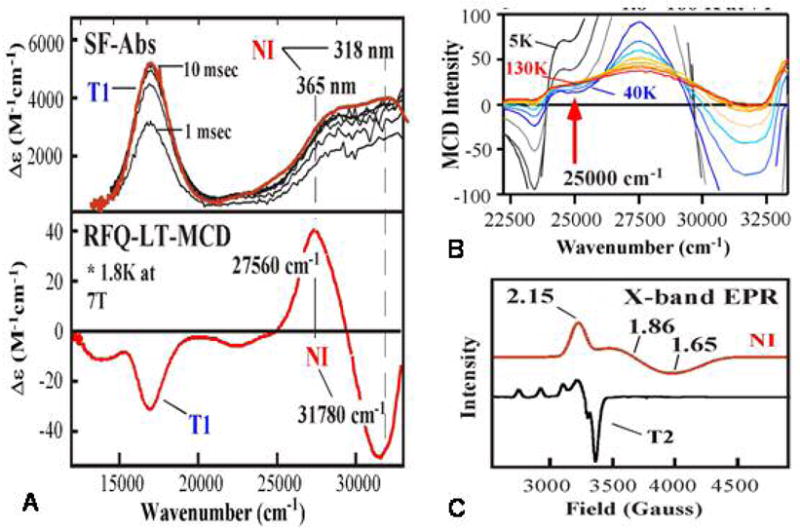
(A) Stopped-flow absorption showing the formation of NI, (B) RFQ-LT-MCD spectrum of NI, (C) VTMCD of NI, and (D) low temperature X-band EPR spectrum of NI compared to resting T2.
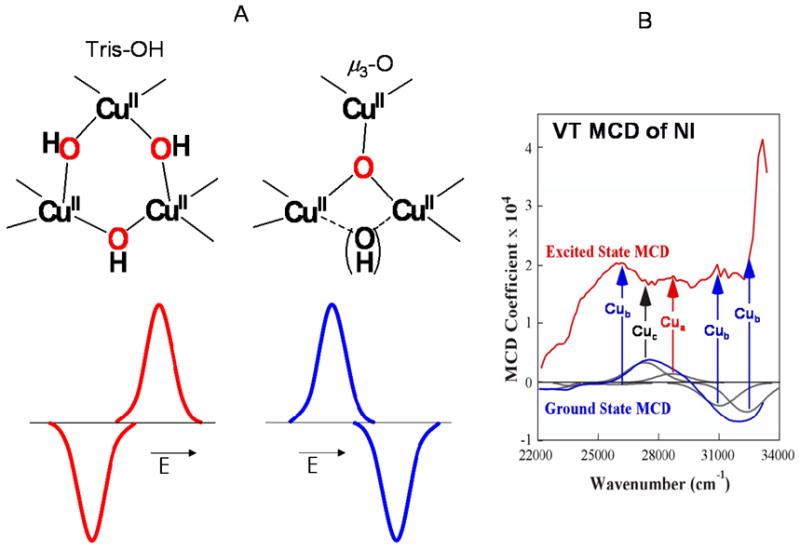
(A) Predicted and observed MCD signs for the two possible structures of NI and (B) ground and excited state MCD spectra of NI, where bands are grouped together according to their different temperature dependencies
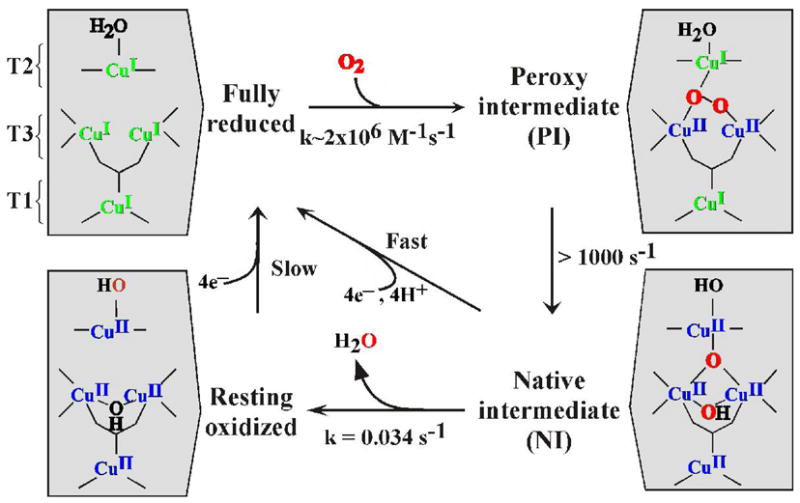
MCO mechanism
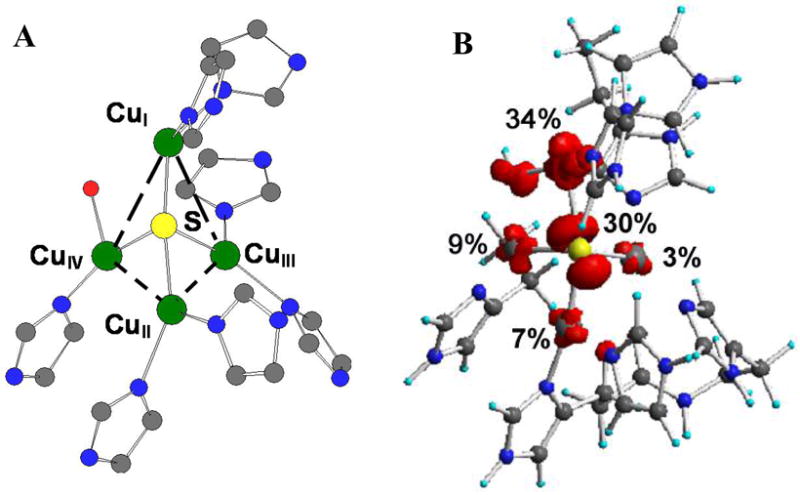
(A) Crystal structure (PnN2OR) (B) Geometry optimized electronic structure
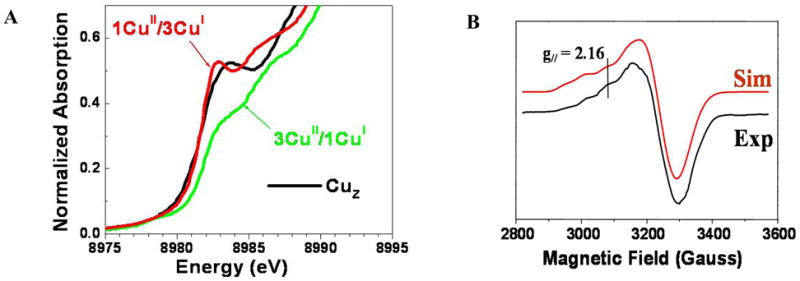
(A) Cu-K edge XAS spectrum of CuZ (black) simulated with 1CuII3/CuI and 3CuII/1CuI (B) EPR spectrum of CuZ from PnN2OR
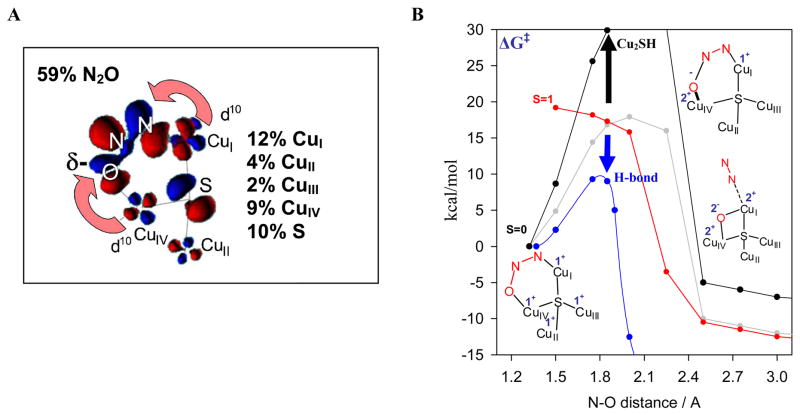
(A) Backbonding interaction from fully reduced CuZ to N2O (B) N-O bond cleavage barrier of CuZ (red/grey), Cu2SH (black), H-bond assisted (blue).
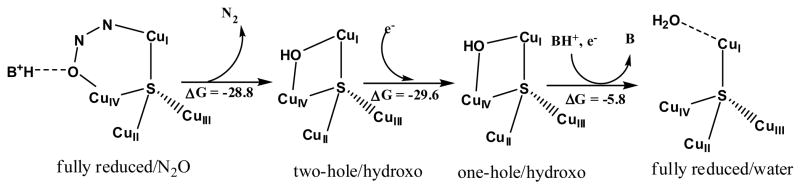
N2OR reaction mechanism
References
-
- Solomon EI, Sundaram UM, Machonkin TE. Multicopper Oxidases and Oxygenases. Chem Rev. 1996;96:2563–2605. - PubMed
-
- Pate JE, Cruse RW, Karlin KD, Solomon EI. Vibrational, electronic. and resonance Raman spectral studies of (Cu2(XYL-O-)O2)+, a copper(II) peroxide model complex of oxyhemocyanin. J Am Chem Soc. 1987;109:2624–30.
-
- Baldwin MJ, Ross PK, Pate JE, Tyeklár Z, Karlin KD, Solomon EI. Spectroscopic and Theoretical Studies of an End-On Peroxide-Bridged Coupled Binuclear Copper(II) Model Complex of Relevance to the Active Sites in Hemocyanin and Tyrosinase. J Am Chem Soc. 1991;113:8671–8679.
-
- Baldwin MJ, Root DE, Pate JE, Fujisawa K, Kitajima N, Solomon EI. Spectroscopic Studies of Side-on Peroxide-Bridged Binuclear Copper(II) Model Complexes of Relevance to Oxyhemocyanin and Oxytyrosinase. J Am Chem Soc. 1992;114:10421–10431.
-
- Metz M, Solomon EI. Dioxygen Binding to Deoxyhemocyanin: Electron Structure and Mechanism of the Spin Forbidden Two-Electron Reduction of O2. J Am Chem Soc. 2001;123:4938. - PubMed
Publication types
MeSH terms
Substances
Grants and funding
LinkOut - more resources
Full Text Sources
