Review
. 2007 Nov 29;362(1487):2105-21.
doi: 10.1098/rstb.2007.2103.

Hypoxia and the antipredator behaviours of fishes

Affiliations
Review

Hypoxia and the antipredator behaviours of fishes

P Domenici et al. Philos Trans R Soc Lond B Biol Sci. .

Abstract

Hypoxia is a phenomenon occurring in marine coastal areas with increasing frequency. While hypoxia has been documented to affect fish activity and metabolism, recent evidence shows that hypoxia can also have a detrimental effect on various antipredator behaviours. Here, we review such evidence with a focus on the effect of hypoxia on fish escape responses, its modulation by aquatic surface respiration (ASR) and schooling behaviour. The main effect of hypoxia on escape behaviour was found in responsiveness and directionality. Locomotor performance in escapes was expected to be relatively independent of hypoxia, since escape responses are fuelled anaerobically. However, hypoxia decreased locomotor performance in some species (Mugilidae) although only in the absence of ASR in severe hypoxia. ASR allows fish to show higher escape performance than fish staying in the water column where hypoxia occurs. This situation provides a trade-off whereby fish may perform ASR in order to avoid the detrimental effects of hypoxia, although they would be subjected to higher exposure to aerial predation. As a result of this trade-off, fishes appear to minimize surfacing behaviour in the presence of aerial predators and to surface near shelters, where possible. For many fish species, schooling can be an effective antipredator behaviour. Severe hypoxia may lead to the disruption of the school unit. At moderate levels, hypoxia can increase school volume and can change the shuffling behaviour of individuals. By altering school structure and dynamics, hypoxia may affect the well functioning of schooling in terms of synchronization and execution of antipredator manoeuvres. School structure and volume appear to be the results of numerous trade-offs, where school shape may be dictated by the presence of predators, the need for energy saving via hydrodynamic advantages and oxygen level. The effects of hypoxia on aquatic organisms can be taxon specific. While hypoxia may not necessarily increase the vulnerability of fish subject to predation by other fish (since feeding in fish also decreases in hypoxia), predators from other taxa such as birds, jellyfish or aquatic mammals may take advantage of the detrimental effects of hypoxia on fish escape ability. Therefore, the effect of hypoxia on fish antipredator behaviours may have major consequences for the composition of aquatic communities.


Figures
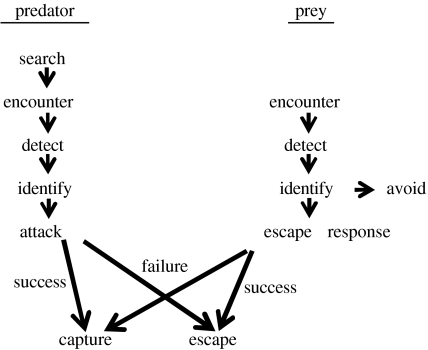
Figure 1
Figure 1
The main phases of predator–prey encounters. Based on Batty & Domenici (2000).
Figure 2
Figure 2
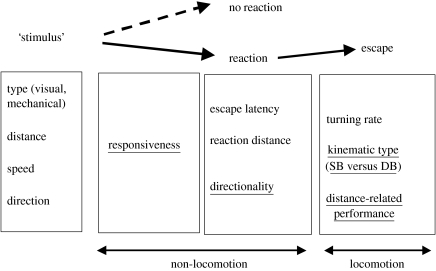
The phases of an escape response, from stimulation to escape and relative variables. Variables are divided into non-locomotion and locomotion ones. Variables that are underlined indicate those on which hypoxia was shown to have an effect. SB and DB indicate single bend and double bend response, respectively (Lefrançois et al. 2005).
Figure 3
Figure 3
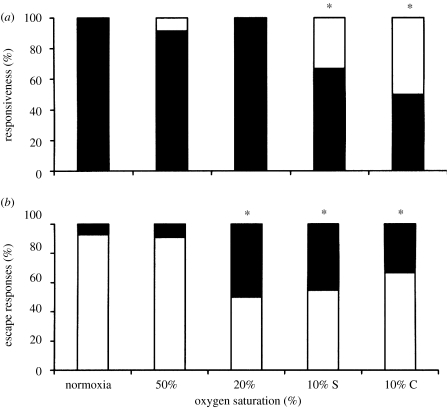
(a) The percentage of golden grey mullet (L. aurata) that responded to a mechanical stimulation in normoxia and various hypoxic conditions (black bars). Ten per cent C indicated no access to the surface at 10% oxygen saturation. Asterisks indicate significant difference from normoxia. (b) The percentage of fish that made an escape response in a direction away (white bars) or towards (black bars) the mechanical stimulus. Asterisks indicate different from random. From Lefrançois et al. (2005).
Figure 4
Figure 4
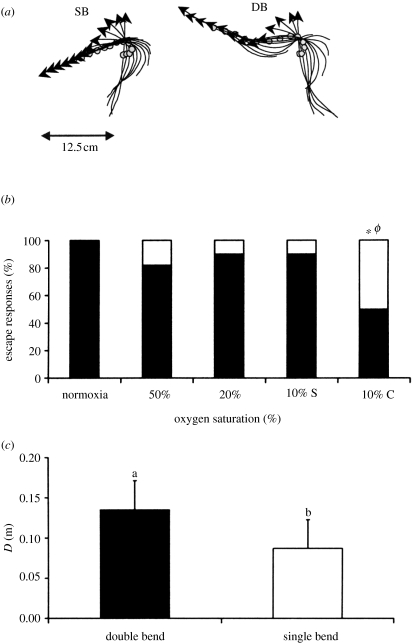
Golden grey mullet (a) examples of tracings of a single bend (SB) and a double bend (DB) response, performed in hypoxia and normoxia, respectively. Midline and centre of mass (open circle) of the fish are shown at 10 ms intervals from the frame preceding the onset of the response. Arrows indicate the head. While the DB response shows a reversal in the direction of turning of the head (at frame six) and the fish return flip is complete, in SB the fish goes into a glide after frame six. (b) Percentage of DB responses (black bars) out of the total in normoxia and various hypoxic conditions. Ten per cent C indicates no access to the surface at 10% oxygen saturation. Asterisk indicates a significant difference from normoxia. ϕ indicates a significant difference between 10% S and 10% C. (c) The locomotor performance of SB and DB responses (D, distance covered in 80 ms). Values not sharing a common subscripts are significantly different. From Lefrançois et al. (2005).
Figure 5
Figure 5
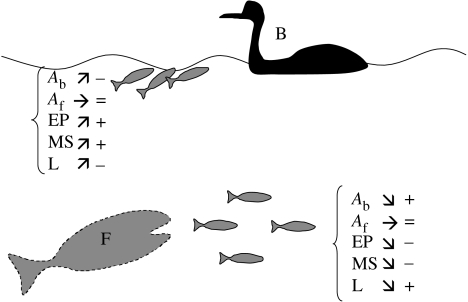
Trade-offs in predator–prey risks for fish that perform ASR in hypoxia. AB indicates the probability of attack by aerial predators (B), Af, the probability of attacks by fish predators (F); EP, escape performance; MS, metabolic scope and the probability of survival related to the physiological effects of hypoxia, L, the cost of locomotion. Signs ↗, ↘ and → indicate a relative increase, decrease or no potential differences, respectively, when comparing surfacing versus staying in the water column. Piscivorous fish are represented in grey and dotted contour since they may not represent a threat in hypoxia. The sign ‘+’ indicates an advantage; ‘−’, a disadvantage; and ‘=’, no difference in relation to the fitness of the fish. Surfacing allows fish to avoid the negative effect of hypoxia on their metabolic scope and to have a high escape performance. On the other hand, surfacing increases the probability of being detected by aerial predators and it implies a higher cost of locomotion due to vertical excursions.
Figure 6
Figure 6
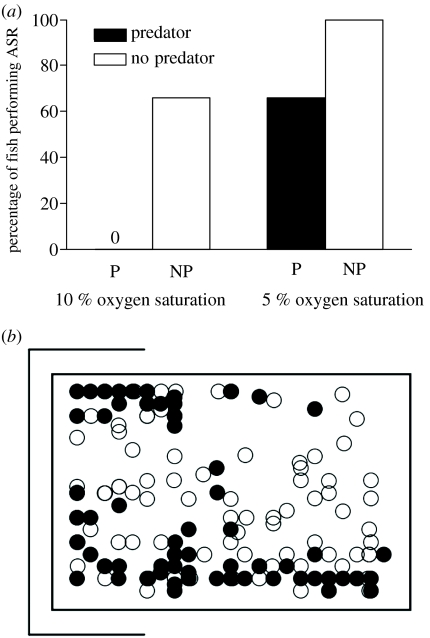
(a) Percentage of flathead grey mullet (M. cephalus) performing ASR in hypoxia (10 and 5% oxygen saturation) in the presence (P, black bars) and absence (NP, white bars) of a model bird predator. No fish performed ASR at 10% oxygen saturation in the presence of the model predator. Data from Shingles et al. 2005. (b) Location of the ASR episodes in hypoxia in the presence (black dots) and absence (white dots) of a predator model. Open rectangle on the left indicates a shelter area. In the presence of the predator model, fish preferred to perform ASR near the shelter area and near the walls (adapted from Shingles et al. 2005).
Figure 7
Figure 7
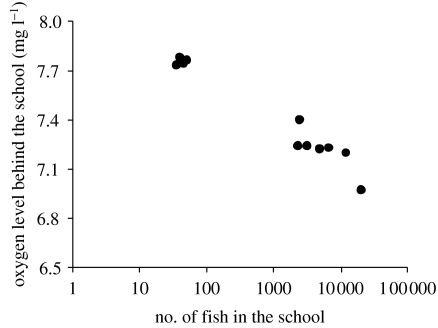
Oxygen level behind schools composed of different numbers of individuals of blacksmith (Chromis punctipinnis). Data from Green & McFarland (1994).
Figure 8
Figure 8
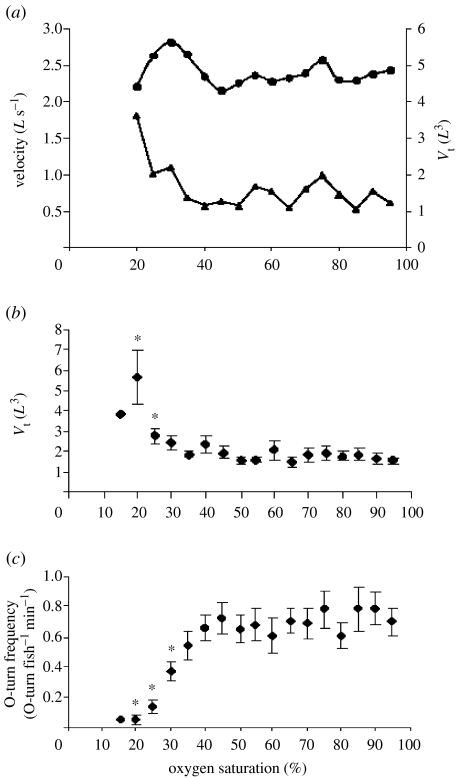
(a) Example of the effect of hypoxia on school volume (volume of water per fish) (Vt in length3) and speed (in length s−2) in a school of herring subject to progressive hypoxia. (b) The effect of oxygen saturation on the average herring school volume. (c) The effect of hypoxia on the frequency of O-turn manoeuvres in schools of herring. Adapted from Domenici et al. (2002). Asterisks represent significant differences from normoxia.
Figure 9
Figure 9
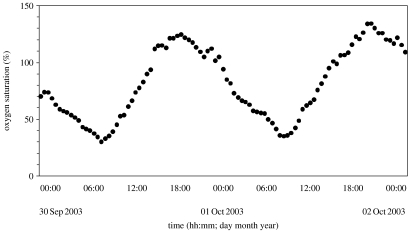
The daily variation in oxygen level in Cabras Lagoon (western Sardinia, Italy) during the end of September 2003. Oxygen level goes from normoxia to hypoxia (about 30% oxygen saturation) within about 6 h.
Figure 10
Figure 10
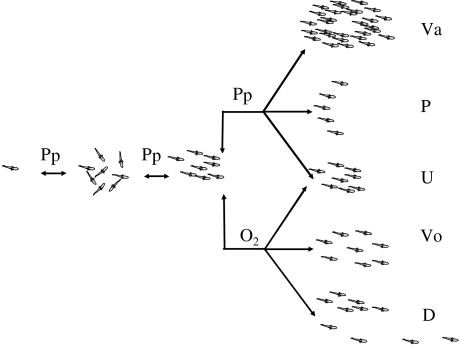
The effect of hypoxia and predator–prey interactions on the aggregation behaviour of fish. From left to right, predator–prey (Pp) interactions may cause single fish to join in a group or vice versa, and they may affect the degree of polarization of a school and they may affect school speed (indicated by ‘U’) and shape (Pitcher & Parrish 1993). (Va) and (P) represent school shapes as described in Pitcher & Parrish 1993 (Va, ‘vacuole’ as a response to predator attacks) and Partridge et al. (1983) (P, ‘parabolic schools’ of predators), respectively. Oxygen level (O2) may affect school volume (Vo), it may cause schools to disrupt (D) and may affect school speed (U). Changes in speed do not imply changes in school shape.

References

    1. Abrahams M.V, Colgan P. Risk of predation, hydrodynamic efficiency and their influence on school structure. Environ. Biol. Fishes. 1985;13:195–202. doi:10.1007/BF00000931 - DOI
    1. Barber J, Walker P, Svensson P.A. Behavioural responses to simulated avian predation in female three spined sticklebacks: the effect of experimental Schistocephalus solidus infections. Behaviour. 2004;141:1425–1440. doi:10.1163/1568539042948231 - DOI
    1. Batty R.S, Domenici P. Predator–prey relationships in fish and other aquatic vertebrates: kinematics and behaviour. In: Domenici P, Blake R.W, editors. Biomechanics in animal behaviour. BIOS Scientific Publishers Ltd; Oxford, UK: 2000. pp. 237–257.
    1. Beamish F.W.H. Respiration of fish with special emphasis on standard oxygen consumption, III. Influence of oxygen. Can. J. Zool. 1964;42:355–366.
    1. Beamish F.W.H. In: Swimming capacity. Fish physiology. Hoar W.S, Randall D.J, editors. vol. 7. Academic Press, Inc; New York, NY: 1978. pp. 101–187.

Publication types