


Environmental constraints upon locomotion and predator-prey interactions in aquatic organisms: an introduction
- PMID: 17472928
- PMCID: PMC2042526
- DOI: 10.1098/rstb.2007.2078
Environmental constraints upon locomotion and predator-prey interactions in aquatic organisms: an introduction
Abstract
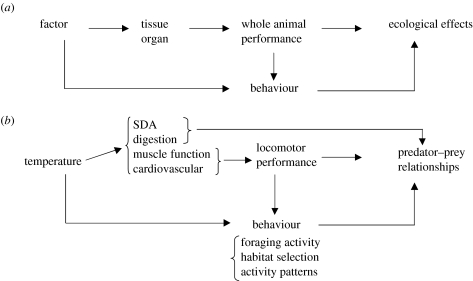
Environmental constraints in aquatic habitats have become topics of concern to both the scientific community and the public at large. In particular, coastal and freshwater habitats are subject to dramatic variability in various environmental factors, as a result of both natural and anthropogenic processes. The protection and sustainable management of all aquatic habitats requires greater understanding of how environmental constraints influence aquatic organisms. Locomotion and predator-prey interactions are intimately linked and fundamental to the survival of mobile aquatic organisms. This paper summarizes the main points from the review and research articles which comprise the theme issue 'Environmental constraints upon locomotion and predator-prey interactions in aquatic organisms'. The articles explore how natural and anthropogenic factors can constrain these two fundamental activities in a diverse range of organisms from phytoplankton to marine mammals. Some major environmental constraints derive from the intrinsic properties of the fluid and are mechanical in nature, such as viscosity and flow regime. Other constraints derive from direct effects of factors, such as temperature, oxygen content of the water or turbidity, upon the mechanisms underlying the performance of locomotion and predator-prey interactions. The effect of these factors on performance at the tissue and organ level is reflected in constraints upon performance of the whole organism. All these constraints can influence behaviour. Ultimately, they can have an impact on ecological performance. One issue that requires particular attention is how factors such as temperature and oxygen can exert different constraints on the physiology and behaviour of different taxa and the ecological implications of this. Given the multiplicity of constraints, the complexity of their interactions, and the variety of biological levels at which they can act, there is a clear need for integration between the fields of physiology, biomechanics, behaviour, ecology, biological modelling and evolution in both laboratory and field studies. For studies on animals in their natural environment, further technological advances are required to allow investigation of how the prevailing physico-chemical conditions influence basic physiological processes and behaviour.
Figures
References
-
- Abrahams M.V, Mangel M, Hedges K. Predator–prey interactions and changing environments: who benefits? Phil. Trans. R. Soc. B. 2007;362:2095–2104. doi:10.1098/rstb.2007.2102 - DOI - PMC - PubMed
-
- Bailleul F, Charrassin J.-B, Monestiez P, Roquet F, Biuw M, Guinet C. Successful foraging zones of southern elephant seals from Kerguelen Islands in relation to oceanographic conditions. Phil. Trans. R. Soc. B. 2007;362:2169–2181. doi:10.1098/rstb.2007.2109 - DOI - PMC - PubMed
-
- Block B.A, et al. Migratory movements, depth preferences, and thermal biology of Atlantic bluefin tuna. Science. 2001;293:1310–1314. doi:10.1126/science.1061197 - DOI - PubMed
-
- Bonsdorf E, Blomquist E.M, Mattila J, Norkko A. Long-term changes and coastal eutrophication. Examples from the Åland Islands and the Archipelago Sea, northern Baltic Sea. Oceanol Acta. 1997;20:319–329.
-
- Boyd I.L, Croxall J.P. Dive durations in pinnipeds and seabirds. Can. J. Zool. 1996;74:1696–1705.
Publication types
MeSH terms
LinkOut - more resources
Full Text Sources