. 2007 Oct 29;362(1486):1741-50.
doi: 10.1098/rstb.2007.2066.

Models of primitive cellular life: polymerases and templates in liposomes

Affiliations

Models of primitive cellular life: polymerases and templates in liposomes

Pierre-Alain Monnard et al. Philos Trans R Soc Lond B Biol Sci. .

Abstract

Nutrient transport, polymerization and expression of genetic information in cellular compartments are hallmarks of all life today, and must have appeared at some point during the origin and early evolution of life. Because the first cellular life lacked membrane transport systems based on highly evolved proteins, they presumably depended on simpler processes of nutrient uptake. Using a system consisting of an RNA polymerase and DNA template entrapped in submicrometre-sized lipid vesicles (liposomes), we found that the liposome membrane could be made sufficiently permeable to allow access of ionized substrate molecules as large as nucleoside triphosphates (NTPs) to the enzyme. The encapsulated polymerase transcribed the template-specific base sequences of the DNA to the RNA that was synthesized. These experiments demonstrate that units of genetic information can be associated with a functional catalyst in a single compartment, and that transcription of gene-sized DNA fragments can be achieved by relying solely on passive diffusion to supply NTPs substrates.


Figures
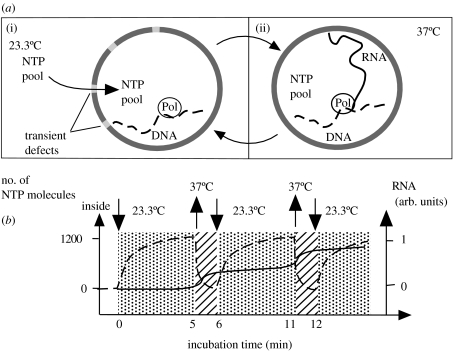
Figure 1
Figure 1
Schematic of the T7 RNA polymerase liposomal system. (a(i)) NTPs diffuse across lipid membrane by passive diffusion across membrane defects at 23.3°C (phase transition temperature of DMPC bilayers). (a(ii)) At 37°C, whereas the diffusion of NTPs is impaired, the enzyme activity is at an optimum. (b) The internal concentration of NTPs (dashed line) and the RNA formation (solid line) following the temperature cycles: when the temperature is set at 23.3°C, NTPs accumulate in the internal medium; and when it is set at 37°C, the internal supply of monomers is rapidly depleted to transcribe the template to RNA.
Figure 2
Figure 2
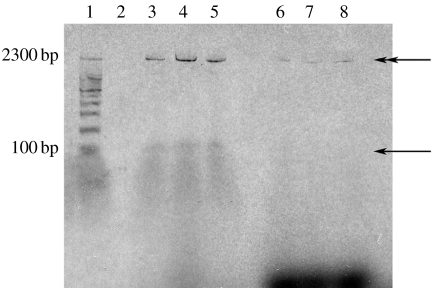
Gel electrophoresis of radioactively labelled RNA products. T7 RNA polymerase, its template and [α-33P]UTP were entrapped in DMPC liposomes which were subsequently extruded through filters of 400 nm pore size. Lane 1 contains size marker, lanes 2–5 show the product formation within liposomes after 0, 25, 53 and 90 temperature cycles. Lanes 6–8 show the residual reactions outside 400 nm extruded liposomes after digestion with DNase I/exonuclease III and proteinase K: after 0.5, 1.5 and 2.5 h incubation at 37°C. In all lanes, the same reaction volume was loaded for a direct comparison.
Figure 3
Figure 3
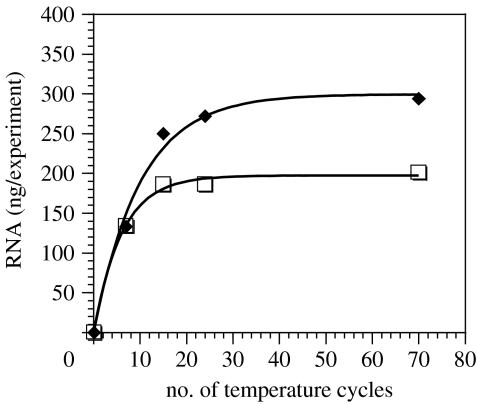
Accumulation of RNA within liposomes over time. RNA polymerization within 400 nm (filled diamonds) and 800 nm (open squares) extruded liposomes was assayed by fluorescence (RiboGreen assay) at various times during 70 temperature cycles.
Figure 4
Figure 4
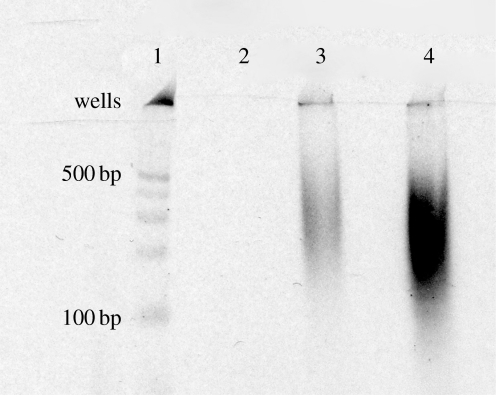
RT of the RNA products transcribed from the pTRI-EXF plasmid in 400 nm extruded liposomes. Lane 1 contains the DNA marker ladder. Lanes 2–4 show RT products of liposome-encapsulated reactions after 0, 15 and 25 temperature cycles.
Figure 5
Figure 5
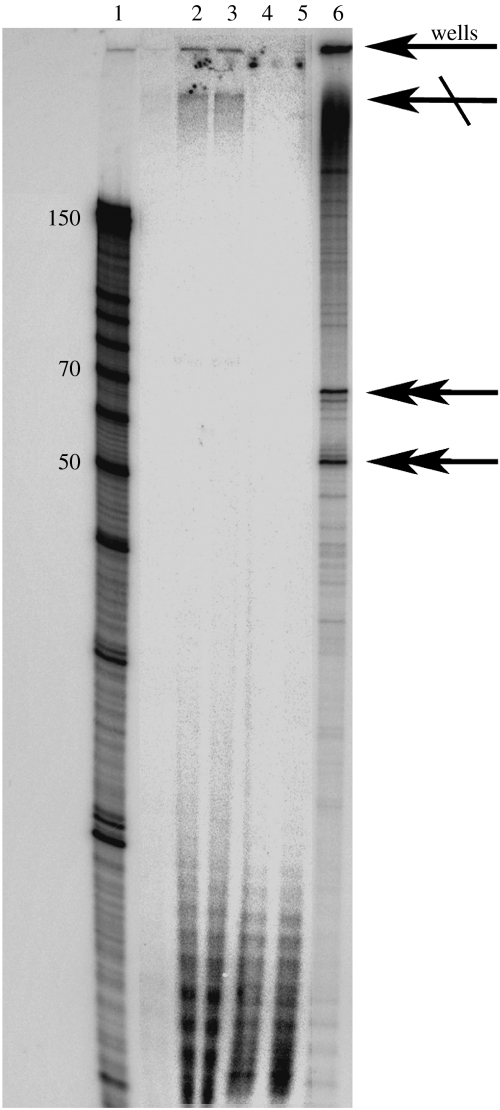
Transcription of short RNAs (17% PAGE gel). Lane 1, decade marker containing RNA molecular weight markers of 150 (full-length marker) and shorter RNAs of 100, 90, 80, 70, 60, 50, 40, 30, 20 and 10 nt. Lanes 2 and 3, two independent transcription reactions of plasmid d56-33 in the liposomes; lanes 4 and 5, two independent control reactions of the inactivation of the non-entrapped transcription system; lane 6, positive control: transcription performed outside liposomes. The single-head arrows indicate transcription products (single-head arrow, well aggregate; crossed arrow, run-on transcription) and the double-head products of the ribozyme indicate self-cleavage.

References

    1. Aidley D.J, Stanfield P.R. Cambridge University Press; New York, NY: 1996. Ion channels. Molecules in action.
    1. Chakrabarti A.C, Breaker R.R, Joyce G.F, Deamer D.W. Production of RNA by polymerase protein encapsulated within phospholipid vesicles. J. Mol. Evol. 1994;39:555–559. doi:10.1007/BF00160400 - DOI - PubMed
    1. Chamberlin M, Ryan T. Bacteriophage DNA-dependent RNA polymerases. In: Boyer P.D, editor. The enzymes. Academic Press; New York, NY: 1985. pp. 87–108.
    1. Chen I, Salehi-Ashtiani K, Szostak J.W. RNA catalysis in model protocell vesicles. J. Am. Chem. Soc. 2005;127:13 213–13 219. doi:10.1021/ja051784p - DOI - PMC - PubMed
    1. Deamer D.W. The first living systems: a bioenergetic perspective. Microbiol. Mol. Biol. Rev. 1997;61:230–261. - PMC - PubMed

Publication types

MeSH terms