


Selective endothelin A receptor antagonism with sitaxsentan for pulmonary arterial hypertension associated with connective tissue disease
- PMID: 17472992
- PMCID: PMC2111639
- DOI: 10.1136/ard.2007.069609
Selective endothelin A receptor antagonism with sitaxsentan for pulmonary arterial hypertension associated with connective tissue disease
Abstract
Introduction: Endothelin receptor antagonism has become an important component in the treatment of pulmonary arterial hypertension (PAH) associated with connective tissue disease (CTD). The purpose of this study was to analyse the safety and effectiveness of sitaxsentan, a selective antagonist of the ET(A) receptor, in a cohort of patients with PAH and CTD. Short-term clinical and haemodynamic effects and longer-term follow-up data are presented.
Methods: A post hoc subgroup analysis was performed on 42 patients who had PAH associated with CTD, out of a group of 178 patients enrolled in a 12-week, double-blind, randomised clinical trial of sitaxsentan versus placebo. Data from 33 patients assigned to sitaxsentan 100 mg or 300 mg daily were pooled and compared with nine placebo-treated patients. There were 41 patients entered into the blinded extension study, in which all patients received either 100 mg or 300 mg sitaxsentan once daily.
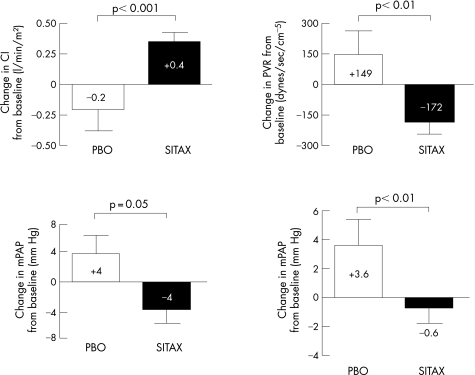
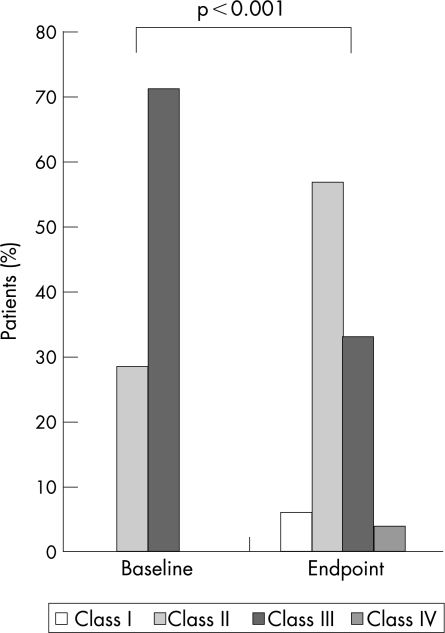
Results: Patients treated with sitaxsentan had a mean (SD) increase in 6 minute walk distance of 20 (5) m from baseline to week 12 (p = 0.037), whereas the placebo group had a decrease of 38 (84) m, resulting in a placebo-subtracted treatment effect of 58 m (p = 0.027). Parallel improvements in quality of life and haemodynamics were also observed. No patient discontinued their drug during the 12-week trial. In the blinded extension study (median treatment duration 26 weeks), more patients were in functional class I-II than in III-IV (p<0.001) at the end of the study compared with the start of active therapy. Elevation of hepatic transaminase levels occurred in two patients.
Conclusions: Sitaxsentan appears to be efficacious in patients with PAH associated with CTD.
Comment in
-
Is sitaxsentan a good therapeutic option for pulmonary arterial hypertension associated with connective tissue disease?Nat Clin Pract Rheumatol. 2008 May;4(5):238-9. doi: 10.1038/ncprheum0790. Epub 2008 Apr 1. Nat Clin Pract Rheumatol. 2008. PMID: 18382424
References
-
- Wigley F M, Lima J A, Mayes M, McLain D, Chapin J L, Ward‐Able C. The prevalence of undiagnosed pulmonary arterial hypertension in subjects with connective tissue disease at the secondary health care level of community‐based rheumatologists (the UNCOVER study). Arthritis Rheum 2005522125–2132. - PubMed
-
- Johnson S R, Gladman D D, Urowitz M B, Ibanez D, Granton J T. Pulmonary hypertension in systemic lupus. Lupus 200413506–509. - PubMed
-
- Koh E T, Lee P, Gladman D D, Abu‐Shakra M. Pulmonary hypertension in systemic sclerosis: an analysis of 17 patients. Br J Rheumatol 199635989–993. - PubMed
-
- Stupi A M, Steen V D, Owens G R, Barnes E L, Rodnan G P, Medsger T A., Jr Pulmonary hypertension in the CREST syndrome variant of systemic sclerosis. Arthritis Rheum 198629515–524. - PubMed
Publication types
MeSH terms
Substances
LinkOut - more resources
Full Text Sources
Other Literature Sources
Medical
