


doi: 10.1038/sj.bjc.6603746.
Epub 2007 May 1.
The future burden of cancer in England: incidence and numbers of new patients in 2020
Affiliations
- PMID: 17473821
- PMCID: PMC2360166
- DOI: 10.1038/sj.bjc.6603746
Item in Clipboard
The future burden of cancer in England: incidence and numbers of new patients in 2020
Br J Cancer.
.
Abstract
We estimated the future cancer incidence rates and the future numbers of cancer cases in England up to 2020 using cancer registration data for 1974-2003, and the official population projections from ONS up to 2023. Data were analysed using an age-period-cohort model as developed for the Nordic countries. We predict that for all cancers combined there will be relatively little change in age-standardised incidence rates in 2020. The number of new cancer cases per year in England is, however, predicted to increase by 33%, from 224,000 in 2001 to 299,000 cases in 2020. This increase is mainly due to the anticipated effects of population growth and ageing; cancer patients in 2020 will be older than today's cancer population.
Figures
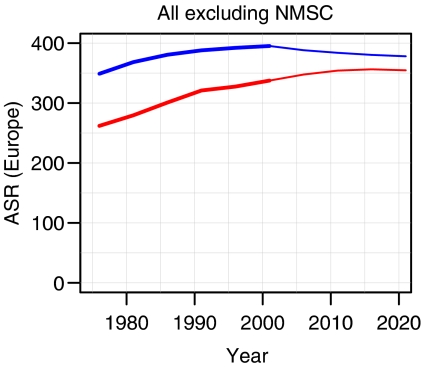
Trends in age-standardised (European standard population) incidence rates of all cancers combined (excluding non-melanoma skin cancer) up to 2020. Rates in males in blue; rates in females in red.
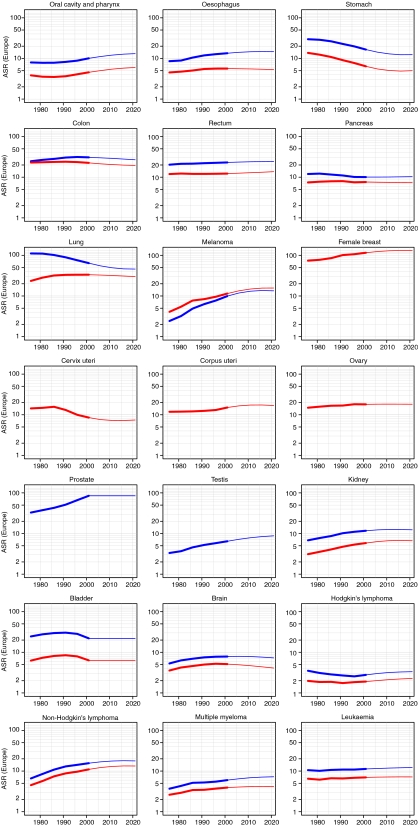
Trends in age-standardised (European standard population) incidence rates of different cancers and predictions up to 2020. Rates in males in blue; rates in females in red.
References
-
- Balducci L, Ershler WB (2005) Cancer and ageing: a nexus at several levels. Nat Rev Cancer 5(8): 655–662 - PubMed
-
- Bray F, Moller B (2006) Predicting the future burden of cancer. Nat Rev Cancer 6(1): 63–74 - PubMed
-
- Clayton D, Schifflers E (1987) Models for temporal variation in cancer rates. II: Age-period-cohort models. Stat Med 6(4): 469–481 - PubMed
-
- Clements MS, Armstrong BK, Moolgavkar SH (2005) Lung cancer rate predictions using generalized additive models. Biostatistics 6(4): 576–589 - PubMed
-
- Coleman MP, Esteve J, Damiecki P, Arslan A, Renard H (1993) Trends in Cancer Incidence and Mortality, IARC Scientific Publications No. 121. IARC Scientific Publications: Lyon - PubMed
MeSH terms
LinkOut - more resources
Full Text Sources
