. 2007 Jul;81(13):7310-5.
doi: 10.1128/JVI.00034-07. Epub 2007 May 2.

The vaccinia virus F13L YPPL motif is required for efficient release of extracellular enveloped virus

Affiliations

The vaccinia virus F13L YPPL motif is required for efficient release of extracellular enveloped virus

Kady M Honeychurch et al. J Virol. 2007 Jul.

Abstract

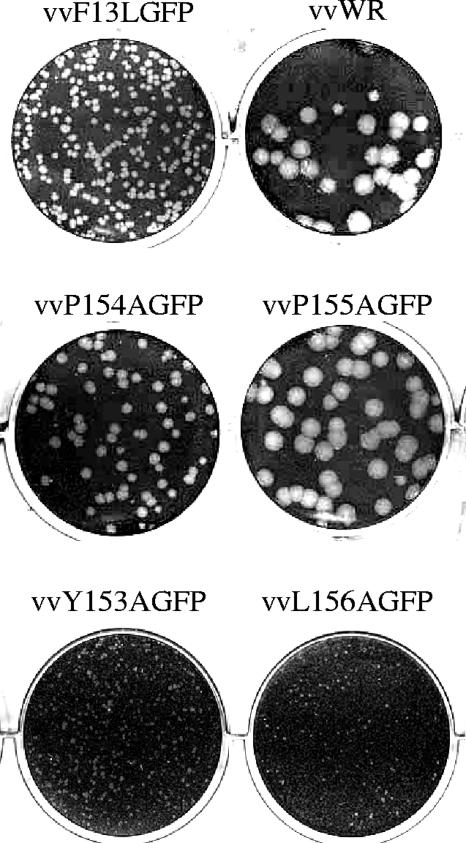
The Tyr-X-X-Leu (YxxL) motif of the vaccinia virus F13L protein was examined for late (L) domain activity. The ability of an F13L deletion virus to form plaques was restored by PCR products containing single alanine substitutions within the motif and a YAAL construct but not by constructs lacking both the Y and L residues. Recombinant viruses possessing alanine substitutions in place of the tyrosine or the leucine residue in the YxxL motif demonstrated small, asymmetrical plaques. RNA interference-dependent depletion of Alix and TSG101 (host proteins involved in L domain-dependent protein trafficking) diminished extracellular enveloped virion production to various degrees, suggesting that the YxxL motif is a genuine L domain.


Figures
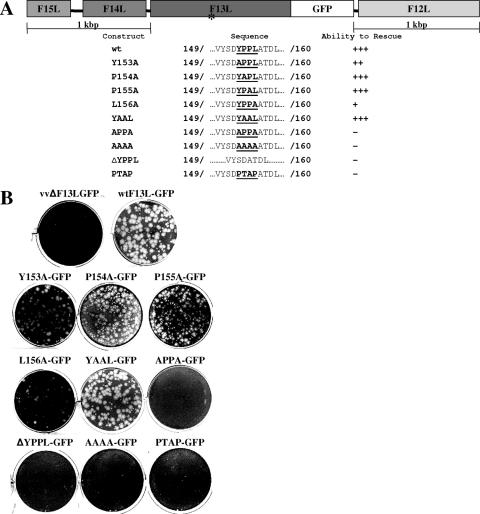
FIG. 1.
FIG. 1.
trans complementation of an F13L deletion mutant virus. (A) Panel of F13L PCR products. *, the approximate location of the YxxL motif within F13L. (B) Six-well plates containing BSC40 cells seeded at a density of 2 × 10⁵ cells/well were infected with an F13L deletion mutant virus for 1 h and then transfected with a PCR product containing one of several F13L YxxL mutations. Twenty-four hours postinfection, the transfection inoculum was replaced with medium containing 1% methylcellulose and incubated for an additional 48 h. The cells were fixed, and plaques were visualized by staining with 0.1% crystal violet.
FIG. 2.
FIG. 2.
Plaque phenotypes of recombinant F13L YxxL mutant viruses. Six-well plates containing BSC40 cells seeded at a density of 3 × 10⁵ cells/well were infected with virus for 1 h, overlaid with growth medium containing 1% methylcellulose, and incubated for 3 days. Cells were fixed and plaques visualized by staining with 0.1% crystal violet. vvWR, VV WR strain.
FIG. 3.
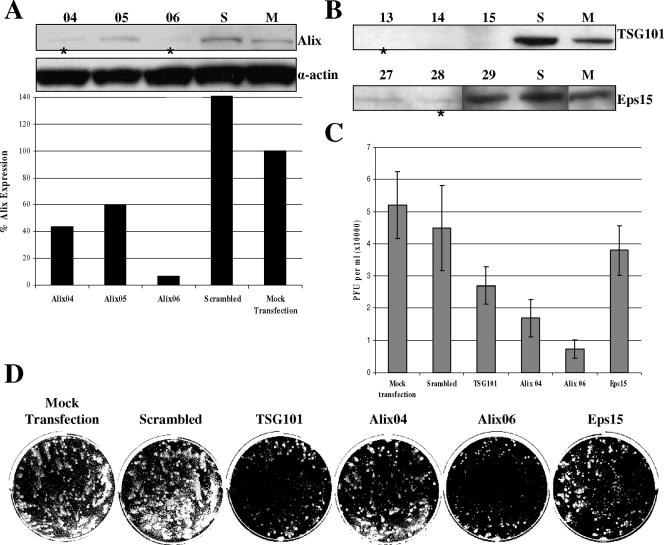
FIG. 3.
Depletion of host trafficking factors by RNAi. Six-well plates containing BSC40 cells seeded at a density of 1.5 × 10⁵ cells/well were transfected with RNAi oligonucleotides overnight and then incubated for an additional 24 h in growth medium. At 48 h posttransfection, cells were harvested, lysed, and subjected to immunoblot analysis using commercially available monoclonal antibodies purchased from BD Biosciences Pharmingen (Philadelphia, PA). (A) Determination of Alix inhibition. The amount of protein loaded into each well was normalized to the actin-loading control by densitometry analysis. *, oligo sets selected for use in subsequent assays. (B) Determination of TSG101 and Eps15 inhibition. *, oligo set selected for use in subsequent assays. (C) EEV quantification. Six-well plates containing BSC40 cells seeded at a density of 1.5 × 10⁵ cells/well were transfected with RNAi oligonucleotides overnight and then incubated for an additional 24 h in growth medium. At 48 h posttransfection, cells were infected with VV strain IHDJ for 1 h, at which time the viral inoculum was replaced with fresh growth medium. Cells were then incubated for an additional 29 h. At 30 h postinfection, the supernatant was collected and treated with anti-A27L antisera for 1 h. Titers were determined via plaque assay. Bars and vertical lines represent the mean PFUs and standard deviations for each RNAi treatment. (D) Comet inhibition. Cells were fixed, and comets were visualized by staining with 0.1% crystal violet.

References

    1. Ansarah-Sobrinho, C., and B. Moss. 2004. Role of the I7L protein in proteolytic processing of vaccinia virus membrane and core components. J. Virol. 78:6335-6343. - PMC - PubMed
    1. Benmerah, A., M. Bayrou, N. Cerf-Bensussan, and A. Dautry-Varsat. 1999. Inhibition of clathrin-coated pit assembly by an Eps15 mutant. J. Cell Sci. 112:1303-1311. - PubMed
    1. Blasco, R., and B. Moss. 1991. Extracellular vaccinia virus formation and cell-to-cell virus transmission are prevented by deletion of the gene encoding the 37,000-dalton outer envelope protein. J. Virol. 65:5910-5920. - PMC - PubMed
    1. Blasco, R., J. R. Sisler, and B. Moss. 1993. Dissociation of progeny vaccinia virus from the cell membrane is regulated by a viral envelope glycoprotein: effect of a point mutation in the lectin homology domain of the A34R gene. J. Virol. 67:3319-3325. - PMC - PubMed
    1. Byrd, C. M., T. C. Bolken, and D. E. Hruby. 2002. The vaccinia virus I7L gene product is the core protein protease. J. Virol. 76:8973-8976. - PMC - PubMed

Publication types

MeSH terms

LinkOut - more resources