Review
. 2007 May;117(5):1175-83.
doi: 10.1172/JCI31537.

A cytokine-mediated link between innate immunity, inflammation, and cancer

Affiliations
Review

A cytokine-mediated link between innate immunity, inflammation, and cancer

Wan-Wan Lin et al. J Clin Invest. 2007 May.

Abstract

It has been established that cancer can be promoted and/or exacerbated by inflammation and infections. Indeed, chronic inflammation orchestrates a tumor-supporting microenvironment that is an indispensable participant in the neoplastic process. The mechanisms that link infection, innate immunity, inflammation, and cancer are being unraveled at a fast pace. Important components in this linkage are the cytokines produced by activated innate immune cells that stimulate tumor growth and progression. In addition, soluble mediators produced by cancer cells recruit and activate inflammatory cells, which further stimulate tumor progression. However, inflammatory cells also produce cytokines that can limit tumor growth. Here we provide an overview of the current understanding of the role of inflammation-induced cytokines in tumor initiation, promotion, and progression.


Figures
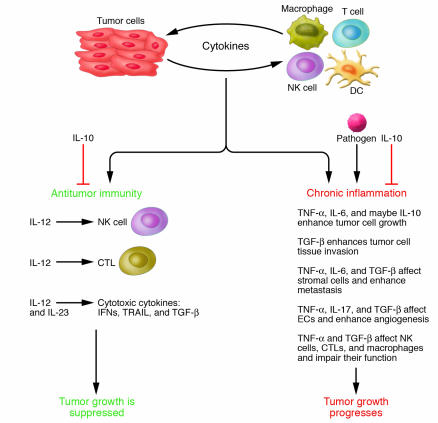
Figure 1
Figure 1. The diagram shows two outcomes of interactions between tumor cells and infiltrating inflammatory and/or immune cells in the tumor microenvironment.
Cytokines secreted by tumor and inflammatory/immune cells can either promote tumor development and tumor cell survival or exert antitumor effects. Chronic inflammation develops through the action of various inflammatory mediators, including TNF-α, IL-6, and IL-17, leading to eradication of antitumor immunity and accelerated tumor progression. However, TRAIL, through direct induction of tumor cell apoptosis, IL-10, through antiinflammatory effects, and IL-12, through activation of CTLs and NK cells and expression of cytotoxic mediators, can lead to tumor suppression. The multiple actions of TGF-β (cytotoxic in colon cancer cells, and having both positive and negative effects on the tumor microenvironment) and IL-23 (see Figure 3) explain their dual roles in tumor development.
Figure 2
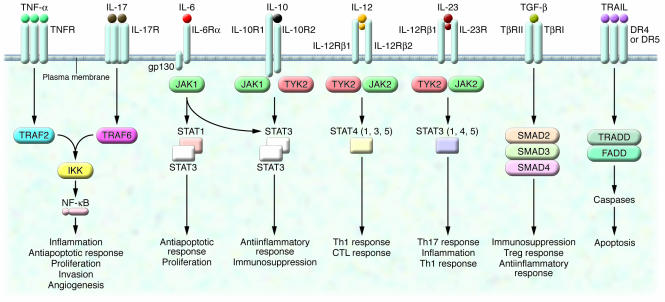
Figure 2. Signal transduction pathways and major biological responses of inflammation-modulating cytokines in cancer.
The signaling pathways shown can control tumor development through a direct effect on tumor cells (e.g., NF-κB, STAT3, and caspases) and/or an indirect effect on immune and endothelial cells (e.g., NF-κB, STAT3, STAT4, and SMAD). DR4, death receptor 4; FADD, Fas-associated death domain; gp130, glycoprotein 130; TRADD, TNF receptor–associated death domain protein; TRAF2, TNF receptor–associated factor 2; TYK2, tyrosine kinase 2.
Figure 3
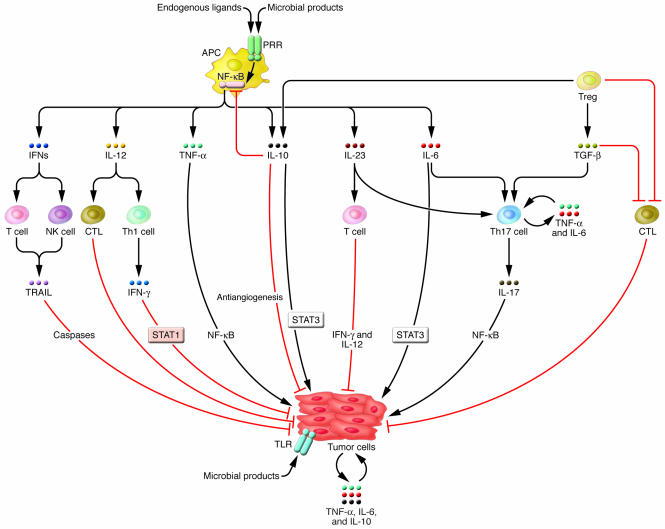
Figure 3. Interactions between various cell types in the tumor microenvironment determine the effects of cytokines on tumor development and progression.
Upon pathogen infection, both proinflammatory and antiinflammatory cytokines are produced by activated myeloid cells. In addition to their direct effects on tumor cell growth, survival, and invasive properties, cytokines can govern the functions of Th1 cells, NK cells, Tregs, and Th17 cells, all of which infiltrate the tumor. Treg-mediated suppression of antitumor CTL responses and induction of inflammatory Th17 cell–mediated responses contribute to tumor progression. Paradoxically, IL-10 can mediate the antitumor effects of Tregs. IL-23, TGF-β, IL-6, and TNF-α promote the development of Th17 cells, which have a central role in coordinating chronic inflammatory responses. IL-23 can induce the release of IFN-γ and IL-12 from activated T cells, TNF-α and IL-12 from APCs, and IL-17 from Th17 cells. In certain cases, cytokines such as TNF-α and IL-6 might be produced by tumor cells and function in an autocrine and paracrine fashion.

References

    1. Hanahan D., Weinberg R.A. The hallmarks of cancer. Cell. . 2000;100:57–70. - PubMed
    1. Coussens L.M., Werb Z. Inflammation and cancer. Nature. 2002;420:860–867. - PMC - PubMed
    1. Shacter E., Weitzman S.A. Chronic inflammation and cancer. Oncology. . 2002;16:217–226. - PubMed
    1. Hussain S.P., Hofseth L.J., Harris C.C. Radical causes of cancer. Nat. Rev. Cancer. 2003;3:276–285. - PubMed
    1. Fox J.G., Wang T.C. Inflammation, atrophy, and gastric cancer. . J. Clin. Invest. 2007;117:60–69. doi: 10.1172/JCI30111. - DOI - PMC - PubMed