


A comprehensive salivary analysis for oral cancer diagnosis
- PMID: 17479291
- PMCID: PMC12160907
- DOI: 10.1007/s00432-007-0207-z
A comprehensive salivary analysis for oral cancer diagnosis
Abstract
Purpose: This study utilized comprehensive salivary analysis to evaluate biochemical and immunological parameters in the saliva of oral squamous cell carcinoma (OSCC) patients.
Methods: Whole saliva was collected from 25 otherwise healthy OSCC patients and compared to 25 healthy, age- and gender-matched individuals. All OSCC lesions were located at the lateral aspect of the mobile tongue. The salivary parameters analyzed included: sodium (Na), potassium (K), calcium (Ca), inorganic phosphate (P), magnesium (Mg), total protein (TP), albumin (Alb), lactate dehydrogenase (LDH), amylase (Amy), total immunoglobulin G (IgG), secretory immunoglobulin A (Sec. IgA), epidermal growth factor, insulin growth factor I (IGF-I) and metalloproteinases MMP-2 and MMP-9.
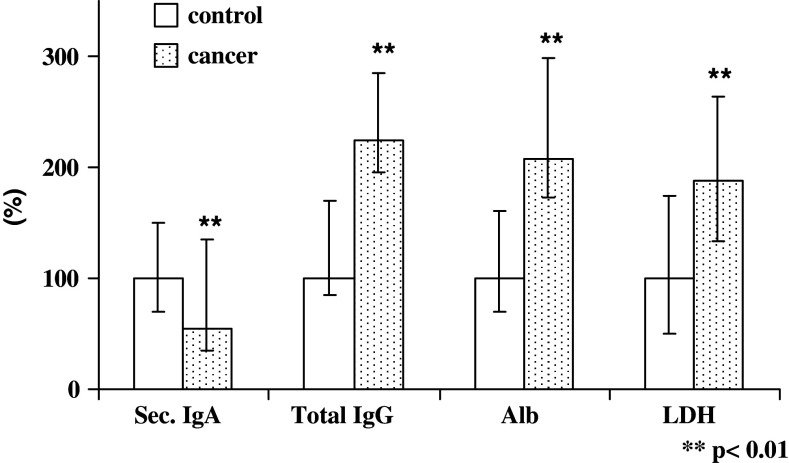
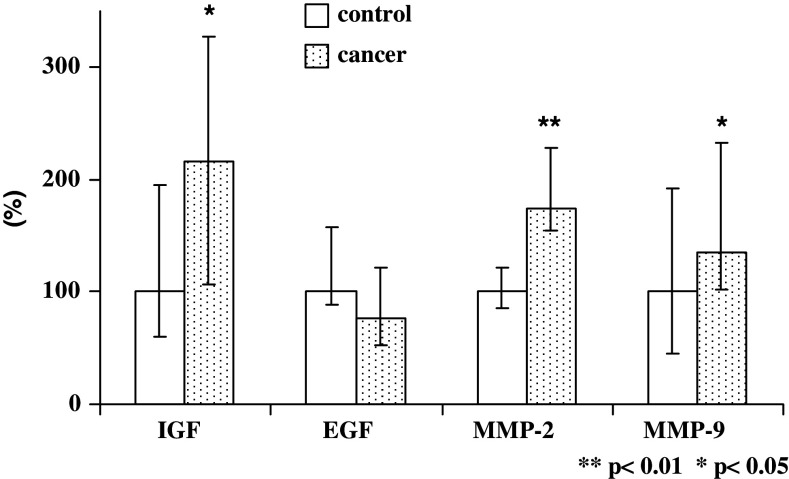
Results: In cancer patients, salivary median total protein concentration was significantly higher by 26% (P = 0.01), as were concentrations of Na, Ca, P and Mg by 14% (P = 0.05), 59% (P = 0.05), 39% (P = 0.08) and 28% (P = 0.12), respectively. Amy and K concentrations were lower by 25% (P = 0.12) and 15% (P = 0.03), respectively. Alb was 108% higher (P = 0.0007), as were salivary LDH (88%, P = 0.002) and total IgG (125%, P = 0.01), while Sec. IgA was lower by 45% (P = 0.001). Concentrations of IGF, MMP-2 and MMP-9 were significantly higher by 117% (P = 0.03), 75% (P = 0.0003) and 35% (P = 0.05), respectively.
Conclusions: Comprehensive salivary analysis revealed an overall altered salivary composition in OSCC, indicating a compromised oral environment in these patients and suggesting salivary analysis as a new diagnostic tool for oral cancer. Local therapeutic agents can be easily applied to the oral mucosa, altering its "bathing medium"-the saliva.
Figures
References
-
- Adams TE, McKern NM, Ward CW (2004) Signalling by the type 1 insulin-like growth factor receptor: interplay with the epidermal growth factor receptor. Growth Factors 22(2):89–95 - PubMed
-
- Baum JB, Costa PT, Izutsu TK (1989) Sodium handling by aging human parotid glands is inconsistent with a two-stage secretion model. Amer J Physiol 246:35–39 - PubMed
-
- Bayes-Genis A, Conover CA, Schwartz RS (2000) The insulin-like growth factor axis: a review of atherosclerosis and restenosis. Circ Res 86(2):125–130 - PubMed
-
- Ben Aryeh H, Jungerman T, Szargel R, Klein E, Laufer D (1996) Salivary flow-rate and composition in schizophrenic patients on clozapine: subjective reports and laboratory data. Biol Psychiatry 39:946–949 - PubMed
MeSH terms
LinkOut - more resources
Full Text Sources
Other Literature Sources
Medical
Miscellaneous
