


Community-associated methicillin-resistant Staphylococcus aureus isolates causing healthcare-associated infections
- PMID: 17479885
- PMCID: PMC2725868
- DOI: 10.3201/eid1302.060781
Community-associated methicillin-resistant Staphylococcus aureus isolates causing healthcare-associated infections
Abstract
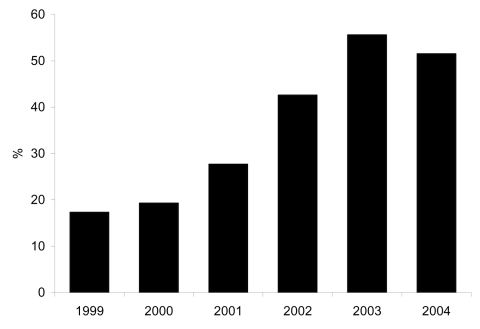
We noted a marked increase in healthcare-associated (HA) methicillin-resistant Staphylococcus aureus (MRSA) infections caused by isolates phenotypically consistent with community-associated (CA)-MRSA strains. To study this trend, we retrospectively examined all HA-MRSA isolates from patients in our institution during 1999-2004. An isolate was considered an SCCmecIV phenotype if it had antimicrobial drug susceptibilities consistent with typical CA-MRSA isolates. Our phenotypic definition was validated in a limited subset of isolates by SCCmec genotype, pulsed-field gel electrophoresis, and multilocus sequence typing. Among 352 patients with HA-MRSA isolates, SCCmecIV phenotype increased from 17% in 1999 to 56% in 2003 (p < 0.0001). Antimicrobial drug-susceptibility phenotype and genotype were consistent in 21 (91%) of 23 isolates. In a multivariate model, the SCCmec type IV phenotype was independently associated with wound culture source, later year of collection, and MRSA isolated earlier during hospitalization. In conclusion, MRSA isolates phenotypically similar to CA strains have become the predominant isolates associated with HA-MRSA in our hospital.
Figures
References
-
- Outbreaks of community-associated methicillin-resistant Staphylococcus aureus skin infections—Los Angeles County, California, 2002–2003. MMWR Morb Mortal Wkly Rep. 2003;52:88. - PubMed
Publication types
MeSH terms
Grants and funding
LinkOut - more resources
Full Text Sources
Medical