. 2007 May 4:7:21.
doi: 10.1186/1472-6750-7-21.

Potential pitfalls in the accuracy of analysis of natural sense-antisense RNA pairs by reverse transcription-PCR

Affiliations

Potential pitfalls in the accuracy of analysis of natural sense-antisense RNA pairs by reverse transcription-PCR

Fadia Haddad et al. BMC Biotechnol. .

Abstract

Background: The ability to accurately measure patterns of gene expression is essential in studying gene function. The reverse transcription polymerase chain reaction (RT-PCR) has become the method of choice for the detection and measurement of RNA expression patterns in both cells and small quantities of tissue. Our previous results show that there is a significant production of primer-independent cDNA synthesis using a popular RNase H- RT enzyme. A PCR product was amplified from RT reactions that were carried out without addition of RT-primer. This finding jeopardizes the accuracy of RT-PCR when analyzing RNA that is expressed in both orientations. Current literature findings suggest that naturally occurring antisense expression is widespread in the mammalian transcriptome and consists of both coding and non-coding regulatory RNA. The primary purpose of this present study was to investigate the occurrence of primer-independent cDNA synthesis and how it may influence the accuracy of detection of sense-antisense RNA pairs.

Results: Our findings on cellular RNA and in vitro synthesized RNA suggest that these products are likely the results of RNA self-priming to generate random cDNA products, which contributes to the loss of strand specificity. The use of RNase H+ RT enzyme and carrying the RT reaction at high temperature (50 degrees C) greatly improved the strand specificity of the RT-PCR detection.

Conclusion: While RT PCR is a basic method used for the detection and quantification of RNA expression in cells, primer-independent cDNA synthesis can interfere with RT specificity, and may lead to misinterpretation of the results, especially when both sense and antisense RNA are expressed. For accurate interpretation of the results, it is essential to carry out the appropriate negative controls.


Figures
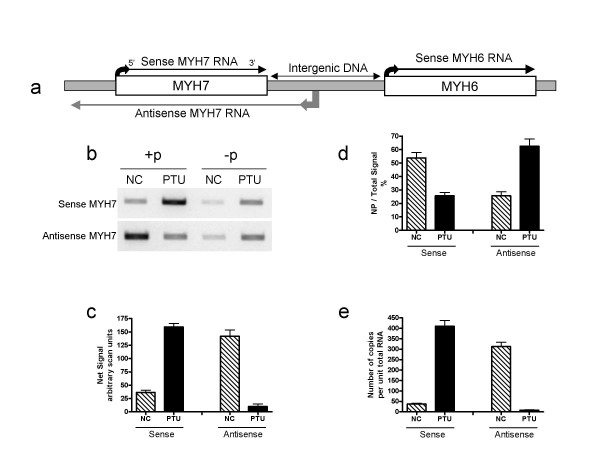
Figure 1
Figure 1
RT-PCR in the analyses of naturally occurring endogenous sense-antisense RNA pair expression. (a) Schematic of the cardiac MHC (MYH) gene locus and its transcription products. The upper strand transcribes the cardiac MYH7 and MYH6 sense RNA, the lower strand transcribes the antisense MYH7 RNA, which is abundant in normal control hearts [1]. (b): representative gels obtained from RT-PCR targeting sense and antisense RNA corresponding to the MYH7 gene. RT used RNase H- enzyme under manufacturer standard conditions (see methods) in presense of specific primers (+p) or in absence of primers (-p). (c) Bar graph depicting the net signal of MYH7 sense and antisense in each group, net consisting of the difference between +p and -p RT-PCR band intensity. Note that a normal control heart in the rat is associated with abundant relatively MYH7 gene expression (MYH6 gene expression is dominant). Under the PTU condition, MYH7sense RNA expression is increased. Antisense MYH7 RNA is strongly expressed in the normal control heart, based on strong net signal. In PTU heart, the antisense MYH7 RNA is decreased to a very low level. Note the +p product is similar to -p when targeting antisense MYH7 RNA in PTU hearts. (d) Bar graph depicting relative no-primer signal (NP) to the total signal in each group as determined by real time PCR methods. (e) Net MYH7 sense and antisense RNA copy numbers in NC and PTU hearts using real time PCR. Data are means ± SE. N = 6/group. See Additional file 4 for primer information. For both sense and antisense MYH7 targets, end-point PCR (b and c) used 0.2 μl of the cDNA and was performed for 28 cycles. For real time PCR, we used 320 nl cDNA for each sample, and the signal was compared to a standard curve established with a serial dilution of a standard consisting of purified PCR product as explained in the methods. See Additional file 4 for primer information. Based on standard curve linear regression analyses, copies for each target RNA were calculated.+p: a strand specific RT primer was included; -p: RT without primer. Sense is the amplification product of the sense target obtained when the reverse primer was added to the RT reaction. Antisense is the amplification product of the antisense target obtained when the forward primer was included in the RT reaction. In all these reactions, the presence of the no primer product depended on the presence of RNA and the RT enzyme, and was not formed in RT reactions that were carried out in the absence of the reverse transcriptase enzyme.
Figure 2
Figure 2
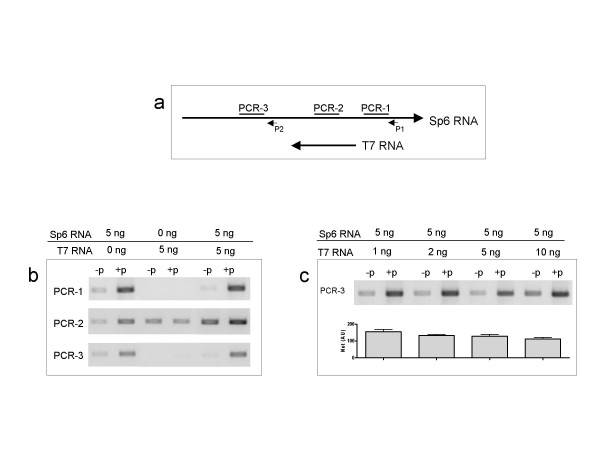
RT PCR Analyses of pure in vitro sense and antisense RNA. (a) Schematic diagram depicting the relative overlap between complementary in vitro RNA, Sp6 and T7 RNA. Position of the RT primer (P1 and P2) and of the PCR targets (PCR-1, PCR-2, and PCR-3) are also depicted. (b) Representative ethidium bromide stained gel results of RT-PCR. Sp6 and T7 RNA (5 ng) were reverse transcribed in 20 μl reaction either each one in pure form or mixed together. Reverse transcription was carried out in absence of any primers (-p), or in presence of Sp6-specific primer (+p); P1 for PCR1 and PCR-2; and P2 for PCR-3. PCR was performed on 100 nl cDNA for 22 cycles. (c) Sp6 RNA (5 ng) was reverse transcribed in 20 μl reaction mixed together with increasing amounts of T7 RNA as shown (from 1 to 10 ng). Reverse transcription was carried out in absence of any primers (-p), or in presence of Sp6-specific primer (+p, P1) followed by PCR using PCR-3 on 100 nl cDNA for 22 cycles. A representative ethidium bromide stained gel is shown, as well as a bar graph of the net signal [(+p)-(-p)] in arbitrary units (AU) as means+SE of 3 independent RT-PCR reactions. See Additional file 4 for primer information.
Figure 3
Figure 3
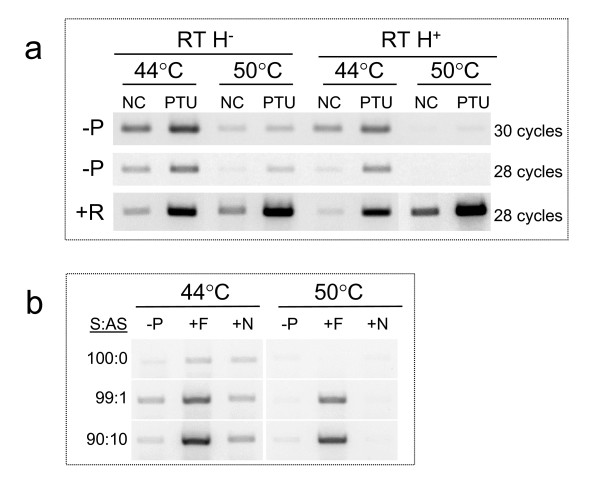
Testing different RT enzyme properties and conditions. (a) In a two-step RT-PCR system, 2 μg total RNA from NC and PTU treated hearts were reverse transcribed in 20 μl reactions in absence (-p) or presence (+p) of RT primers. The RT primer targeted the MYH7 sense RNA, and the PCR primer set amplified a 284 bp product corresponding to the 3' end of the MYH7 gene. PCR used 1 μl cDNA and was carried out for either 28 or 30 cycles. Shown are results from using two different RT enzymes that differed by their RNase H properties. RNase H- and RNase H+. For each enzyme, the RT reactions were carried out under two different temperatures: 44°C or 50°C for 30 minutes/ea. (b) RT-PCR targeting the antisense MYH7 RNA in total RNA mixes of known proportions of sense and antisense RNA. RNA template contained either only sense MYH7 RNA, or a mix of sense and antisense MYH7 RNA corresponding to 99 to1 or 90 to 10 sense to antisense ratios (S:AS). Soleus total RNA was used as a source of the sense MYH7 RNA in absence of antisense. Whereas, T3-treated heart total RNA was used as a source of the antisense MYH7 RNA without co-expression of the sense. Mixes of soleus and T3 treated heart RNA were used to achieve the noted S:AS amounts in 2 μg of total RNA per 20 μl reactions. Reverse transcriptions were carried out in absence of RT primers (-P), in presence of the forward primer (+F) targeting the antisense, and in presence of a non specific primer corresponding to the 3' untranslated region of the human MYH4 mRNA sequence (+N). RT reactions used RNase H- RT (Invitrogen), performed at 44°C or at 50°C for 30 min. PCR was carried out on 1 μcDNA for 28 cycles targeting the 3' end of the MYH7 gene. See Additional file 4 for primers information.
Figure 4
Figure 4
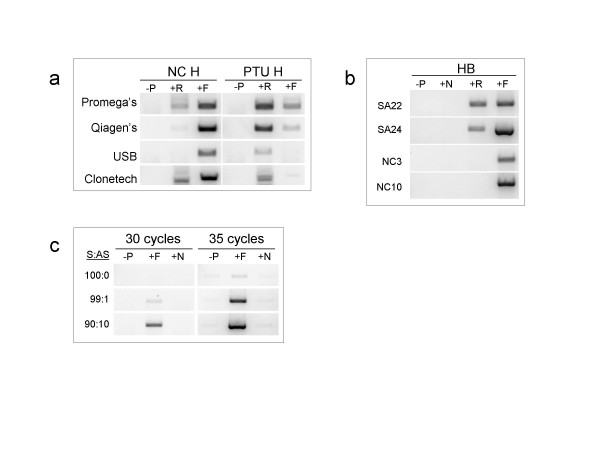
One Step RT-PCR systems and specificity for the analyses of sense-antisense RNA pairs. (a) Comparisons of four commercially available one step RT-PCR kits regarding their performance in analyses of sense and antisense MYH7 RNA expression in NC and PTU heart total RNA. -P is when the RT step was carried out in absence of primers. +R is when the RT was carried out in presence of reverse primer that is targeting the sense RNA. +F is when the RT was carried out in presence of forward primer that is targeting the antisense RNA. (b). One Step RT-PCR using the Qiagen kit. Reactions used human brain RNA and PCR targeting either sense or antisense RNA of specific genes shown to be expressed in sense/antisense pairs (SA22, SA24) or in a single form (NC3, NC10). These primers were used previously by Chen et al., [9]. As a further test of specificity, the RT reactions were carried out in absence of primers (-P) or in presence of a non specific primer (+N), complementary to human MYH4 mRNA, MYH 4 is not expressed in the brain and is not related to any of the studied genes. (c) One step RT-PCR (Qiagen kit) used to detect small amount of antisense (AS) MYH 7 RNA in mixed total RNA preparations containing either 100% sense (S) MYH7 RNA, (100:0), or 99:1 and 90:10 of S:AS ratios. Sense MYH7 is derived from soleus muscle total RNA, whereas antisense MYH7 is derived from total RNA in T3-treated rat hearts. Reactions contained 100 ng of total RNA of the specified S:AS composition. RT reaction included either no primers (-P), a forward primer (+F) to target the antisense, and a non-specific primer (+N). For all these reactions in a, b, and c, 100 ng total RNA was used per reaction, and the RT was carried out at 50°C for 30 minutes followed by 10 minutes at 95°C. The PCR was carried out for 30 cycles (a, b, and c) or 35 cycles (c). See Additional file 4 for primer information.

References

    1. Haddad F, Qin AX, Bodell PW, et al. Regulation of antisense RNA expression during cardiac MHC gene switching in response to pressure overload. Am J Physiol Heart Circ Physiol. 2006;290:H2351–2361. doi: 10.1152/ajpheart.01111.2005. - DOI - PubMed
    1. Stahlberg A, Hakansson J, Xian X, Semb H, Kubista M. Properties of the Reverse Transcription Reaction in mRNA Quantification. Clin Chem. 2004;50:509–515. doi: 10.1373/clinchem.2003.026161. - DOI - PubMed
    1. Gunji T, Kato N, Hijikata M, Hayashi K, Saitoh S, Shimotohno K. Specific detection of positive and negative stranded hepatitis C viral RNA using chemical RNA modification. Arch Virol. 1994;134:293–302. doi: 10.1007/BF01310568. - DOI - PubMed
    1. Lanford RE, Sureau C, Jacob JR, White R, Fuerst TR. Demonstration of in vitro infection of chimpanzee hepatocytes with hepatitis C virus using strand-specific RT/PCR. Virology. 1994;202:606–14. doi: 10.1006/viro.1994.1381. - DOI - PubMed
    1. Lin L, Fevery J, Hiem Yap S. A novel strand-specific RT-PCR for detection of hepatitis C virus negative-strand RNA (replicative intermediate): evidence of absence or very low level of HCV replication in peripheral blood mononuclear cells. Journal of Virological Methods. 2002;100:97–105. doi: 10.1016/S0166-0934(01)00399-8. - DOI - PubMed

Publication types

MeSH terms