


Review
doi: 10.1016/j.exger.2007.03.007.
Epub 2007 Mar 30.
Telomerase and the aging process
Affiliations
- PMID: 17482404
- PMCID: PMC1933587
- DOI: 10.1016/j.exger.2007.03.007
Item in Clipboard
Review
Telomerase and the aging process
Exp Gerontol.
2007 Jul.
Abstract
The level of telomerase activity is important in determining telomere length in aging cells and tissues. Here evidence on the importance of telomerase activity is reviewed with respect to aging rates of mammalian species and the health and life span of individuals within a species. The significance of telomerase reactivation for both cancer development and for immortalizing cells for therapeutic processes is assessed.
Figures
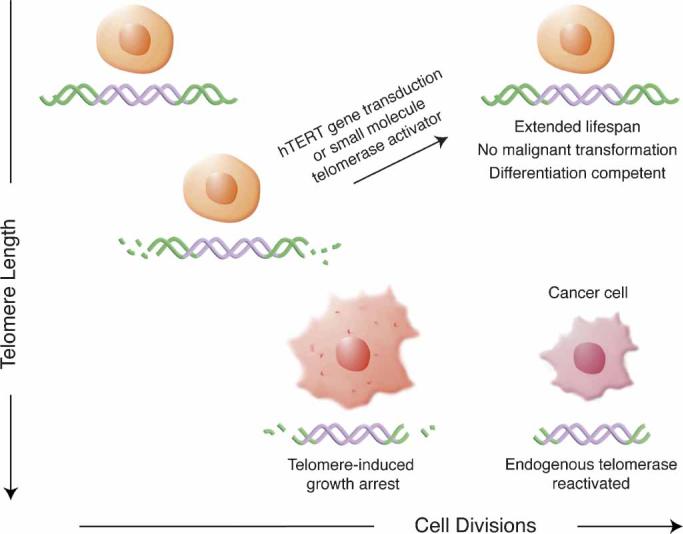
The absence of telomerase activity in most human somatic cells results in telomere shortening during aging. Telomerase activity can be restored to human cells by hTERT gene transduction or potentially via drug therapy; such extended-lifespan cells could be useful in forms of cell therapy to be developed for age-related diseases. On the other hand, the absence of telomerase acts as a limitation on cancer growth unless telomerase becomes reactivated. Reproduced with permission from Shay and Wright, 2007.
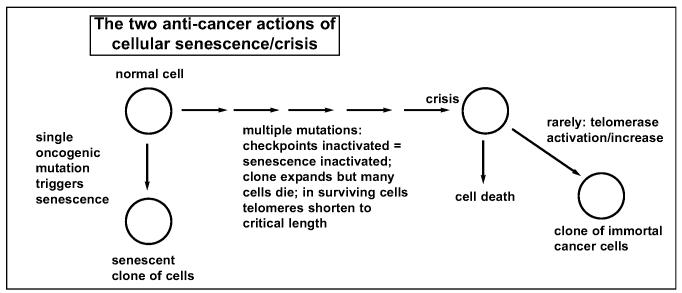
The two anti-cancer mechanisms of cellular senescence. Left: Senescence can be triggered by an oncogenic mutation. The oncogenic protein both stimulates cell proliferation and triggers senescence, with the result that, despite some expansion of the clone, the cells eventually cease dividing. The end result is a benign lesion, such as a nevus. Right: When an abnormal cell clone acquires multiple mutations over time, one or more of the mutations act to inactivate cell cycle checkpoints. In this case the cell clone continues to divide; senescence is inactive and so cannot act to limit the proliferation of the cells. Many cells within the clone die or are lost as result of differentiation or immune surveillance. If cells in the clone continue to divide telomeres progressively shorten until they become so short as to cause end-to-end fusions. Breakage-fusion-bridge cycles may ensue. This state (crisis) is a terminal one for the cell and the cell will eventually die. However either before crisis or during crisis telomerase may be upregulated. In that case telomere erosion is stopped and an immortal cell clone arises. Because of the many mutations that the cell has acquired by this time the cell may already be tumorigenic or may have acquired many of the mutations needed to reach that stage.
References
-
- Baird DM. Telomeres. Exp. Gerontol. 2006;41:1223–7. - PubMed
-
- Bodnar AG, Ouellette M, Frolkis M, Holt SE, Chiu CP, Morin GB, Harley CB, Shay JW, Lichtsteiner S, Wright WE. Extension of life-span by introduction of telomerase into normal human cells. Science. 1998;279:349–52. - PubMed
-
- Campisi J. Cancer and ageing: Rival demons? Nature Rev. Cancer. 2003;3:339–49. - PubMed
Publication types
MeSH terms
Substances
Grants and funding
LinkOut - more resources
Full Text Sources
Medical
