


Further structure-activity studies of lactam derivatives of MT-II and SHU-9119: their activity and selectivity at human melanocortin receptors 3, 4, and 5
- PMID: 17482720
- PMCID: PMC1955225
- DOI: 10.1016/j.peptides.2007.02.012
Further structure-activity studies of lactam derivatives of MT-II and SHU-9119: their activity and selectivity at human melanocortin receptors 3, 4, and 5
Abstract
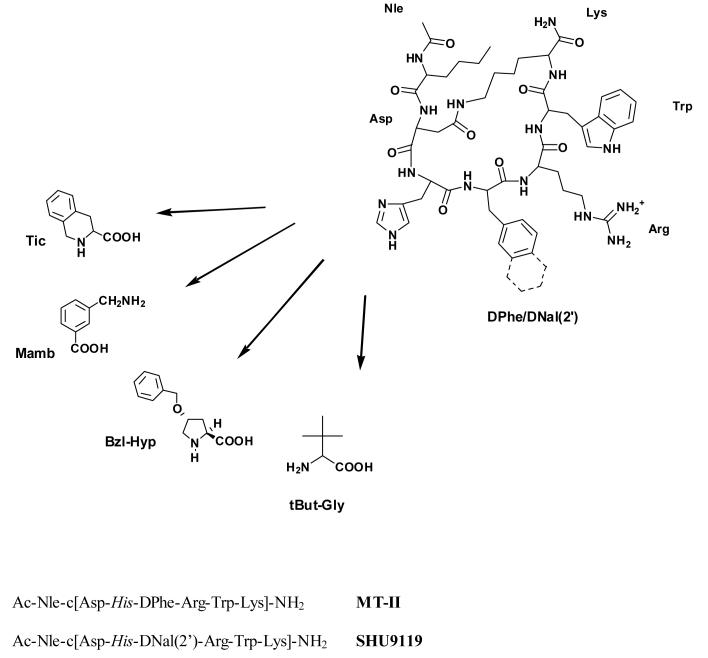
Recently we have demonstrated that replacing His(6) by constrained amino acids(2) in the well-known antagonist SHU-9119 resulted in potent and selective antagonist ligands especially at the hMC3R and hMC5 receptors. With the aim to further explore position 6 in the sequence of SHU-9119 and MT-II, we have designed, synthesized, and pharmacologically characterized a series of peptide analogues of MT-II and SHU-9119 at the human melanocortin receptors subtypes MC3R, MC4R and MC5R. All these peptides were modified at position 6 with constrained amino acids which are commercially available. In this study, we have identified new selective ligands for the hMC4R, and an antagonist for the hMC3/hMC4 receptors. Additionally, we have discovered an interesting new selective antagonist at the hMC3R, Ac-Nle-c[Asp-betaAla-DNal(2')-Arg-Trp-Lys]-NH(2) (2, PG-106) which represents an important tool in further biological investigations of the hMC3R. PG-106 will be useful in further efforts to differentiate the substructural features responsible for selectivity at the hMC3R, hMC4R, and hMC5R.
Figures
References
-
- Al-Obeidi F, Hadley ME, Pettitt BM, Hruby VJ. Design of a new class of superpotent cyclic α-Melanotropins based on quenched dynamic stimulations. J Am Chem Soc. 1989;111:3413–6.
-
- Bednarek MA, MacNeil T, Tang R, Kalyani RN, Van der Ploeg LHT, Weinberg DH. Potent and selective peptide agonists of α-melanotropin action at human melanocortin receptor 4: Their synthesis and biological evaluation in vitro. Biochem Biophy Res Comm. 2001;286:641–5. - PubMed
-
- Cai M, Cai C, Mayorov AV, Xiong C, Cabello CM, Soloshonok VA, Swift JR, Trivedi D, Hruby VJ. Biological and conformational study of β-substituted prolines in MT-II template: Steric effects leading to human MC5 receptor selectivity. J Peptide Res. 2004;63:116–31. - PubMed
-
- Cone RD, Mountjoy KG, Robbins LS, Nadeau JH, Johnson KR, Roselli-Rehfuss L, Mortrud MT. (1993) Cloning and functional characterization of a family of receptors for the melanotropic peptides. Ann NY Acad Sci. 1993;680:342–63. - PubMed
-
- Cone RD, editor. The melanocortin receptors. Humana Press; Totowa, New Jersey: 2000.
Publication types
MeSH terms
Substances
Grants and funding
LinkOut - more resources
Full Text Sources
Other Literature Sources
Molecular Biology Databases
