


SCOPE: a web server for practical de novo motif discovery
- PMID: 17485471
- PMCID: PMC1933170
- DOI: 10.1093/nar/gkm310
SCOPE: a web server for practical de novo motif discovery
Abstract
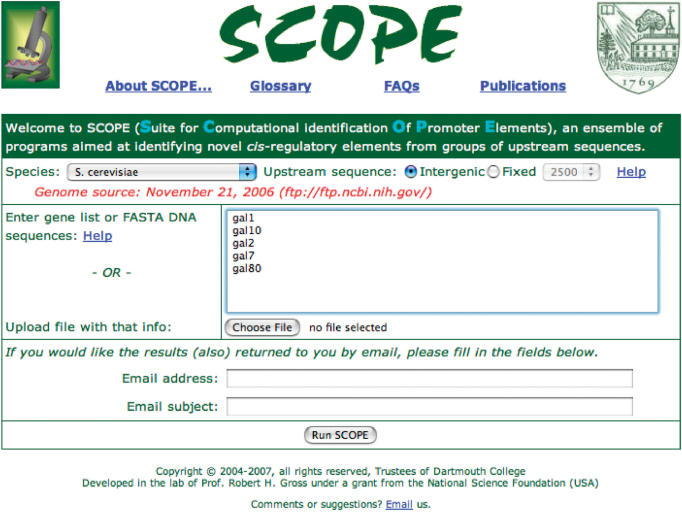
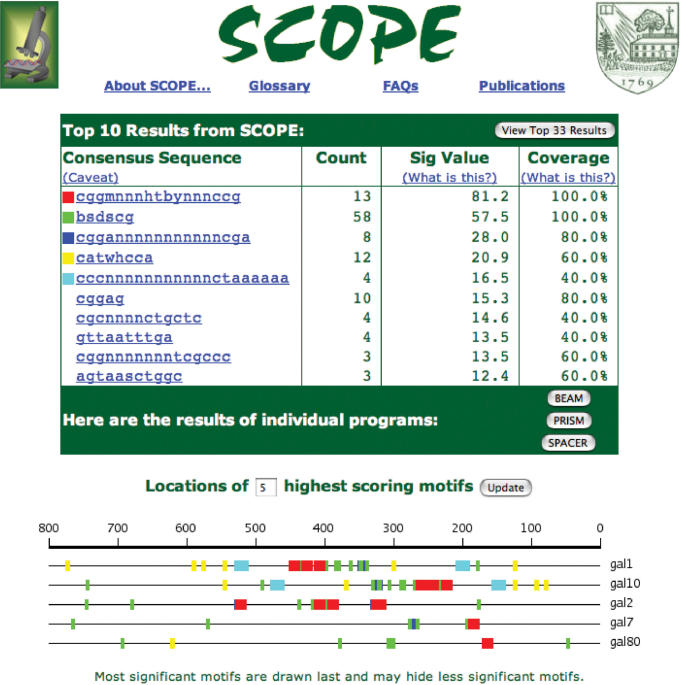
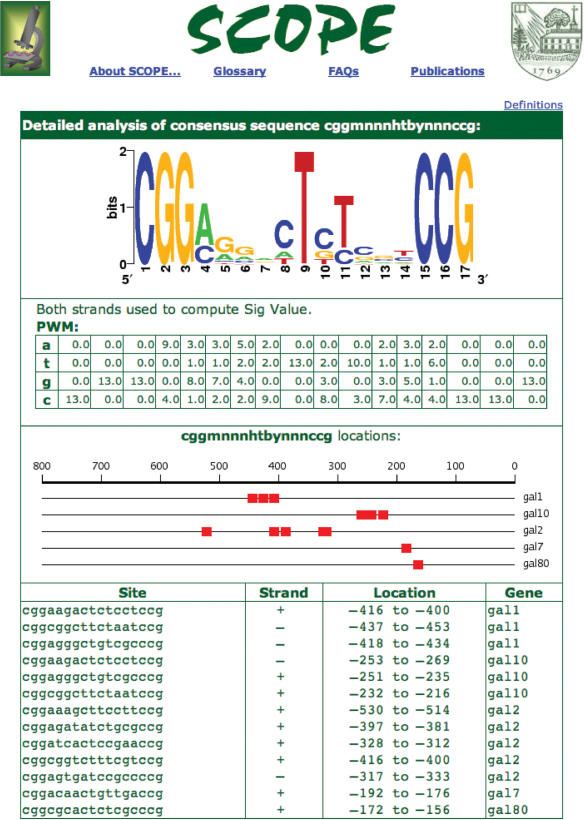
SCOPE is a novel parameter-free method for the de novo identification of potential regulatory motifs in sets of coordinately regulated genes. The SCOPE algorithm combines the output of three component algorithms, each designed to identify a particular class of motifs. Using an ensemble learning approach, SCOPE identifies the best candidate motifs from its component algorithms. In tests on experimentally determined datasets, SCOPE identified motifs with a significantly higher level of accuracy than a number of other web-based motif finders run with their default parameters. Because SCOPE has no adjustable parameters, the web server has an intuitive interface, requiring only a set of gene names or FASTA sequences and a choice of species. The most significant motifs found by SCOPE are displayed graphically on the main results page with a table containing summary statistics for each motif. Detailed motif information, including the sequence logo, PWM, consensus sequence and specific matching sites can be viewed through a single click on a motif. SCOPE's efficient, parameter-free search strategy has enabled the development of a web server that is readily accessible to the practising biologist while providing results that compare favorably with those of other motif finders. The SCOPE web server is at <http://genie.dartmouth.edu/scope>.
Figures
References
-
- Wasserman WW, Sandelin A. Applied bioinformatics for the identification of regulatory elements. Nat. Rev. Genet. 2004;5:276–287. - PubMed
Publication types
MeSH terms
Substances
LinkOut - more resources
Full Text Sources
Other Literature Sources
Molecular Biology Databases
