


Association of fetuin-A with mitral annular calcification and aortic stenosis among persons with coronary heart disease: data from the Heart and Soul Study
- PMID: 17485576
- PMCID: PMC2771196
- DOI: 10.1161/CIRCULATIONAHA.106.682450
Association of fetuin-A with mitral annular calcification and aortic stenosis among persons with coronary heart disease: data from the Heart and Soul Study
Abstract
Background: Fetuin-A is a multifunctional hepatic secretory protein that inhibits dystrophic vascular and valvular calcification. Lower serum fetuin-A concentrations are associated with valvular calcification in persons with end-stage renal disease. Whether fetuin-A is associated with valvular calcification in other patient populations is unknown.
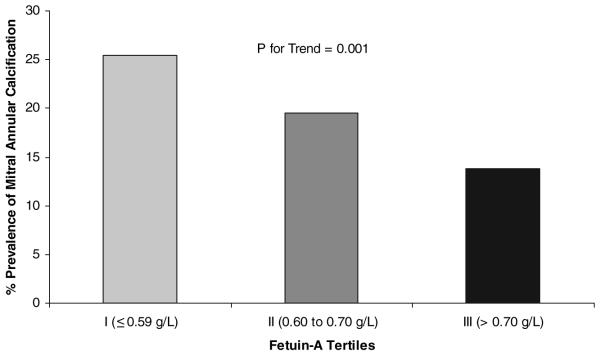
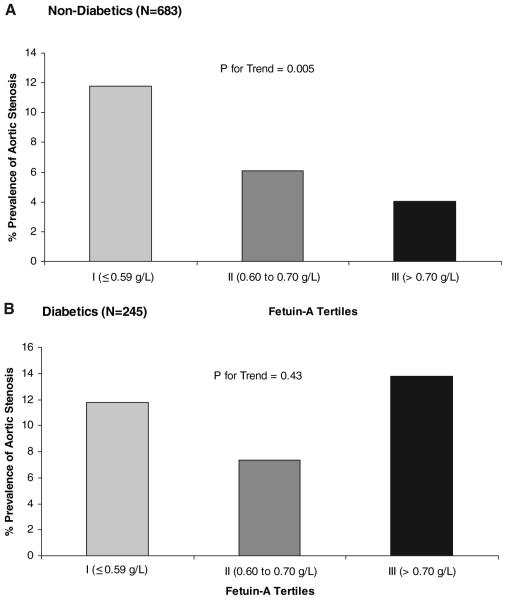
Methods and results: We evaluated the associations among serum fetuin-A concentrations, mitral annular calcification, and aortic stenosis in 970 ambulatory persons with coronary heart disease and without severe kidney disease. The presence or absence of mitral annular calcification and aortic stenosis was determined by transthoracic echocardiography. The subjects' mean age was 66 years; 81% were men; 189 (20%) had mitral annular calcification; and 79 (8%) had aortic stenosis. Participants were categorized by tertiles of fetuin-A concentrations. Those within the highest fetuin-A tertile had significantly lower odds of mitral annular calcification compared with the lowest tertile (adjusted odds ratio, 0.47; 95% confidence interval, 0.29 to 0.77; P=0.002); this association was similar regardless of diabetes status (P for interaction=0.34). In contrast, the association of fetuin-A with aortic stenosis was modified by the presence or absence of diabetes mellitus (P for interaction=0.03). Among participants without diabetes, the highest fetuin-A tertile had a significantly lower odds of aortic stenosis compared with the lowest tertile (adjusted odds ratio, 0.37; 95% confidence interval, 0.15 to 0.92; P=0.03), whereas among participants with diabetes, no statistically significant association was observed between fetuin-A and aortic stenosis (adjusted odds ratio, 1.49; 95% confidence interval, 0.48 to 4.63; P=0.49).
Conclusions: Among persons with coronary heart disease, we observed an inverse association of fetuin-A and mitral annular calcification. An inverse association also was observed between fetuin-A and aortic stenosis among participants without diabetes mellitus. Fetuin-A may represent an important inhibitor of dystrophic calcification in persons with coronary heart disease.
Figures
Comment in
-
Fetuin-A, valve calcification, and diabetes: what do we understand?Circulation. 2007 May 15;115(19):2464-7. doi: 10.1161/CIRCULATIONAHA.107.698324. Circulation. 2007. PMID: 17502586 No abstract available.
References
-
- Giachelli CM. Vascular calcification: in vitro evidence for the role of inorganic phosphate. J Am Soc Nephrol. 2003;14:S300–S304. - PubMed
-
- Giachelli CM. Vascular calcification mechanisms. J Am Soc Nephrol. 2004;15:2959–2964. - PubMed
-
- Mohler ER, 3rd, Chawla MK, Chang AW, Vyavahare N, Levy RJ, Graham L, Gannon FH. Identification and characterization of calcifying valve cells from human and canine aortic valves. J Heart Valve Dis. 1999;8:254–260. - PubMed
Publication types
MeSH terms
Substances
Grants and funding
LinkOut - more resources
Full Text Sources
Medical
Miscellaneous
