. 2007 May 15;104(20):8433-7.
doi: 10.1073/pnas.0702936104. Epub 2007 May 7.

Agalactosylated IgG antibodies depend on cellular Fc receptors for in vivo activity

Affiliations

Agalactosylated IgG antibodies depend on cellular Fc receptors for in vivo activity

Falk Nimmerjahn et al. Proc Natl Acad Sci U S A. .

Abstract

IgG antibodies are glycoproteins containing a branched sugar moiety attached to the asparagine 297 residue in the antibody constant region (Fc). This glycan is essential for maintaining a functional Fc structure, which is a prerequisite for antibody-mediated effector functions, such as the interaction with cellular Fc receptors or the complement component C1q. Variations in the composition of the sugar moiety can dramatically influence antibody activity. Moreover, humans and mice with autoimmune disorders, such as rheumatoid arthritis, have altered IgG glycosylation patterns with increased levels of antibodies lacking terminal sialic acid and galactose residues (IgG-G0). There is great interest in understanding whether this altered glycosylation pattern influences antibody-mediated effector functions. In vitro studies have suggested that IgG-G0 antibodies gain the capacity to activate the complement pathway via mannose-binding lectin (MBL), which could contribute to antibody-mediated inflammation. We have analyzed the activity of IgG-G0 antibodies in mice with a genetic deletion of MBL (MBL-null mice) and demonstrate that IgG-G0 antibodies are unimpaired in MBL-null mice. In contrast, the activity of these antibody glycovariants is fully dependent on the presence of activating Fc receptors.


Conflict of interest statement

The authors declare no conflict of interest.

Figures
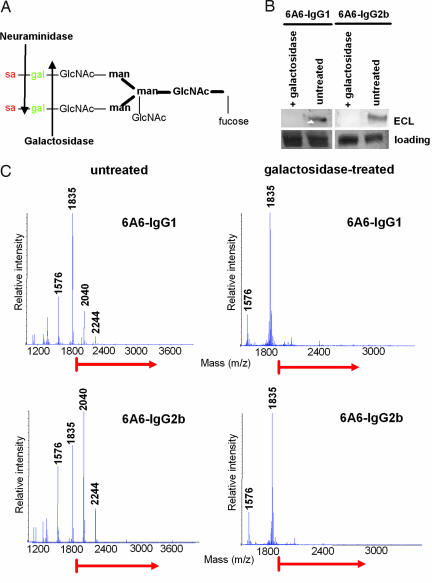
Fig. 1.
Fig. 1.
Generation of IgG-G0 glycovariants. (A) Schematic representation of the fully processed ASN-297 attached sugar moiety of IgG. Arrows indicate which sugar subunits are cleaved by the indicated glycosidases. (B and C) IgG-G0 glycovariants of 6A6-IgG1 and IgG2b were generated by removal of terminal galactose residues from sialic acid-depleted preparations by digestion with β-galactosidase. The efficiency of galactose removal was assayed by lectin blotting with ECL (B) or by MALDI-TOF analysis (C).
Fig. 2.
Fig. 2.
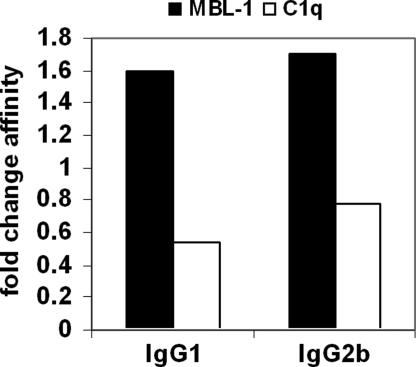
Effect of galactose removal on binding of complement proteins. The affinity of MBL-1 and C1q to wild-type and agalactosylated IgG-G1 and IgG2b was investigated by surface plasmon resonance. Data are expressed as the fold change in affinity between wild-type and agalactosyl IgG.
Fig. 3.
Fig. 3.
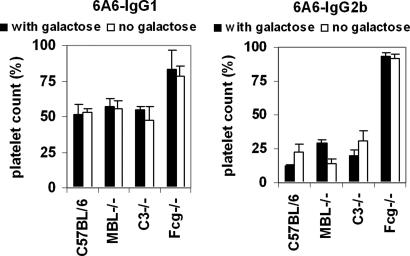
Activity of antiplatelet IgG-G0 antibodies in vivo. C57BL/6, MBL−/−, C3−/−, and common FcR γ-chain−/− (Fcg−/−) mice were injected with 6A6-IgG1 and -IgG2b antibody glycovariants with (filled bars) or without (open bars) galactose. Platelet counts were determined before and after antibody injection and are shown as the percentages of platelets present 4 h after antibody injection.
Fig. 4.
Fig. 4.
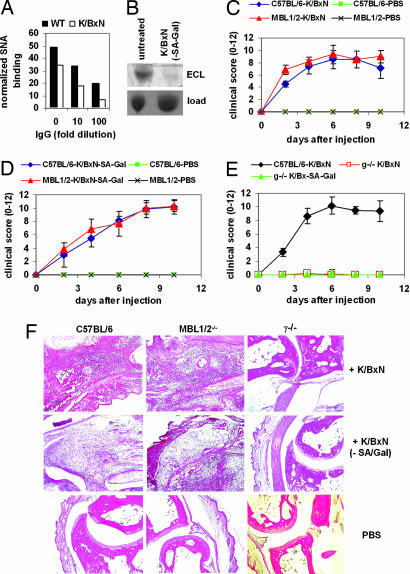
Activity of IgG-G0 antibodies in the K/BxN serum transfer model of arthritis. (A) The level of serum IgG sialylation in arthritic K/BxN mice compared with healthy wild-type controls was determined by lectin blotting with SNA and normalized to the loading control as described (14). (B) K/BxN serum was left untreated or treated with neuraminidase and galactosidase (K/BxN-SA-Gal) followed by isolation of serum IgG and determination of terminal galactose residues by blotting with ECL. The Coomassie-stained gel is shown as a loading control (load). (C and D) C57BL/6 or MBL-null (MBL 1/2) mice were injected with K/BxN serum either untreated (C) or pretreated with neuraminidase and galactosidase (K/BxN-SA-Gal) (D) and analyzed for the development of arthritis over the next 10 days; clinical scores were calculated as described in Materials and Methods. (E) C57BL/6 or common FcR γ-chain knockout mice (g−/−) were injected with untreated or neuraminidase- and galactosidase-treated serum and followed for the development of arthritis. (F) Ankle sections of C57BL/6, MBL-null, or FcR γ-chain knockout mice (γ−/−) that were injected with untreated K/BxN serum, serum depleted in sialic acid and galactose (K/BxN-SA-Gal), or PBS as a control were prepared at days 8–10 after serum injection and stained with H&E to detect the infiltration of inflammatory cells.

References

    1. Nimmerjahn F, Ravetch JV. Immunity. 2006;24:19–28. - PubMed
    1. Nimmerjahn F, Ravetch JV. Science. 2005;310:1510–1512. - PubMed
    1. Arnold JN, Wormald MR, Sim RB, Rudd PM, Dwek RA. Annu Rev Immunol. 2007;25:21–50. - PubMed
    1. Butler M, Quelhas D, Critchley AJ, Carchon H, Hebestreit HF, Hibbert RG, Vilarinho L, Teles E, Matthijs G, Schollen E, et al. Glycobiology. 2003;13:601–622. - PubMed
    1. Jefferis R, Lund J, Mizutani H, Nakagawa H, Kawazoe Y, Arata Y, Takahashi N. Biochem J. 1990;268:529–537. - PMC - PubMed

Publication types

LinkOut - more resources