Sleep and aging: 2. Management of sleep disorders in older people
- PMID: 17485699
- PMCID: PMC1863539
- DOI: 10.1503/cmaj.070335
Sleep and aging: 2. Management of sleep disorders in older people
Abstract
The treatment of sleep-related illness in older patients must be undertaken with an appreciation of the physiologic changes associated with aging. Insomnia is common among older people. When it occurs secondary to another medical condition, treatment of the underlying disorder is imperative. Benzodiazepines, although potentially effective, must be used with care and in conservative doses. Daytime sedation, a common side effect, may limit use of benzodiazepines. Newer non-benzodiazepine drugs appear to be promising. Rapid eye movement (REM) sleep behaviour disorder can be treated with clonazepam, levodopa-carbidopa or newer dopaminergic agents such as pramipexole. Sleep hygiene is important to patients with narcolepsy. Excessive daytime sleepiness can be treated with central stimulants; cataplexy may be improved with an antidepressant. Restless legs syndrome and periodic leg-movement disorder are treated with benzodiazepines or dopaminergic agents such as levodopa-carbidopa and, more recently, newer dopamine agonists. Treatment of obstructive sleep apnea includes weight reduction and proper sleep positioning (on one's side), but may frequently necessitate the use of a continuous positive air-pressure (CPAP) device. When used regularly, CPAP machines are very effective in reducing daytime fatigue and the sequelae of untreated obstructive sleep apnea.
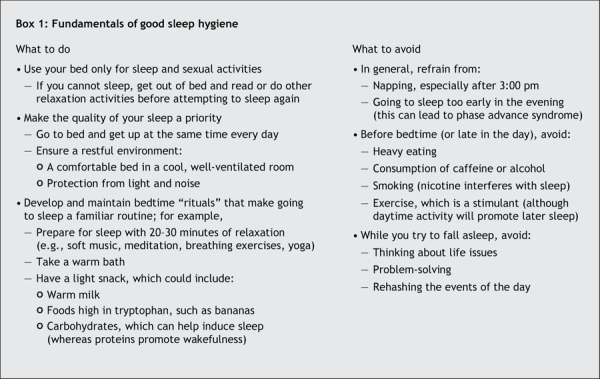
References
-
- Stewart RB, Moore MT, May FE, et al. Nocturia: a risk factor for falls in the elderly. J Am Geriatr Soc 1992;40:1217-20. - PubMed
-
- Barkin RL, Schwer WA, Barkin SJ. Recognition and management of depression in primary care: a focus on the elderly: a pharmcotherapeutic overview of the selection process among the traditional and new antidepressants. Am J Ther 2000;7:205-26. - PubMed
-
- McGaffigan S, Bliwise DL. The treatment of sundowning: a selective review of pharmacological and nonpharmacological studies. Drugs Aging 1997;10:10-7. - PubMed
-
- Silber MH. Clinical practice. Chronic insomnia. N Engl J Med 2005;353:803-10. - PubMed
Publication types
MeSH terms
Substances
LinkOut - more resources
Full Text Sources
Other Literature Sources
Medical