


Identification of the high-risk group for metastasis of gastric cancer cases by vascular endothelial growth factor receptor-1 overexpression in peripheral blood
- PMID: 17486129
- PMCID: PMC2359929
- DOI: 10.1038/sj.bjc.6603785
Identification of the high-risk group for metastasis of gastric cancer cases by vascular endothelial growth factor receptor-1 overexpression in peripheral blood
Abstract
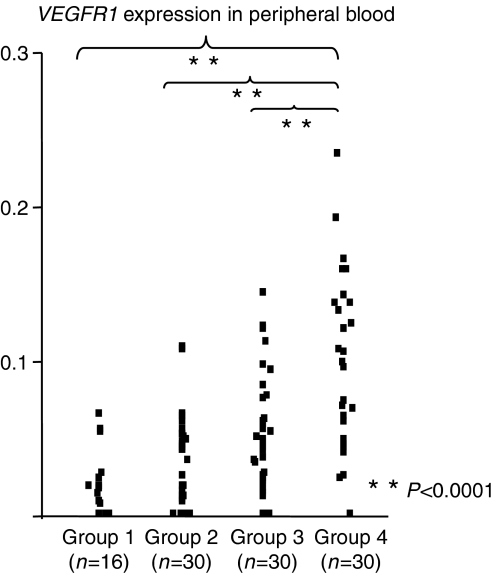
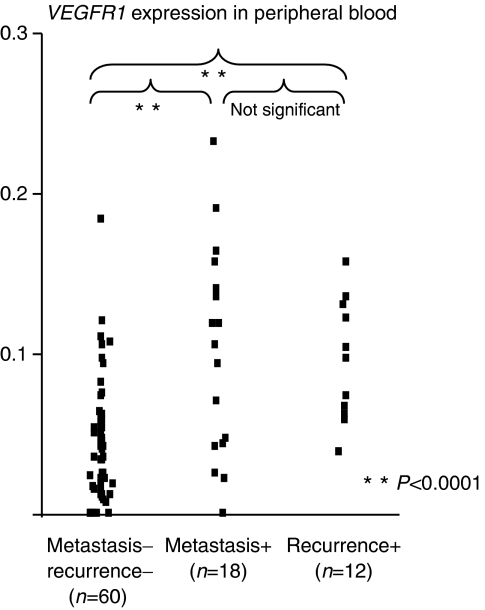
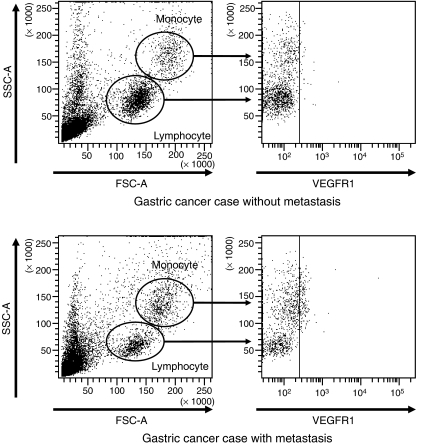
Identification of an isolated tumour cell with metastatic ability is important for predicting the recurrence and prognosis of gastric cancer. A biological marker for evaluating the metastatic ability of gastric cancer cells has not yet been identified. We assessed vascular endothelial growth factor receptor-1 mRNA expression by quantitative real-time reverse transcriptase-polymerase chain reaction. Vascular endothelial growth factor receptor-1 mRNA in peripheral blood was more highly expressed in perioperative metastasis-positive and postoperative recurrence cases than in normal control cases, early cancer cases and nonmetastatic advanced cancer cases. The peripheral blood vascular endothelial growth factor receptor-1 mRNA-positive group was associated with advanced clinical stage, deep invasion beyond the muscularis propria, lymphatic involvement, vascular involvement, lymph node metastasis, positive peritoneal lavage cytology, preoperative metastasis and postoperative recurrence. Flow cytometry analysis disclosed that vascular endothelial growth factor receptor-1 expressing cells in the peripheral blood were more abundant in cancer cases with metastases than in cases without metastases. Our data suggest that the amount of positive cells may provide information on the clinical features of gastric cancer, especially in regard to gastric cancer metastasis.
Figures
References
-
- Beerepoot LV, Mehra N, Vermaat JS, Zonnenberg BA, Gebbink MF, Voest EE (2004) Increased levels of viable circulating endothelial cells are an indicator of progressive disease in cancer patients. Ann Oncol 15: 139–145 - PubMed
-
- Clark DE, Smith SK, He Y, Day KA, Licence DR, Corps AN, Lammoglia R, Charnock-Jones DS (1998) A vascular endothelial growth factor antagonist is produced by the human placenta and released into the maternal circulation. Biol Reprod 59: 1540–1548 - PubMed
-
- Fan F, Wey JS, McCarty MF, Belcheva A, Liu W, Bauer TW, Somcio RJ, Wu Y, Hooper A, Hicklin DJ, Ellis LM (2005) Expression and function of vascular endothelial growth factor receptor-1 on human colorectal cancer cells. Oncogene 24: 2647–2653 - PubMed
-
- Ferrara N, Davis-Smyth T (1997) The biology of vascular endothelial growth factor. Endocr Rev 18: 4–25 - PubMed
-
- Galland F, Karamysheva A, Pebusque MJ, Borg JP, Rottapel R, Dubreuil P, Rosnet O, Birnbaum D (1993) The FLT4 gene encodes a transmembrane tyrosine kinase related to the vascular endothelial growth factor receptor. Oncogene 8: 1233–1240 - PubMed
Publication types
MeSH terms
Substances
LinkOut - more resources
Full Text Sources
Medical
