


doi: 10.1900/RDS.2006.3.54.
Epub 2006 Aug 10.
Central control of glucose homeostasis
Affiliations
- PMID: 17487327
- PMCID: PMC1783580
- DOI: 10.1900/RDS.2006.3.54
Item in Clipboard
Central control of glucose homeostasis
Rev Diabet Stud.
2006 Summer.
No abstract available
Figures
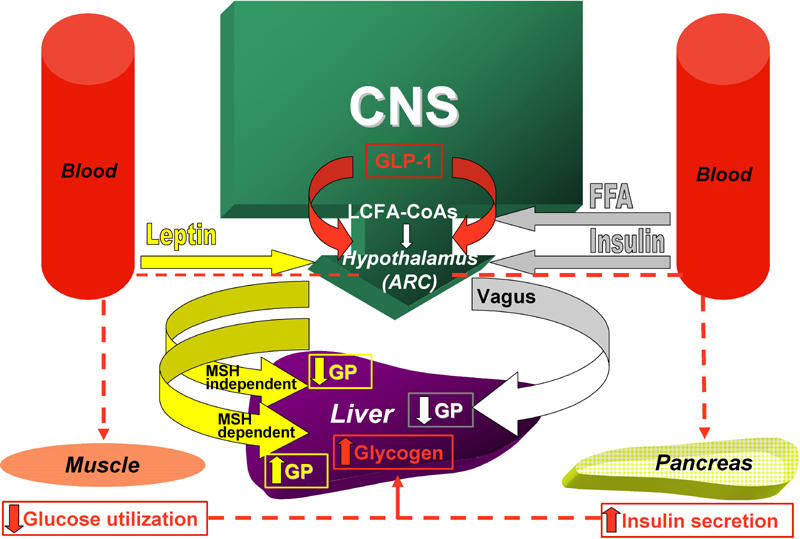
The activation of insulin signaling in hypothalamic arcuate nucleus (ARC) is sufficient to decrease blood glucose levels via the inhibition of hepatic glucose production (GP). This effect is mediated by the activation of efferent vagal fibers which innervate the liver. The effects of central leptin on glucose homeostasis involve both melanocortin-dependent and melanocortin-independent pathways. Acute activation of hypothalamic melanocortin receptors, results in an increased rate of hepatic gluconeogenesis. The effect of central leptin on the suppression of glucose production and glycogenolysis is mediated by the stimulation of melanocortin-independent pathways involving insulin-like pathways such as the PI3K signaling cascade. Glucagon-like peptide-1 (GLP-1) is produced in a discrete set of hindbrain neurons that project to a specific population of GLP-1 receptor-containing cells in the hypothalamus. During hyperglycemia following a meal, GLP-1 inhibits muscle glucose utilization and increases insulin secretion to favor hepatic glycogen storage. The intracellular pool of long-chain fatty acids (LCFA-CoAs) is under the control of several biochemical events including a free fatty acids (FFA) flux. Accumulation of LCFA-CoAs reduces hepatic glucose production.
References
-
- Taylor SI. Deconstructing type 2 diabetes. Cell. 1999;97:9–12. - PubMed
-
- Saltiel AR, Kahn CR. Insulin signaling and the regulation of glucose and lipid metabolism. Nature. 2001;414:799–806. - PubMed
-
- Elmquist JK, Marcus JN. Rethinking the central causes of diabetes. Nat Med. 2003;9:645–647. - PubMed
-
- Sindelar DK, Chu CA, Venson P, Donahue EP, Neal DW, Cherrington AD. Basal hepatic glucose production is regulated by the portal vein insulin concentration. Diabetes. 1998;47(4):523–529. - PubMed
LinkOut - more resources
Full Text Sources