


Racial differences in clinical and pathological associations with PhIP-DNA adducts in prostate
- PMID: 17487839
- PMCID: PMC2132438
- DOI: 10.1002/ijc.22806
Racial differences in clinical and pathological associations with PhIP-DNA adducts in prostate
Abstract
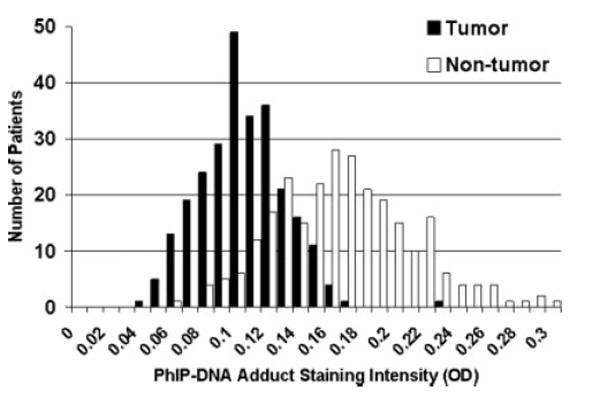
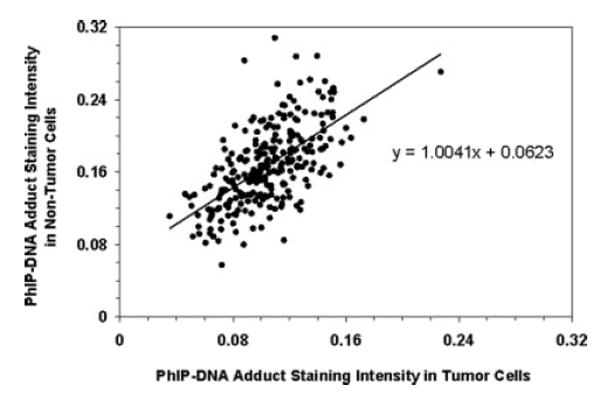
African-American men have a higher dietary intake of 2-amino-1-methyl-6-phenylimidazo[4,5-b]pyridine (PhIP), which is the most abundant heterocyclic amine in cooked meats and is carcinogenic in rat prostate through the formation of DNA adducts. To determine the clinical and demographic factors associated with PhIP-DNA adduct levels, the biologically effective dose of PhIP in human prostate, we immunohistochemically measured PhIP-DNA adducts in a study of 162 Caucasian and 102 African-American men who underwent radical prostatectomy for prostate cancer. A strong correlation between PhIP-DNA adduct levels in prostate tumor and adjacent non-tumor cells was observed (rho = 0.62; p < 0.0001); however, non-tumor cells had significantly higher adduct levels compared with tumor (0.167 optical density (OD) units +/- 0.043 vs. 0.104 OD +/- 0.027; p < 0.0001). Race was not associated with PhIP-DNA adduct levels in either tumor or non-tumor cells, but race-specific associations were observed. In prostate tumor and non-tumor cells, tumor volume had the strongest association with PhIP-DNA adducts in Caucasians, whereas in African-Americans prostate volume was most strongly associated with adduct levels in tumor cells and advanced Gleason grade had the strongest association in non-tumor cells. In race interaction models, while the only statistically significant interaction was between African-American race and advanced Gleason grade in non-tumor cells (beta = 0.029; p = 0.02), in tumor cells we observed opposite effects by race (positive for African-Americans, negative for Caucasians) for older age and high PSA levels at diagnosis. In conclusion, while PhIP-DNA adduct levels in prostate cells do not vary significantly by race, our results suggest that PhIP exposure may have stronger effects on prostate tumor differentiation in African-American men.
(c) 2007 Wiley-Liss, Inc.
Figures
References
-
- Kolonel LN. Fat, meat, and prostate cancer. Epidemiol Rev. 2001;23:72–81. - PubMed
-
- Sugimura T. Nutrition and dietary carcinogens. Carcinogenesis. 2000;21:387–95. - PubMed
-
- Shirai T, Sano M, Tamano S, Takahashi S, Hirose M, Futakuchi M, Hasegawa R, Imaida K, Matsumoto K, Wakabayashi K, Sugimura T, Ito N. The prostate: a target for carcinogenicity of 2-amino-1-methyl-6-phenylimidazo[4,5-b]pyridine (PhIP) derived from cooked foods. Cancer Res. 1997;57:195–8. - PubMed
-
- Nakai Y, Nelson WG, De Marzo AM. The dietary charred meat carcinogen 2-Amino-1-Methyl-6-Phenylimidazo[4,5-b]Pyridine acts as both a tumor initiator and promoter in the rat ventral prostate. Cancer Res. 2007;67:1378–84. - PubMed
-
- Shirai T, Kato K, Futakuchi M, Takahashi S, Suzuki S, Imaida K, Asamoto M. Organ differences in the enhancing potential of 2-amino-1-methyl-6-phenylimidazo[4,5-b]pyridine on carcinogenicity in the prostate, colon and pancreas. Mutat Res. 2002;506/507:129–36. - PubMed
Publication types
MeSH terms
Substances
Grants and funding
LinkOut - more resources
Full Text Sources
Medical
Research Materials
Miscellaneous
