


Review
doi: 10.1111/j.1582-4934.2007.00031.x.
The extracellular matrix and blood vessel formation: not just a scaffold
Affiliations
- PMID: 17488472
- PMCID: PMC3822822
- DOI: 10.1111/j.1582-4934.2007.00031.x
Item in Clipboard
Review
The extracellular matrix and blood vessel formation: not just a scaffold
J Cell Mol Med.
2007 Mar-Apr.
Abstract
The extracellular matrix plays a number of important roles, among them providing structural support and information to cellular structures such as blood vessels imbedded within it. As more complex organisms have evolved, the matrix ability to direct signalling towards the vasculature and remodel in response to signalling from the vasculature has assumed progressively greater importance. This review will focus on the molecules of the extracellular matrix, specifically relating to vessel formation and their ability to signal to the surrounding cells to initiate or terminate processes involved in blood vessel formation.
Figures
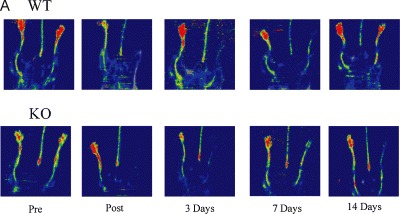
Effects on arteriogenesis by synectin disruption in mice. (A) Laser Doppler images of the time course of perfusion in hindlimbs of synectin wildtype (WT) and null (KO) mice (perfusion is indicated by colour where red > yellow > green > blue) (B) Quantitative analysis of laser Doppler images indicates significant alterations in hindlimb reperfusion immediate post and 14 days after femoral artery ligation in synectin null mice (black bars). Means +/- SEM, P < 0.05 from Chittenden et al. Dev. Cell. (2006), 10: 783–795.
References
-
- Sullivan L. In: Athey I, Kindergarten chats (revised 1918) and other writings. New York: Peter Smith; >The tall office building artistically considered. pp. 202–13.
-
- Hynes RO, Zhao Q. The evolution of cell adhesion. J Cell Biol. 2000;150:F89–96. - PubMed
-
- Huxley-Jones J, Robertson DL, Boot-Handford RP. On the origins of the extracellular matrix in vertebrates. Matrix Biol. 2007;26:2–11. - PubMed
-
- Prockop DJ, Kivirikko KI. Collagens: molecular biology, diseases, and potentials for therapy. Annu Rev Biochem. 1995;64:403–34. - PubMed
-
- Christiano AM, Greenspan DS, Lee S, Uitto J. Cloning of human type VII collagen. Complete primary sequence of the alpha 1(VII) chain and identification of intragenic polymorphisms. J Biol Chem. 1994;269:20256–62. - PubMed
Publication types
MeSH terms
Substances
Grants and funding
LinkOut - more resources
Full Text Sources
Other Literature Sources
Research Materials
