


Comment
doi: 10.1016/j.cmet.2007.04.006.
Targeting fat to prevent diabetes
Affiliations
- PMID: 17488634
- PMCID: PMC4303763
- DOI: 10.1016/j.cmet.2007.04.006
Item in Clipboard
Comment
Targeting fat to prevent diabetes
Cell Metab.
2007 May.
Abstract
An emerging view is that obesity causes metabolic problems when adipose tissue fails to meet the increased demands for fat storage. A study in this issue of Cell Metabolism (Waki et al., 2007) has identified harmine as a proadipogenic small molecule that promotes energy expenditure in white adipose tissue and delays the onset of obesity-associated diabetes.
Figures
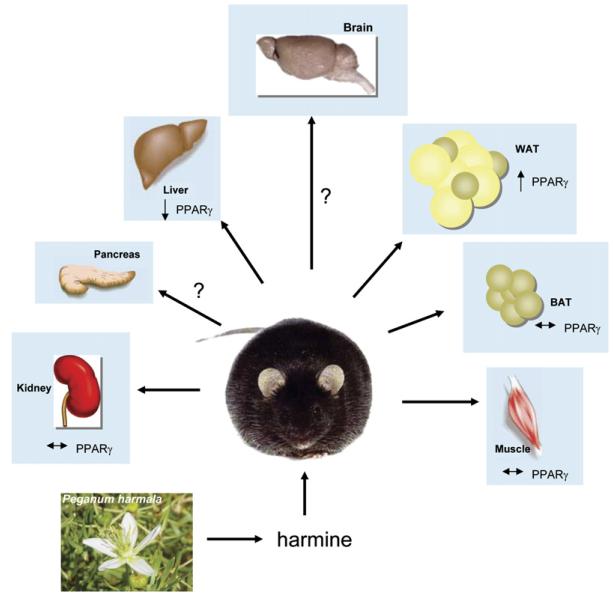
Harmine is a naturally occurring β-carboline alkaloid found in Syrian rue (Peganum harmala) and other plants. A small-molecule library screen (Waki et al., 2007) has identified it as a proadipogenic molecule that acts by inducing PPARγ expression. Obese (db/db) mice treated with harmine show a delay in the onset of diabetes, coincident with increased oxygen consumption and thermogenesis. A 2-fold increase in PPARγ levels was selectively seen in white adipose tissue, while there was a 50% decrease in PPARγ levels in the liver and no change in muscle, brown adipose tissue, or kidney. The effect of harmine on PPARγ expression in the brain and pancreas is currently unknown. Peganum harmala image reproduced from http://commons.wikimedia.org/ .
Comment on
-
The small molecule harmine is an antidiabetic cell-type-specific regulator of PPARgamma expression.Cell Metab. 2007 May;5(5):357-70. doi: 10.1016/j.cmet.2007.03.010. Cell Metab. 2007. PMID: 17488638
References
-
- Cooper EJ, Hudson AL, Parker CA, Morgan NG. Eur. J. Pharmacol. 2003;482:189–196. - PubMed
-
- Gray SL, Dalla Nora E, Backlund EC, Manieri M, Virtue S, Noland RC, O’Rahilly S, Cortright RN, Cinti S, Cannon B, Vidal-Puig A. Endocrinology. 2006;147:5708–5714. - PubMed
-
- Inestrosa NC, Godoy JA, Quintanilla RA, Koenig CS, Bronfman M. Exp. Cell Res. 2005;304:91–104. - PubMed
Publication types
MeSH terms
Substances
Grants and funding
LinkOut - more resources
Full Text Sources
Other Literature Sources
Medical
