


Organizational culture and physician satisfaction with dimensions of group practice
- PMID: 17489908
- PMCID: PMC1955261
- DOI: 10.1111/j.1475-6773.2006.00648.x
Organizational culture and physician satisfaction with dimensions of group practice
Abstract
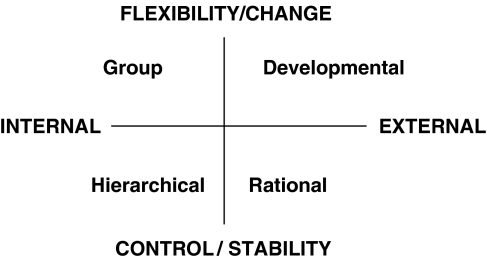
Research objective: To assess the extent to which the organizational culture of physician group practices is associated with individual physician satisfaction with the managerial and organizational capabilities of the groups.
Study design and methods: Physician surveys from 1997 to 1998 assessing the culture of their medical groups and their satisfaction with six aspects of group practice. Organizational culture was conceptualized using the Competing Values framework, yielding four distinct cultural types. Physician-level data were aggregated to the group level to attain measures of organizational culture. Using hierarchical linear modeling, individual physician satisfaction with six dimensions of group practice was predicted using physician-level variables and group-level variables. Separate models for each of the four cultural types were estimated for each of the six satisfaction measures, yielding a total of 24 models. SAMPLE STUDIED: Fifty-two medical groups affiliated with 12 integrated health systems from across the U.S., involving 1,593 physician respondents (38.3 percent response rate). Larger medical groups and multispecialty groups were over-represented compared with the U.S. as a whole.
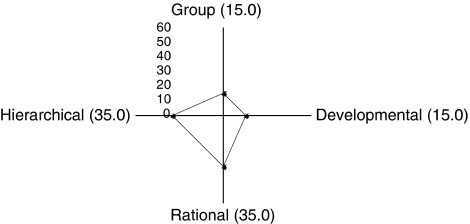
Principal findings: Our models explain up to 31 percent of the variance in individual physician satisfaction with group practice, with individual organizational culture scales explaining up to 5 percent of the variance. Group-level predictors: group (i.e., participatory) culture was positively associated with satisfaction with staff and human resources, technological sophistication, and price competition. Hierarchical (i.e., bureaucratic) culture was negatively associated with satisfaction with managerial decision making, practice level competitiveness, price competition, and financial capabilities. Rational (i.e., task-oriented) culture was negatively associated with satisfaction with staff and human resources, and price competition. Developmental (i.e., risk-taking) culture was not significantly associated with any of the satisfaction measures. In some of the models, being a single-specialty group (compared with a primary care group) and a group having a higher percent of male physicians were positively associated with satisfaction with financial capabilities. Physician-level predictors: individual physicians' ratings of organizational culture were significantly related to many of the satisfaction measures. In general, older physicians were more satisfied than younger physicians with many of the satisfaction measures. Male physicians were less satisfied with data capabilities. Primary care physicians (versus specialists) were less satisfied with price competition.
Conclusion: Some dimensions of physician organizational culture are significantly associated with various aspects of individual physician satisfaction with group practice.
Figures

References
-
- Abbott A. The System of Professions: An Essay on the Division of Expert Labor. Chicago: University of Chicago Press; 1988.
-
- Bodenheimer T, Wagner EH, Grumbach K. Improving Primary Care for Patients with Chronic Illness. Journal of the American Medical Association. 2002;288(14):1775–9. - PubMed
-
- Cameron K, Freeman S. Cultural Congruence, Strength and Type: Relationships to Effectiveness. In: Woodman R, Pasmore W, editors. Research in Organization Change and Development. Vol. 5. Greenwich, CT: JAI Press; 1991. pp. 23–58.
-
- Casalino L, Gilllies RR, Shortell SM, Schmittdiel JA, Bodenheimer T, Robinson JC, Rundall T, Oswald N, Schauffler H, Wang MC. External Incentives, Information Technology, and Organized Processes to Improve Health Care Quality for Patients with Chronic Diseases. Journal of the American Medical Association. 2003;289(4):434–41. - PubMed
-
- Charns MP. Organization Design of Integrated Delivery Systems. Hospital Health Service Administration. 1997;42(3):411–32. - PubMed
Publication types
MeSH terms
LinkOut - more resources
Full Text Sources
