


Effects of dietary calcium compared with calcium supplements on estrogen metabolism and bone mineral density
- PMID: 17490982
- PMCID: PMC9087302
- DOI: 10.1093/ajcn/85.5.1428
Effects of dietary calcium compared with calcium supplements on estrogen metabolism and bone mineral density
Abstract
Background: High calcium intake has been associated with both high bone mineral density (BMD) and high urinary estrogen metabolites. However, the role of dietary calcium and calcium supplements on estrogen metabolism and BMD remains unknown.
Objective: The objective was to investigate the importance of the source of calcium intake on estrogen metabolism and BMD.
Design: The average total daily calcium intake from supplements and diet, urinary estrogen metabolites, and spine and proximal femur BMD were studied in 168 healthy postmenopausal white women.
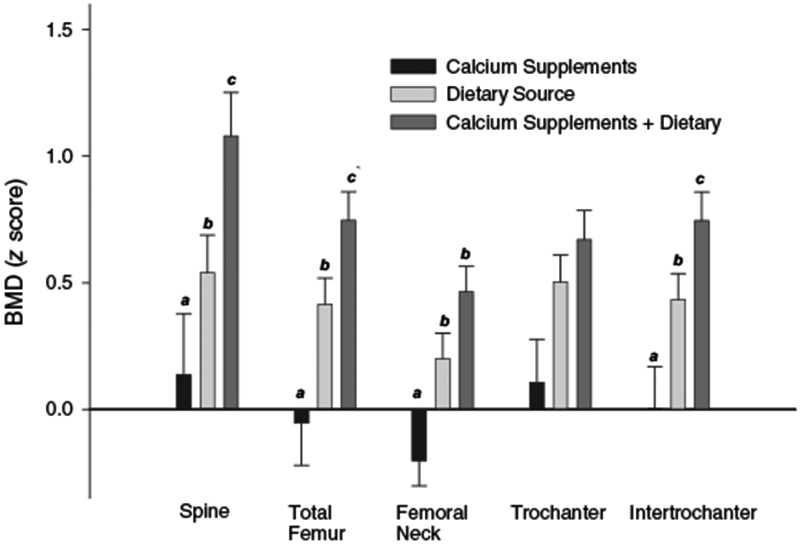
Results: Women who obtained calcium primarily from the diet or from both the diet and supplements had significantly (P=0.03) lower ratios of nonestrogenic to estrogenic metabolites (2-hydroxyestrone 1/16 alpha-hydroxyestrone) than did those who obtained calcium primarily from supplements. Adjusted BMD z scores were significantly greater in the subjects who obtained calcium primarily from the diet or from both the diet and supplements than in those who obtained calcium primarily from calcium supplements at the spine (P=0.012), femoral neck (P=0.02), total femur (P=0.003), and intertrochanter (P=0.005). This difference was evident especially in those who obtained calcium primarily from the diet, whose total calcium intake was lower than that in those who obtained calcium primarily from supplements.
Conclusion: Calcium from dietary sources is associated with a shift in estrogen metabolism toward the active 16 alpha-hydroxyl metabolic pathway and with greater BMD and thus may produce more favorable effects in bone health in postmenopausal women than will calcium from supplements.
Conflict of interest statement
The authors’ responsibilities were as follows—NN, JT, RC, and RCA-V: preparation and analysis of the data and writing of the manuscript; NN: recruitment of the participants, dietary assessment, blood and urine collection, and data entry; JT: dietary assessment and data entry; RCA-V (principal investigator): study design and supervision; RC: data interpretation. None of the authors had a personal or financial conflict of interest.
Figures
Comment in
-
Dietary calcium, the 16alpha-hydroxyl metabolic pathway of steroids, and sex hormones in blood and urine.Am J Clin Nutr. 2008 Jan;87(1):192-3; author reply 193-4. doi: 10.1093/ajcn/87.1.192. Am J Clin Nutr. 2008. PMID: 18175757 No abstract available.
References
-
- Fishman J, Bradlow HL, Gallagher TF. Oxidative metabolism of estradiol. J Biol Chem 1960;235:3104–7. - PubMed
-
- Adlercreutz H, Gorbach SL, Goldin BR, Woods MN, Dwyer JT, Hamalainen E. Estrogen metabolism and excretion in Oriental and Caucasian women. J Natl Cancer Inst 1994;86:1076–82. - PubMed
-
- Bradlow HL, Telang NT, Sepkovic DW, Osborne MP. 2-hydroxyestrone: the ‘good’ estrogen. J Endocrinol 1996;150(suppl):S259–65. - PubMed
-
- Westerlind KC, Gibson KJ, Malone P, Evans GL, Turner RT. Differential effects of estrogen metabolites on bone and reproductive tissues of ovariectomized rats. J Bone Miner Res 1998;13:1023–31. - PubMed
-
- Muti P, Bradlow HL, Micheli A, et al. Estrogen metabolism and risk of breast cancer: a prospective study of the 2:16alpha-hydroxyestrone ratio in premenopausal and postmenopausal women. Epidemiology 2000;11:635–40. - PubMed
Publication types
MeSH terms
Substances
Grants and funding
LinkOut - more resources
Full Text Sources
Medical
