Comparative Study
. 2007 Jun 6;26(11):2808-20.
doi: 10.1038/sj.emboj.7601704. Epub 2007 May 10.

Atomic resolution insight into host cell recognition by Toxoplasma gondii

Affiliations
Comparative Study

Atomic resolution insight into host cell recognition by Toxoplasma gondii

Tharin M A Blumenschein et al. EMBO J. .

Abstract

The obligate intracellular parasite Toxoplasma gondii, a member of the phylum Apicomplexa that includes Plasmodium spp., is one of the most widespread parasites and the causative agent of toxoplasmosis. Micronemal proteins (MICs) are released onto the parasite surface just before invasion of host cells and play important roles in host cell recognition, attachment and penetration. Here, we report the atomic structure for a key MIC, TgMIC1, and reveal a novel cell-binding motif called the microneme adhesive repeat (MAR). Using glycoarray analyses, we identified a novel interaction with sialylated oligosaccharides that resolves several prevailing misconceptions concerning TgMIC1. Structural studies of various complexes between TgMIC1 and sialylated oligosaccharides provide high-resolution insights into the recognition of sialylated oligosaccharides by a parasite surface protein. We observe that MAR domains exist in tandem repeats, which provide a highly specialized structure for glycan discrimination. Our work uncovers new features of parasite-receptor interactions at the early stages of host cell invasion, which will assist the design of new therapeutic strategies.


Figures

Figure 1
Figure 1
Host cell binding by TgMIC1-NT. (A) Cell binding assays on HFFs were performed using supernatant of P. pastoris cultures expressing TgMIC1, TgMIC1-NT, or TgMIC1MAR2, bacterially produced TgMIC1-NT and PfProfillin, the latter being used as a negative control. Anti-His antibodies are used as the probe for Western blots and the asterisk indicates background from host cells. Samples of input (I), supernatant (S), wash (W) and cell-binding fraction (CB) were run on each gel (see Materials and methods). Molecular weight markers in kDa. The Pichia-produced material is less efficient as it is a crude cell supernatant, whereas that from E. coli is a purified protein. These data show that bacterially produced TgMIC1-NT retains the cell-binding activity of native TgMIC1. Increasing the concentration of the input (I) up to 50 times results in enhanced binding of bacterially produced TgMIC1NT but not of PfProfilin to HFFs. Loading has been adjusted for detection in the linear range. Note: in all cell binding assays, the total volume of the input, supernatant and the wash is 500 μl, whereas the total volume of the cell bound fraction is 50 μl. (B) Cell binding competition experiments were performed using bacterially produced HisTgMIC1-NT and supernatants of P. pastoris cultures expressing TgMIC1myc. Anti-myc and Anti-His antibodies were used as probes for Western blots. Samples are named as follows: input (I), supernatant (S), wash (W) and cell binding fraction (CB). For the different conditions of competition only the cell-bound fraction is shown. These data confirm that no inhibition of TgMIC1 binding to HFFs is observed in the presence of lactose, galactose or heparin. Note: in all cell binding assays, the total volume of the input, supernatant and the wash is 500 μl, whereas the total volume of the cell-bound fraction is 50 μl.
Figure 2
Figure 2
Host cell binding and structure of TgMIC1-NT. (A) Ribbon representation of a representative structure for TgMIC1-NT. Repeat 1 (MAR1) is shown in green and repeat 2 (MAR2) in blue. The orientation shown on the right represents a 180° rotation. (B) Ribbon representation showing the superimposition of Repeat 1 (MAR1, green) and Repeat 2 (MAR2, blue). The orientation shown is the same as the representation on the left in (A). The calculated r.m.s.d. is 2.2 Å over 89 amino-acid residues. (C) Zoomed region illustrating the altered disulfide bond patterns at the C-terminus of repeat 1 (MAR1, green) and repeat 2 (MAR2, blue). The additional ‘β-finger' (amino-acid residues 238–256) is pinned to the main body of MAR2 by a new arrangement of two disulfide bonds C6–C9 and C8–C10 (namely C197–C242 and C236–C252; see Figure 3A) replacing the single connection observed in repeat 1, C6–C8 (namely C107–C143; Figure 3A).
Figure 3
Figure 3
MICs from apicomplexan parasites contain the TgMIC1 repeat. (A) Structure-based sequence alignment of MAR1 and MAR2 domains from other MICs. Including TgMIC1 (MAR1 amino-acid residues 32–144, MAR2 amino-acid residues 145–263), two of the three MIC1-like proteins from T. gondii (MAR1 amino-acid residues 114–222, MAR2 amino-acid residues 223–336 in TgMIC1a and MAR1 amino-acid residues 114–222, MAR2 amino-acid residues 223–335 in TgMIC1b), NcMIC1 (MAR1 amino-acid residues 30–142, MAR2 amino-acid residues 143–261) and EtMIC3 (MAR1 amino-acid residues 42–149, MAR1a amino-acid residues 150–274, MAR1b amino-acid residues 291–425, MAR1c amino-acid residues 36–158 and MAR1d amino-acid residues 180–280). For clarity, the third MIC1-like protein, TgMIC1c, from T. gondii, has been omitted. Conserved residues are shaded in blue. Cysteines and disulfide bond connectivities are highlighted in orange. Cis-proline within the 232NPPL235 motif is shown in red. Secondary structure elements are indicated above the sequences. (B) A schematic representation of a model for the seven sequential MAR1 domains from EtMIC3 is shown in two orientations (left, perpendicular to the helical axis and right, along the helical axis).
Figure 4
Figure 4
Carbohydrate microarray data on sialyl glycan binding by TgMIC1-NT. Numerical scores are shown of the binding signals, means of duplicate spots at 7 fmol/spot (with error bars) for the 58 sialyl oligosaccharide probes examined. Sixty-nine positions are shown, as 11 of the probes were printed more than once (Supplementary Table 1). Selected sialo-oligosaccharide sequences are annotated, with designations of Neu5Acα-2,3-gal linkage as pink; Neu5Acα-2,6Gal, blue; NeuGcα-2-3Gal, green and Neu5Acα-2, 8 linkage yellow. The scores for the non-sialylated probes in the microarray are not shown. These are provided in Supplementary Table 1 (positions 70–218).
Figure 5
Figure 5
Structure of TgMIC-NT in complex with sialyl oligosaccharides. (A) Simulated annealing (FoFc) OMIT map contoured at 3σ (left) and 2σ levels (right) for the TgMIC-NT–glycan complex showing the unambiguous orientation of the sialic acid moiety and the position of the galactose unit of α-2,3-sialyl-N-acetyllactosamine. The omit map was calculated with the glycan omitted; stick models of key side chains (green) and sialic acid (Magenta) are overlaid on the map. (B) Structure of α-2,3-sialyl-N-acetyllactosamine in complex with the MAR2 domain from TgMIC1-NT. Ribbon representation of MAR2 is shown in green. Key interacting side chains and the oligosaccharide are shown as stick representations. Oxygen and nitrogen atoms participating in hydrogen bonds are colored in red and blue, respectively. Note: the structure of the α-2,6-sialyl-N-acetyllactosamine complex is shown in Supplementary Figure 1. (C) Structure of the MAR1 domain from TgMIC1-NT shows the position of the acetate molecules within the active site. Ribbon representation of MAR1 is shown in blue. Key interacting side chains and the acetate molecule are shown as stick representations. (D) Ribbon representation of TgMIC1 showing the separation and relative geometries of two sialic acid-binding sites in MAR1 and MAR2.
Figure 6
Figure 6
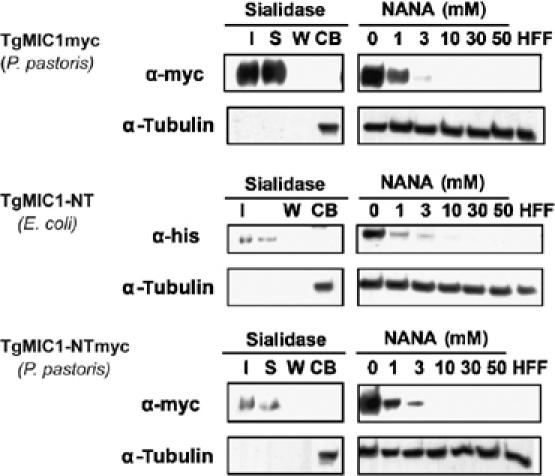
Sialic acid competes with TgMIC1 cell-binding activity. Cell binding competition experiments with sialic acid were performed on HFFs using supernatants of a P. pastoris culture expressing TgMIC1myc (top), bacterially produced HisTgMIC1-NT (middle) or a P. pastoris culture expressing TgMIC1-NTmyc (bottom). Anti-myc and anti-His antibodies were used as the probe for Western blots. Anti-tubulin antibodies were used as a control for equal amount of cell material used in the assay. For the competition experiments with sialic acid, only the cell-bound fractions are shown. In case of pretreatment of HFFs with neuraminidase, samples of input (I), supernatant (S), wash (W) and cell-binding fraction (CB) were run on each gel. These data confirm that TgMIC1 binds to sialic acid exposed receptors on HFF cells. Note: in all cell binding assays, the total volume of the input, supernatant and the wash is 500 μl, whereas the total volume of the cell-bound fraction is 50 μl. NANA, N-acetylneuraminic acid.
Figure 7
Figure 7
Characterization of the interaction of sialyl oligosaccharides with MAR domains and their involvement in host cell invasion. (A) 1H-15N 2D TROSY-HNCO (top) and 1H-15N 2D TROSY-HSQC (bottom) NMR spectra for 13C,15N-labelled Ala, Thr TgMIC1-NT, in the absence (black) and presence (red) of saturating amounts of an α-2,3-sialyl-N-acetyllactosamine. The assignments of the Thr126 and Thr220 were achieved using standard triple-resonance spectra. (B) Cell binding assays using supernatants of P. pastoris cultures expressing TgMIC1, TgMIC1-NT single (T126A and T220A) mutants, TgMIC1-NT double (T126A/T220A) mutant and a TgMIC1-NT C-terminal truncation mutant, lacking the ‘β-finger' (amino-acid residues 238–262). Note that all proteins produced in P. pastoris have a C-terminal myc tag. Anti-myc antibodies are used as the probe for Western blots. Cell-binding fractions are shown for each protein, together with α-tubulin as a control for equal amount of cell material used in the assay. Molecular weight markers in kDa. (C) Cell invasion assays using T. gondii RH parasites in the presence of sialic acid (NANA), lactose and galactose. Invasion assays were carried out in triplicates of two independent experiments. Numbers of intracellular parasites were counted in three microscopic fields. (D) Cell invasion assays using T. gondii RH parasites after pretreatment of target cells with neuraminidase. Four experiments were carried out in parallel. Numbers of intracellular parasites were counted in five microscopic fields.

References

    1. Acheson A, Sunshine J, Rutishauser U (1991) NCAM polysialic acid can regulate both cell–cell and cell–substrate interactions. J Cell Biol 114: 143–153 - PMC - PubMed
    1. Alphey MS, Attrill H, Crocker PR, van Aalten DMF (2003) High resolution crystal structures of Siglec-7. J Biol Chem 278: 3372–3377 - PubMed
    1. Bailey S (1994) The Ccp4 suite—programs for protein crystallography. Acta Crystallogr D 50: 760–763 - PubMed
    1. Brecht S, Carruthers VB, Ferguson DJP, Giddings OK, Wang G, Jakle U, Harper JM, Sibley LD, Soldati D (2001) The Toxoplasma micronemal protein MIC4 is an adhesin composed of six conserved apple domains. J Biol Che 276: 4119–4127 - PubMed
    1. Campanero-Rhodes MA, Childs RA, Kiso M, Komba S, Le Narvor C, Warren J, Otto D, Crocker PR, Feizi T (2006) Carbohydrate microarrays reveal sulphation as a modulator of siglec binding. Biochem Biophys Res Comm 344: 1141–1146 - PubMed

Publication types