


Total imprecision of exposure biomarkers: implications for calculating exposure limits
- PMID: 17492658
- PMCID: PMC2855962
- DOI: 10.1002/ajim.20474
Total imprecision of exposure biomarkers: implications for calculating exposure limits
Erratum in
- Am J Ind Med. 2008 Mar;51(3):229
Abstract
Background: Assessment of the imprecision of exposure biomarkers usually focuses on laboratory performance only. Unrecognized imprecision leads to underestimation of the true toxicity of the exposure. We have assessed the total imprecision of exposure biomarkers and the implications for calculation of exposure limits.
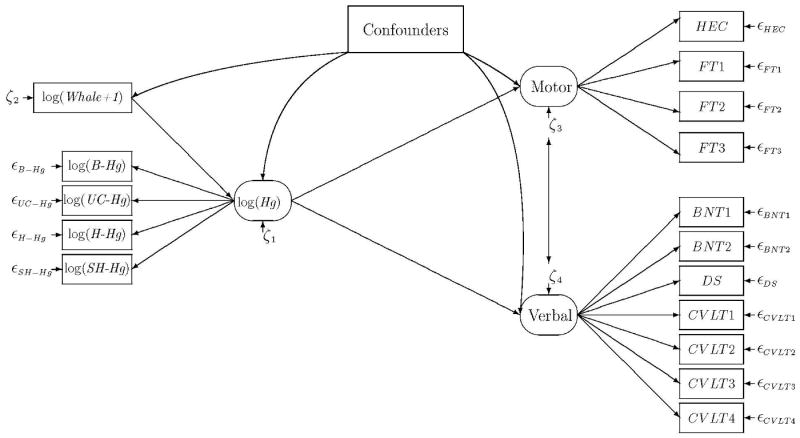
Methods: In a birth cohort study, mercury concentrations in cord blood, cord tissue, and maternal hair were used as biomarkers of prenatal methylmercury exposure. We determined their mutual correlations and their associations with the child's neurobehavioral outcome variables at age 7 years. With at least three exposure parameters available, factor analysis and structural equation modeling could be applied to determine the total imprecision of each biomarker. The estimated imprecision was then applied to adjust benchmark dose calculations and the derived exposure limits.
Results: The exposure biomarkers correlated well with one another, but the cord blood mercury concentration showed the best associations with neurobehavioral deficits. Factor analysis and structural equation models showed a total imprecision of the cord-blood parameter of 25-30%, and almost twice as much for maternal hair. These imprecisions led to inflated benchmark dose levels. Adjusted calculations resulted in an exposure limit 50% below the level recommended by the U.S. National Research Council.
Conclusions: The biomarker imprecisions of 25-50% much exceeded normal laboratory variability. Such imprecision causes underestimation of dose-related toxicity and therefore must be considered in the data analysis and when deriving exposure limits. Future studies should ideally include at least three exposure parameters to allow independent assessment of total imprecision.
(c) 2007 Wiley-Liss, Inc.
Figures
References
-
- Bollen KA. Structural equations with latent variables. New York: John Wiley; 1989.
-
- Bonini P, Plebani M, Ceriotti F, Rubboli F. Errors in laboratory medicine. Clin Chem. 2002;48:691–8. - PubMed
-
- Budtz-Jørgensen E, Keiding N, Grandjean P. Benchmark dose calculation from epidemiological data. Biometrics. 2001;57:698–706. - PubMed
-
- Budtz-Jørgensen E, Keiding N, Grandjean P, Weihe P, White RF. Consequences of exposure measurement error for confounder identification in environmental epidemiology. Stat Med. 2003;22:3089–3100. - PubMed
Publication types
MeSH terms
Substances
Grants and funding
LinkOut - more resources
Full Text Sources
