


Effect of insulin-metformin combination on hepatic steatosis in patients with type 2 diabetes
- PMID: 17493545
- PMCID: PMC1994788
- DOI: 10.1016/j.jdiacomp.2007.02.005
Effect of insulin-metformin combination on hepatic steatosis in patients with type 2 diabetes
Abstract
Objective: Hepatic steatosis occurs in up to 78% of patients with type 2 diabetes. Studies evaluating the effect of metformin on hepatic steatosis are conflicting. Insulin is believed to be detrimental due to its lipogenic effect. Since insulin-metformin combination is commonly used for the treatment of diabetes, it is important to assess the effect of this combined therapy on hepatic steatosis. We evaluated the change in hepatic steatosis following the initiation of insulin and metformin in patients with type 2 diabetes.
Methods: Newly diagnosed treatment-naïve patients with type 2 diabetes had their hepatic triglyceride (TG) content measured by magnetic resonance spectroscopy at baseline and after 3 months of treatment with BiAsp 30 insulin, in combination with metformin. Insulin was administered twice daily and titrated to achieve normal capillary blood glucose levels. Metformin was titrated during the first month from 500 mg daily to 1000 mg bid.
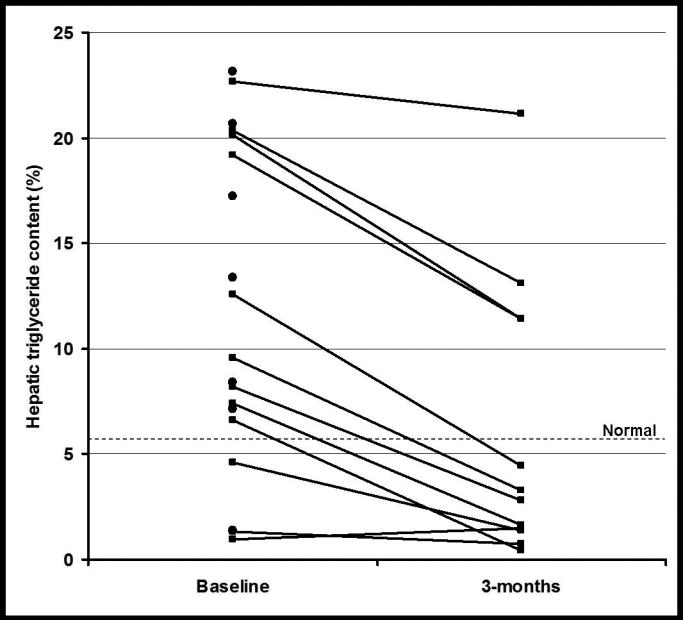
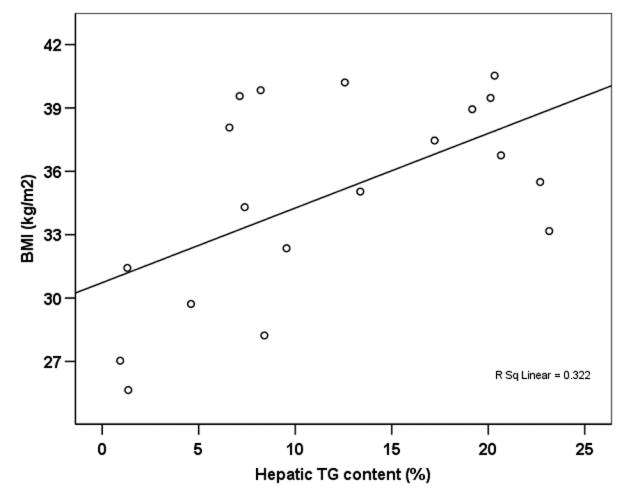
Results: The average hepatic TG content in 19 enrolled subjects was 11.83+/-7.61% (range, 0.93-23.16%) and correlated with body mass index (r=.567). Three months of treatment reduced hepatic steatosis by 45%, with 75% of the study subjects achieving a normal level. The change in hepatic TG content was partially explained by changes in HbA1c (P=.006) and cholesterol (P=.003) levels.
Conclusions: The combined treatment with insulin and metformin significantly reduced hepatic steatosis in patients with newly diagnosed type 2 diabetes.
Figures
References
-
- Luyckx FH, Lefebvre PJ, Scheen AJ. Non-alcoholic steatohepatitis: association with obesity and insulin resistance, and influence of weight loss. Diabetes & metabolism. 2000;26:98–106. - PubMed
-
- Browning JD, Szczepaniak LS, Dobbins R, Nuremberg P, Horton JD, Cohen JC, Grundy SM, Hobbs HH. Prevalence of hepatic steatosis in an urban population in the United States: impact of ethnicity. Hepatology (Baltimore, Md. 2004;40:1387–1395. - PubMed
-
- Toledo FG, Sniderman AD, Kelley DE. Influence of hepatic steatosis (fatty liver) on severity and composition of dyslipidemia in type 2 diabetes. Diabetes care. 2006;29:1845–1850. - PubMed
-
- Sheth SG, Gordon FD, Chopra S. Nonalcoholic steatohepatitis. Annals of internal medicine. 1997;126:137–145. - PubMed
-
- Marchesini G, Brizi M, Bianchi G, Tomassetti S, Zoli M, Melchionda N. Metformin in non-alcoholic steatohepatitis. Lancet. 2001;358:893–894. - PubMed
Publication types
MeSH terms
Substances
Grants and funding
LinkOut - more resources
Full Text Sources
Medical
Miscellaneous
