. 2007 May 15;104(20):8484-9.
doi: 10.1073/pnas.0610888104. Epub 2007 May 9.

Integrated network analysis identifies nitric oxide response networks and dihydroxyacid dehydratase as a crucial target in Escherichia coli

Affiliations

Integrated network analysis identifies nitric oxide response networks and dihydroxyacid dehydratase as a crucial target in Escherichia coli

Daniel R Hyduke et al. Proc Natl Acad Sci U S A. .

Abstract

Nitric oxide (NO) is used by mammalian immune systems to counter microbial invasions and is produced by bacteria during denitrification. As a defense, microorganisms possess a complex network to cope with NO. Here we report a combined transcriptomic, chemical, and phenotypic approach to identify direct NO targets and construct the biochemical response network. In particular, network component analysis was used to identify transcription factors that are perturbed by NO. Such information was screened with potential NO reaction mechanisms and phenotypic data from genetic knockouts to identify active chemistry and direct NO targets in Escherichia coli. This approach identified the comprehensive E. coli NO response network and evinced that NO halts bacterial growth via inhibition of the branched-chain amino acid biosynthesis enzyme dihydroxyacid dehydratase. Because mammals do not synthesize branched-chain amino acids, inhibition of dihydroxyacid dehydratase may have served to foster the role of NO in the immune arsenal.


Conflict of interest statement

The authors declare no conflict of interest.

Figures
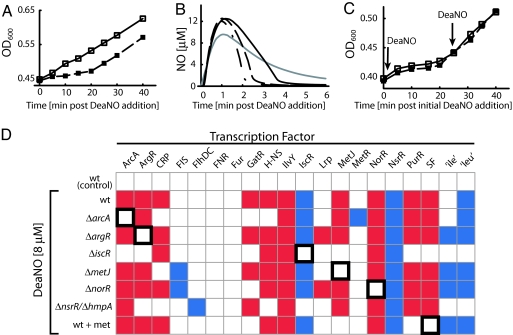
Fig. 1.
Fig. 1.
Phenotypic and regulatory response of E. coli to NO. (A) Exposure to 8 μM DeaNO (■) induces bacteriostasis in the WT relative to the control (□). (B) After an initial exposure to 8 μM DeaNO (——), the WT consumes NO more rapidly when exposed to additional doses of DeaNO at 10 min (— — —) and 20 min (— - — -). The gray line indicates NO release and degradation in the absence of E. coli. (C) Treatment of E. coli with 8 μM DeaNO induces resistance to subsequent DeaNO exposure. Treatment with a single dose of DeaNO induces bacteriostasis for ≈20 min (□). After recovery from bacteriostasis induced by 8 μM DeaNO, a subsequent dose of DeaNO does not induce an additional occurrence of bacteriostasis (■). (D) The regulatory network response to DeaNO is shown. NCA identifies TFs with activity significantly (P < 0.01 vs. random network) increased (red squares) or decreased (blue squares) when E. coli is exposed to 8 μM DeaNO for 5 min. The bolded box indicates expected results from TF deletion. For each condition, at least four biological replicate transcriptome measurements were taken.
Fig. 2.
Fig. 2.
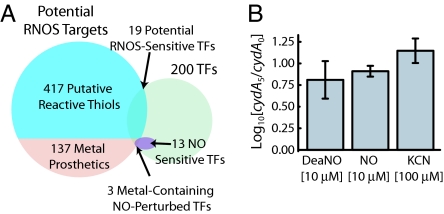
Identification of the modes of RNOS chemistry that interact with genomic program of E. coli after exposure to DeaNO. (A) Chemoinformatic analysis of proteome of E. coli indicates that there are 554 potential RNOS-reactive sites. Of these sites, 417 are thiols and 137 are heme, nonheme iron, Fe–S clusters, or copper. Of the 13 NO-sensitive TFs, three contain NO-reactive metal prosthetics. (B) ArcA is activated in response to DeaNO exposure. Addition of cytochrome oxidase inhibitors (DeaNO, NO, KCN) increases the expression of cydA, a reporter gene for the ArcAB two-component system.
Fig. 3.
Fig. 3.
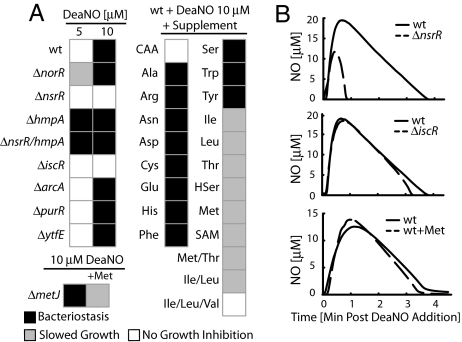
Phenotypic identification of the essential components of the bacteriostatic response and their impact on NO consumption. (A) The effect of NO-sensitive TF deletions and AA supplementation on NO-induced bacteriostasis. The change in the response to DeaNO mediated by the genetic deletion of the regulators IscR, NorR, and NsrR indicates that their regulons are involved in the response to NO. The alleviation of growth inhibition by BCAA, Met, and their precursors indicates that AA depletion is a key symptom of the offensive actions of NO. Deletion of hmpA in conjunction with nsrR indicates that NsrR combats bacteriostasis via regulation of hmpA expression. CAA, Casamino acids; HSer, homoserine; SAM, S-adenosylmethionine. (B) Deletion of NsrR strongly increases the ability of E. coli to consume NO, indicating that it plays a key role in regulating NO consumption. Deletion of iscR or supplementation with Met does not increase NO consumption, indicating that their roles may be related to secondary effects arising from the interaction of NO with E. coli.
Fig. 4.
Fig. 4.
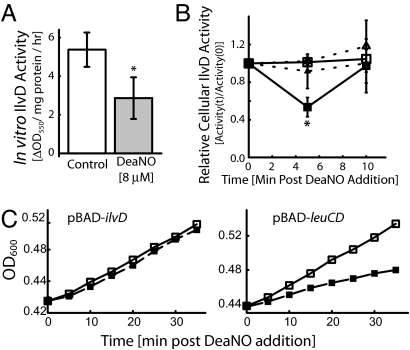
DeaNO induces bacteriostasis by damaging the Fe–S cluster of IlvD. (A) DeaNO inhibits the activity of IlvD, a central enzyme required for BCAA biosynthesis, in crude cell extracts. The values are means ± SD (n = 7). ∗, Significantly (P < 0.01, Wilcoxon Mann–Whitney two-sided test) different from the control activity. (B) Deletion of iscR protects IlvD from inhibition by DeaNO. DeaNO (8 μM) temporally decreases WT IlvD activity (■) relative to the control (□). Deletion of iscR reduces the impact of DeaNO on IlvD activity (▴) relative to the control (▵). The values are means ± SD. (n = 3–4). ∗, Significantly (P < 0.05, Wilcoxon Mann–Whitney two-sided test) different from activity at 0 min. (C) Overexpression of IlvD confers resistance to DeaNO-induced bacteriostasis. Whereas overexpression of LeuCD, an Fe–S enzyme crucial for Leu biosynthesis, does not. Transformants containing the inducible vectors for ilvD (pBAD-ilvD) and leuCD (pBAD-leuCD) were grown in Mops/0.2% fructose with 0.1 mM arabinose to induce expression and were either exposed to cold buffer (□) or 20 μM DeaNO (■).
Fig. 5.
Fig. 5.
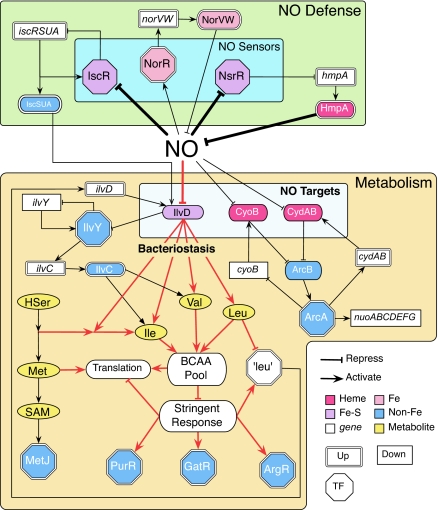
The essential NO response network of E. coli. The network can be divided into two key categories: the metabolic targets and the defense system. The metabolic targets include IlvD and cytochromes. NO inhibits bacterial growth by targeting IlvD, an essential BCAA biosynthesis enzyme. BCAA depletion results in a halt in translation and activates the stringent response. NO also induces a shift in the respiratory system by inhibiting cytochrome bo and bd oxidase. The defense system contains modules for NO detoxification and repair of critical damage; these modules are regulated by proteins that directly sense NO (IscR, NsrR, NorR). NsrR mediates the expression of the aerobic NO detoxification system, NorR controls anaerobic NO detoxification, and IscR controls expression of the Fe–S repair system.

References

    1. MacMicking J, Xie QW, Nathan C. Annu Rev Immunol. 1997;15:323–350. - PubMed
    1. Fang FC. Nat Rev Microbiol. 2004;2:820–832. - PubMed
    1. Ignarro LJ. Nitric Oxide: Biology and Pathobiology. San Diego: Academic; 2000.
    1. Soum E, Drapier JC. J Biol Inorg Chem. 2003;8:226–232. - PubMed
    1. Cruz-Ramos H, Crack J, Wu G, Hughes MN, Scott C, Thomson AJ, Green J, Poole RK. EMBO J. 2002;21:3235–3244. - PMC - PubMed

Publication types

MeSH terms

Associated data