


Adult aural rehabilitation: what is it and does it work?
- PMID: 17494873
- PMCID: PMC4111411
- DOI: 10.1177/1084713807301073
Adult aural rehabilitation: what is it and does it work?
Abstract
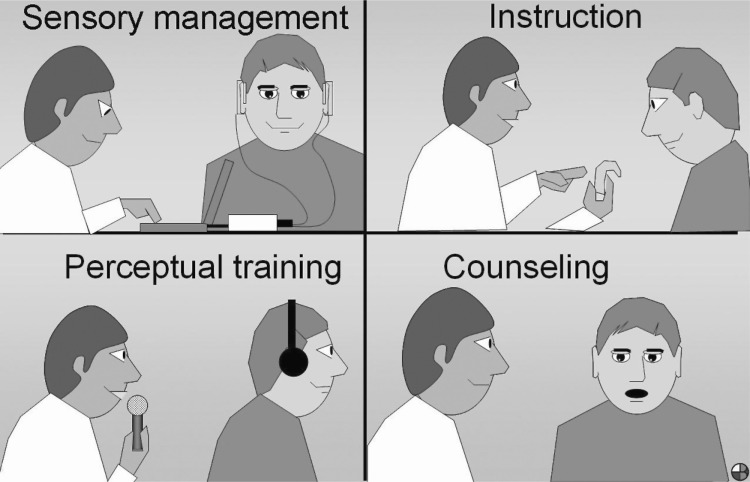
Adult aural rehabilitation is here defined holistically as the reduction of hearing-loss-induced deficits of function, activity, participation, and quality of life through a combination of sensory management, instruction, perceptual training, and counseling. There is a tendency for audiologists to focus on sensory management, aural rehabilitation being seen as something done by someone else after the provision of hearing aids or cochlear implants. Effective sensory management may, by itself, lead to improved activity, participation, and quality of life, but there is no guarantee that these outcomes will be automatic or optimal. In fact, there is often a disconnect between clinical measures of assisted auditory function and self-assessed benefit. Costs associated with a holistic approach can be minimized by bundling as many as possible into the cost of hearing devices, by taking advantage of computer-based perceptual training, and by capitalizing on the benefits of group counseling.
Figures

References
-
- WHO International Classification of Functioning, Disability, and Health (ICF). Geneva, Switzerland: World Health Organization; 2001
-
- WHO International Classification of Impairments, Disabilities, and Handicaps. Geneva, Switzerland: World Health Organization; 1980
-
- Kros CJ. How to build an inner hair cell: challenges for regeneration. Hear Res. In press. - PubMed
-
- White PM, Doetzlhofer A, Lee YS, Groves AK, Segil N. Mammalian cochlear supporting cells can divide and trans-differentiate into hair cells. Nature. 2006;441: 984–987 - PubMed
-
- Boothroyd A. Hearing aid accessories for adults: the remote FM microphone. Ear Hearing. 2004;25: 22–23 - PubMed
Publication types
MeSH terms
LinkOut - more resources
Full Text Sources
Other Literature Sources
Medical