. 2007 Jul 1;582(Pt 1):379-92.
doi: 10.1113/jphysiol.2007.130906. Epub 2007 May 10.

Sweet taste receptors in rat small intestine stimulate glucose absorption through apical GLUT2

Affiliations

Sweet taste receptors in rat small intestine stimulate glucose absorption through apical GLUT2

Oliver J Mace et al. J Physiol. .

Erratum in

  • J Physiol. 2007 Aug 15;583(Pt 1):411

Abstract

Natural sugars and artificial sweeteners are sensed by receptors in taste buds. T2R bitter and T1R sweet taste receptors are coupled through G-proteins, alpha-gustducin and transducin, to activate phospholipase C beta2 and increase intracellular calcium concentration. Intestinal brush cells or solitary chemosensory cells (SCCs) have a structure similar to lingual taste cells and strongly express alpha-gustducin. It has therefore been suggested over the last decade that brush cells may participate in sugar sensing by a mechanism analogous to that in taste buds. We provide here functional evidence for an intestinal sensing system based on lingual taste receptors. Western blotting and immunocytochemistry revealed that all T1R members are expressed in rat jejunum at strategic locations including Paneth cells, SCCs or the apical membrane of enterocytes; T1Rs are colocalized with each other and with alpha-gustducin, transducin or phospholipase C beta2 to different extents. Intestinal glucose absorption consists of two components: one is classical active Na+-glucose cotransport, the other is the diffusive apical GLUT2 pathway. Artificial sweeteners increase glucose absorption in the order acesulfame potassium approximately sucralose > saccharin, in parallel with their ability to increase intracellular calcium concentration. Stimulation occurs within minutes by an increase in apical GLUT2, which correlates with reciprocal regulation of T1R2, T1R3 and alpha-gustducin versus T1R1, transducin and phospholipase C beta2. Our observation that artificial sweeteners are nutritionally active, because they can signal to a functional taste reception system to increase sugar absorption during a meal, has wide implications for nutrient sensing and nutrition in the treatment of obesity and diabetes.


Figures
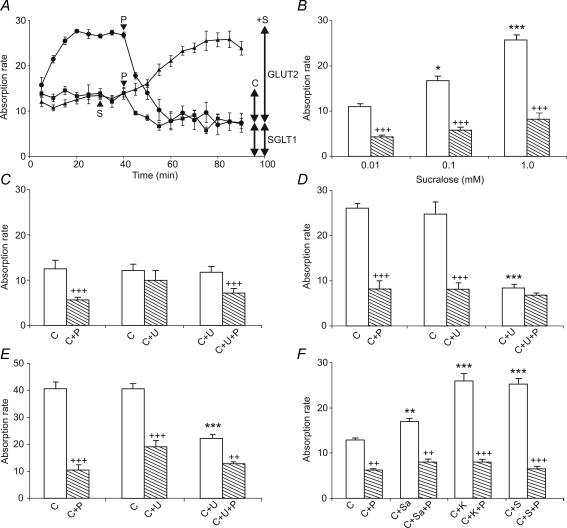
Figure 1
Figure 1. Artificial sweeteners and glucose stimulate glucose absorption
A, effect on 20 mm glucose absorption of sucralose (▴, 1 mm, S arrowhead) added at 30 min and of phloretin added at 40 min (▪, 1 mm P arrowhead): effect on sucralose-stimulated glucose absorption (0–40 min) of phloretin added at 40 min (▪). B, concentration dependence of stimulation of glucose absorption by sucralose; 20 mm glucose and sucralose were perfused in the absence (formula image, 0–40 min) and presence (formula image, 40–80 min) of 1 mm phloretin. CE, role of PLC β2 for (C) 20 mm glucose (C), (D) 20 mm glucose + 1 mm sucralose (C) and (E) 75 mm glucose (C); open bar perfusion for 0–40 min versus hatched bar for 40–80 min; U, 10 μm U-73122; P, 1 mm phloretin. F, comparison of effects of sucralose (S), acesulfame potassium (K) and saccharin (Sa) on the components of 20 mm glucose absorption (C) determined after addition of phloretin (P) at 40 min. Absorption rate in μmol min−1 (g dry weight)−1; values are means ±s.e.m, n= 4–6 for each condition. Student's t test: unpaired comparison for different perfusions, open bar for experiment with open bar for control (C only): *P < 0.05, **P < 0.01, ***P < 0.001, paired comparison within the same perfusion; hatched bar with adjoining open bar, +P < 0.05, ++P < 0.01, +++P < 0.001.
Figure 2
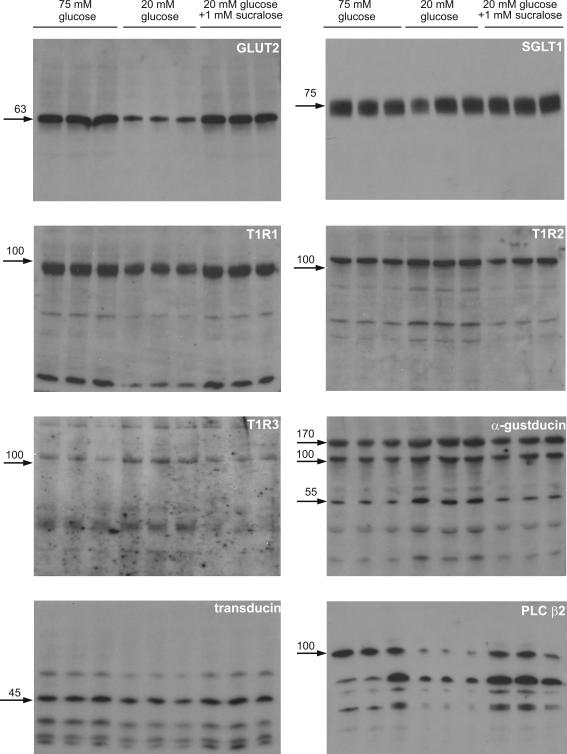
Figure 2. Regulation of transporters and taste reception signalling components by glucose and sucralose detected in Western blots of apical membrane vesicles
Apical membrane vesicles were prepared from rat jejunum perfused in vivo for 20 min with 75 mm glucose, 20 mm glucose or 20 mm glucose + 1 mm sucralose. Vesicle protein (20 μg) was then separated by SDS-PAGE (10% gels), transblotted on to PVDF and Western blotted for signalling components. All bands for a given protein were abolished by preincubation of antibody with excess cognate peptide; peptides were not available for T1R1 and T1R3 (data not shown).
Figure 3
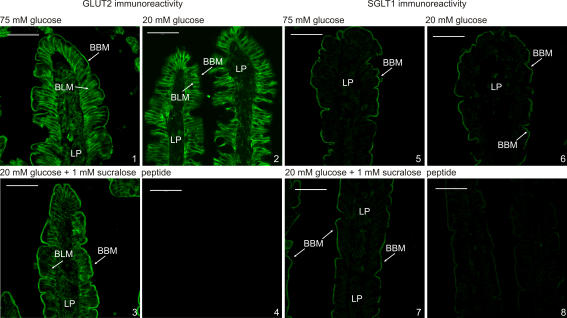
Figure 3. Immunocytochemistry of the regulation of apical GLUT2 and SGLT1
Extracellular loop antibody was used to detect apical GLUT2 in the brush-border (BBM) and basolateral (BLM) membranes of perfused rat jejunum using fluorescein isothiocyanate (FITC)-conjugated secondary antibody. Apical GLUT2 was increased at 75 mm glucose and by sucralose at 20 mm glucose compared with 20 mm glucose alone. There was no significant alteration of SGLT1 between the different conditions. Both peptide controls were performed with vesicles prepared at 75 mm glucose. LP, lamina propria.
Figure 4
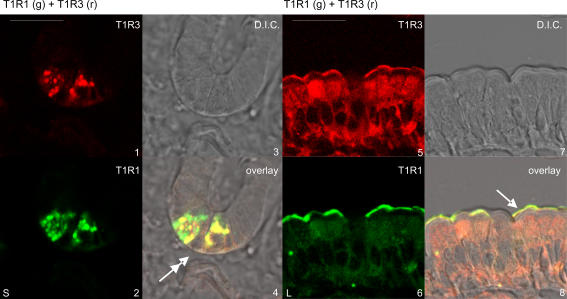
Figure 4. Demonstration of the localization of taste receptors in Paneth cells and in enterocyte apical membrane
T1R1 in green (g), T1R3 in red (r), differential interference contrast (DIC). Double-headed arrow, Paneth cells; single-headed arrow, brush-border membrane. L, low 20 mm glucose; S, 20 mm glucose + 1 mm sucralose. Scale bar, 50 μm. Note that these images were not taken using spectral unmixing, so that DIC images could be used to confirm localization (see Methods).
Figure 5
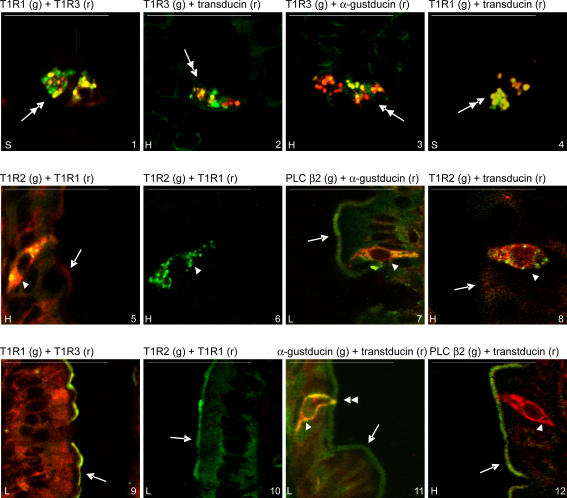
Figure 5. Colocalization of taste reception signalling components in rat jejunum
Double-headed arrow, Paneth cells located at the very bottom of the crypt as shown in image 4 of Figure 4; single-headed arrow, brush-border membrane; single arrow-head, chemosensory cells (SCCs); double arrow-head, SCC tip in brush-border membrane. Colour labelling: green, g; red, r. H, high 75 mm glucose; L, low 20 mm glucose; S, 20 mm glucose + 1 mm sucralose. Scale bar, 50 μm. Localization of images 1–4 is made by reference to the overlay image in Figure 4 (see text and Methods).
Figure 6
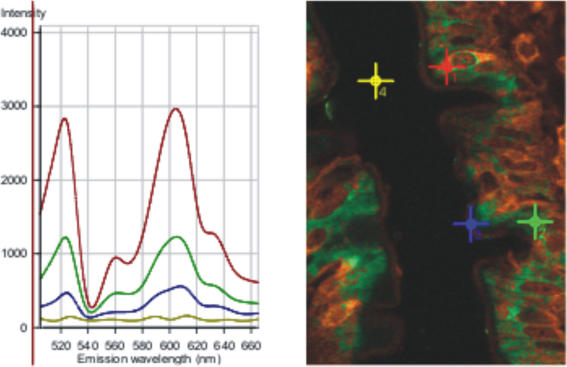
Figure 6. Spectral analysis of the cytosolic and apical membrane colocalization of a-gustducin and transducin
The section was prepared from jejunum perfused with 75 mm glucose. See text for detailed explanation.

References

    1. Adler E, Hoon MA, Mueller KL, Chandrashekar J, Ryba NJ, Zuker CS. A novel family of mammalian taste receptors. Cell. 2000;100:693–702. - PubMed
    1. Affleck J, Helliwell PA, Kellett GL. Immunocytochemical detection of GLUT2 at the rat intestinal brush-border membrane. J Histochem Cytochem. 2003;51:1567–1574. - PMC - PubMed
    1. Ahonen A, Penttila A. Effects of fasting and feeding and pilocarpine on paneth cells of the mouse. Scand J Gastroenterol. 1975;10:347–352. - PubMed
    1. Au A, Gupta A, Schembri P, Cheeseman CI. Rapid insertion of GLUT2 into the rat jejunal brush-border membrane promoted by glucagon-like peptide 2. Biochem J. 2002;367:247–254. - PMC - PubMed
    1. Baba R, Yamami M, Sakuma Y, Fujita M, Fujimoto S. Relationship between glucose transporter and changes in the absorptive system in small intestinal absorptive cells during the weaning process. Med Mol Morphol. 2005;38:47–53. - PubMed

Publication types

MeSH terms