. 2007 Jul;189(14):5193-202.
doi: 10.1128/JB.00330-07. Epub 2007 May 11.

Identical, independent, and opposing roles of ppGpp and DksA in Escherichia coli

Affiliations

Identical, independent, and opposing roles of ppGpp and DksA in Escherichia coli

Lisa U Magnusson et al. J Bacteriol. 2007 Jul.

Abstract

The recent discovery that the protein DksA acts as a coregulator of genes controlled by ppGpp led us to investigate the similarities and differences between the relaxed phenotype of a ppGpp-deficient mutant and the phenotype of a strain lacking DksA. We demonstrate that the absence of DksA and ppGpp has similar effects on many of the observed phenotypes but that DksA and ppGpp also have independent and sometimes opposing roles in the cell. Specifically, we show that overexpression of DksA can compensate for the loss of ppGpp with respect to transcription of the promoters P(uspA), P(livJ), and P(rrnBP1) as well as amino acid auxotrophy, cell-cell aggregation, motility, filamentation, and stationary phase morphology, suggesting that DksA can function without ppGpp in regulating gene expression. In addition, ppGpp and DksA have opposing effects on adhesion. In the course of our analysis, we also discovered new features of the relaxed mutant, namely, defects in cell-cell aggregation and motility.


Figures
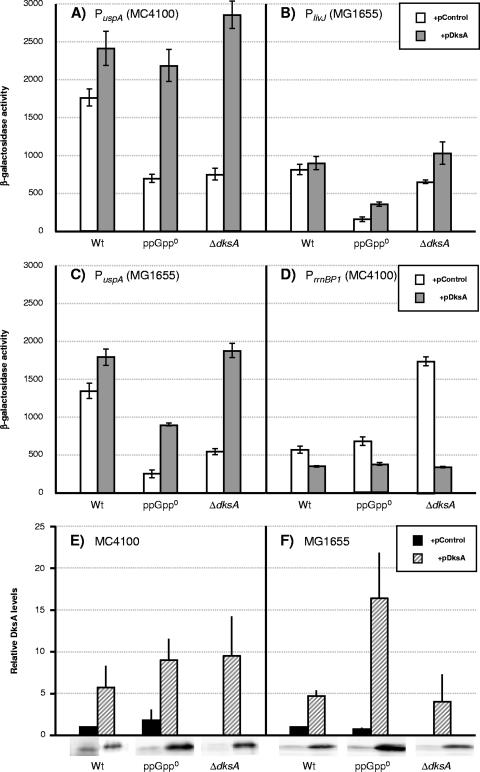
FIG. 1.
FIG. 1.
Overproduction of DksA can compensate for the lack of ppGpp in regulating uspA, livJ and rrnBP1. (A to D) Gene expression measured as β-galactosidase activity in overnight cultures of reporter strains. Cultures were grown in M9 defined medium including glucose, amino acids, and thiamine supplemented with carbenicillin. (A) PuspA-lacZ (MC4100 background). The strains used are LM659, LM571, PJ13, PJ14, BG144, and PJ11. (B) PlivJ-lacZ. The strains used are BG143, LM576, LM663, BG154, BG146, and BG147. (C) PuspA-lacZ (MG1655 background). The strains used are LM671, LM669, LM699, LM700, LM701 and LM702. (D) PrrnBP1-lacZ. The strains used are LM683, LM574, LM661, BG155, BG145, and PJ12. (E) Western blot analysis of the levels of DksA in an MG1655 background. The strains used are LM659, LM571, PJ13, PJ14, BG144, and PJ11. (F) Western blot analysis of the levels of DksA in an MG1655 background. The strains used are PJ1, LM569, LM667, LM657, LM694 and LM624. Wt, wild type.
FIG. 2.
FIG. 2.
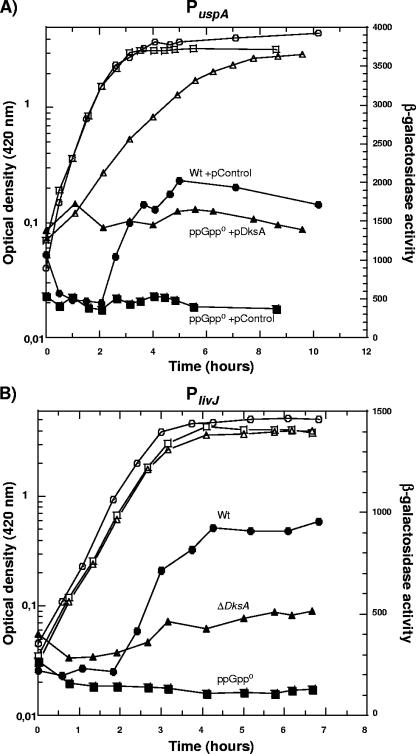
(A) Overproduction of DksA can compensate for the lack of ppGpp in regulating uspA. Growth curve (open symbols) and gene expression (closed symbols) measured as β-galactosidase activity from PuspA-lacZ (MC4100 background) in M9 defined medium including glucose, amino acids, and thiamine supplemented with carbenicillin. The strains used are LM659 (circles), PJ13 (squares), and PJ14 (triangles). (B) Deletion of DksA causes a reduction in expression of livJ but not to the same extent as a deficiency in ppGpp production. Growth curve and gene expression measured as β-galactosidase activity from PlivJ-lacZ in M9 defined medium including glucose, amino acids, and thiamine supplemented with antibiotics when appropriate. The strains used are RLG4422 (circles), BG152 (squares), and LM608 (triangles). Relevant genotypes of the strains used are listed in Table 1. Wt, wild type.
FIG. 3.
FIG. 3.
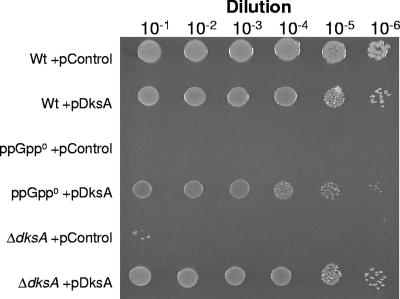
DksA overproduction suppresses amino acid auxotrophy of an MC4100 ppGpp0 mutant. Suppression of the amino acid auxotrophy of the ppGpp0 and ΔdksA strains by overproduction of DksA. Ten microliters of serial dilutions of overnight cultures was spotted on minimal medium plates. Plates were incubated overnight at 37°C and for an additional 24 h at room temperature. The strains used are LM659, LM571, PJ13, PJ14, BG144, and PJ11. Relevant genotypes of the strains used are listed in Table 1.
FIG. 4.
FIG. 4.
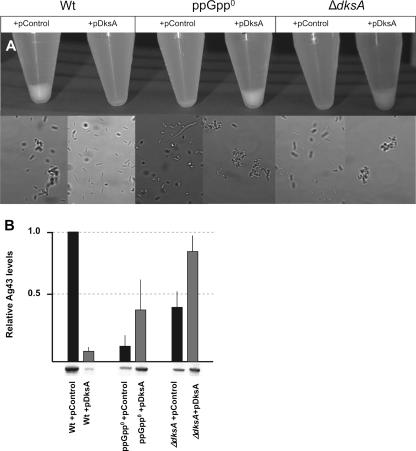
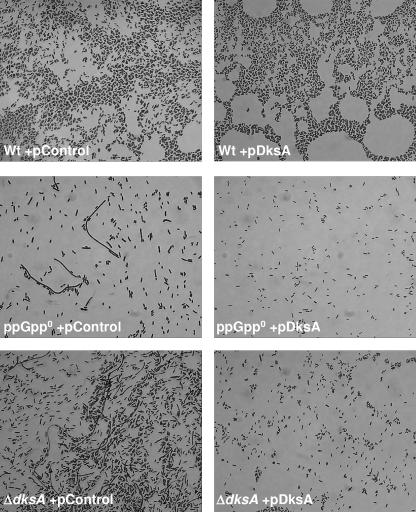
ppGpp and DksA affect cellular autoaggregation. Overnight cultures were vigorously shaken and subsequently incubated statically at room temperature. (A) The top panel shows the cell settling state of each strain after 2 h. For the experiment shown in the lower panel, an aliquot of each culture was taken at the beginning of the assay for microscopic observation. Images were captured with a magnification of ×1,000, and representative data are shown. The strains used are PJ1, LM569, LM667, LM657, LM694, and LM624. Relevant genotypes of the strains used are listed in Table 1. (B) Ag43 production. For each strain, the equivalent of 0.2 OD600 unit of an overnight culture was analyzed by Western blotting and immunodetection using a polyclonal rabbit antiserum raised against the α-domain of Ag43. Quantification of the signal in the upper panel is normalized to the wild type, and the Western blot is shown below.
FIG. 5.
FIG. 5.
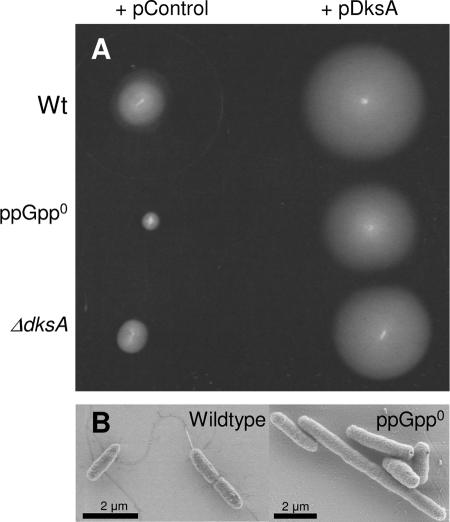
DksA overproduction rescues the motility defect of ppGpp0 cells. Effect of dksA and relA spoT mutations as well as DksA overproduction on cell motility and flagella expression in wild type and ppGpp0. (A) Low-agar plates (0.3%) were inoculated with each strain as indicated. The halo of growing motile cells was observed after a 24-h incubation at room temperature. The strains used are PJ1, LM569, LM667, LM657, LM694, and LM624. (B) Detection of flagella by scanning electron microscopy. The relevant genotype of the observed strain is indicated in each panel; the strains used are MG1655 and KK371. Relevant genotypes of the strains used are listed in Table 1.
FIG. 6.
FIG. 6.
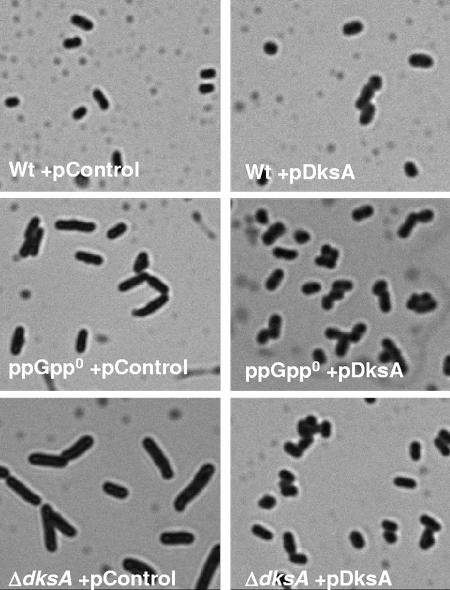
Filamentation of both ppGpp0 and ΔdksA mutants can be suppressed by overproduction of DksA. Cells were grown on LB plates overnight, resuspended in water, dried on glass slides, stained with crystal violet for 6 min, and destained with water. Photomicrography was performed with a Leica DMRXA microscope. Images were captured at a magnification of ×1,000. Representative panels are shown. In all the aliquots tested similar proportions of filaments were observed in the ppGpp0 and ΔdksA strains with control plasmids, while no filaments were observed in the corresponding strains overproducing DksA. The strains used are PJ1, LM569, LM667, LM657, LM694, and LM624. Relevant genotypes of the strains used are listed in Table 1.
FIG. 7.
FIG. 7.
Failure of both ppGpp0 and ΔdksA mutants to acquire the coccoid form in stationary phase can be suppressed by overproduction of DksA. Cells were grown 2 h into stationary phase in liquid LB medium, dried on glass slides, stained with crystal violet for 6 min, and destained with water. Photomicrography was performed with a Leica DMRXA microscope. Images were captured at a magnification of ×1,000, and representative panels are shown. Less pronounced morphological differences were observed also in overnight cultures (data not shown). The strains used are PJ1, LM569, LM667, LM657, LM694, and LM624. Relevant genotypes of the strains used are listed in Table 1.
FIG. 8.
FIG. 8.
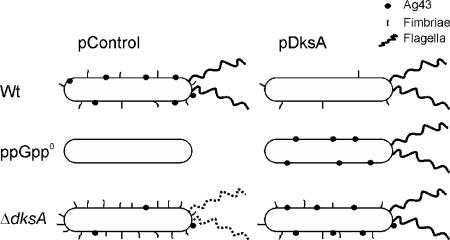
The surface features of wild-type, ppGpp0, and ΔdksA strains. A summary of the surface features (Ag43, fimbriae, and flagella) of the three strains and the effect of overproducing DksA are shown. Both the ppGpp0 and ΔdksA strains express lower levels of Ag43 than wild type and are nonmotile. The dotted flagella on the ΔdksA mutant indicate the failure to move on motility agar even though the presence or absence of flagella has not been confirmed. Overexpression of DksA can restore wild-type surface structures of the ΔdksA strain and also to some extent of the ppGpp0 strain except in fimbriation, where ppGpp and DksA have opposite effects.

References

    1. Aberg, A., V. Shingler, and C. Balsalobre. 2006. (p)ppGpp regulates type 1 fimbriation of Escherichia coli by modulating the expression of the site-specific recombinase FimB. Mol. Microbiol. 60:1520-1533. - PubMed
    1. Albertson, N. H., and T. Nystrom. 1994. Effects of starvation for exogenous carbon on functional mRNA stability and rate of peptide chain elongation in Escherichia coli. FEMS Microbiol. Lett. 117:181-187. - PubMed
    1. Artsimovitch, I., V. Patlan, S. Sekine, M. N. Vassylyeva, T. Hosaka, K. Ochi, S. Yokoyama, and D. G. Vassylyev. 2004. Structural basis for transcription regulation by alarmone ppGpp. Cell 117:299-310. - PubMed
    1. Barker, M. M., T. Gaal, C. A. Josaitis, and R. L. Gourse. 2001. Mechanism of regulation of transcription initiation by ppGpp. I. Effects of ppGpp on transcription initiation in vivo and in vitro. J. Mol. Biol. 305:673-688. - PubMed
    1. Brown, L., D. Gentry, T. Elliott, and M. Cashel. 2002. DksA affects ppGpp induction of RpoS at a translational level. J. Bacteriol. 184:4455-4465. - PMC - PubMed

Publication types

MeSH terms

LinkOut - more resources