. 2007 Jul;189(14):5060-7.
doi: 10.1128/JB.00131-07. Epub 2007 May 11.

CfaD-dependent expression of a novel extracytoplasmic protein from enterotoxigenic Escherichia coli

Affiliations

CfaD-dependent expression of a novel extracytoplasmic protein from enterotoxigenic Escherichia coli

M Carolina Pilonieta et al. J Bacteriol. 2007 Jul.

Abstract

H10407 is a strain of enterotoxigenic Escherichia coli (ETEC) that utilizes CFA/I pili to adhere to surfaces of the small intestine, where it elaborates toxins that cause profuse watery diarrhea in humans. Expression of the CFA/I pilus is positively regulated at the level of transcription by CfaD, a member of the AraC/XylS family. DNase I footprinting revealed that the activator has two binding sites upstream of the pilus promoter cfaAp. One site extends from positions -23 to -56, and the other extends from positions -73 to -103 (numbering relative to the transcription start site of cfaAp). Additional CfaD binding sites were predicted within the genome of H10407 by computational analysis. Two of these sites lie upstream of a previously uncharacterized gene, cexE. In vitro DNase I footprinting confirmed that both sites are genuine binding sites, and cexEp::lacZ reporters demonstrated that CfaD is required for the expression of cexE in vivo. The amino terminus of CexE contains a secretory signal peptide that is removed during translocation across the cytoplasmic membrane through the general secretory pathway. These studies suggest that CexE may be a novel ETEC virulence factor because its expression is controlled by the virulence regulator CfaD, and its distribution is restricted to ETEC.


Figures
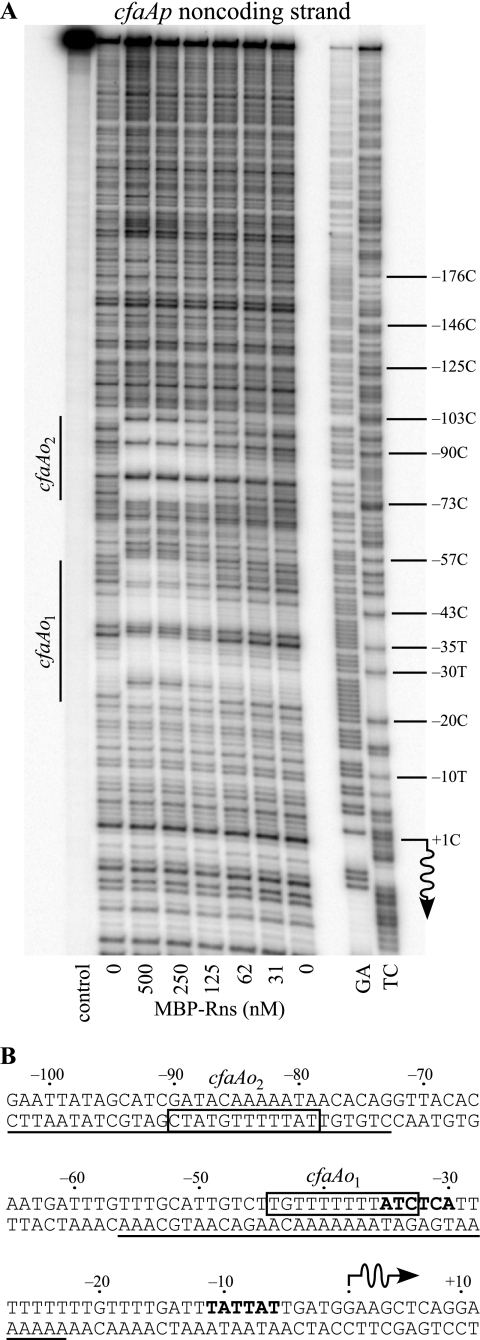
FIG. 1.
FIG. 1.
Locations of CfaD/Rns binding sites upstream of the CFA/I pilus promoter, cfaAp. Numbering is relative to the CfaD-dependent transcription start site of cfaAp, whose location is indicated by a wavy arrow. (A) DNase I protection of MBP-Rns bound to the noncoding strand of cfaAp. CfaD/Rns binding sites are indicated as cfaAo1 and cfaAo2. DNase I was not added to the DNA in the lane labeled control. Lanes labeled GA and TC contain Maxam-Gilbert sequencing ladders. (B) Sequence of cfaAp and upstream region. The underlined sequence indicates the extent of MBP-Rns DNase I footprints on the noncoding strand. Boxed sequences indicate nucleotides that are conserved among various CfaD/Rns binding sites. Probable −35 and −10 hexamers are shown in boldface type.
FIG. 2.
FIG. 2.
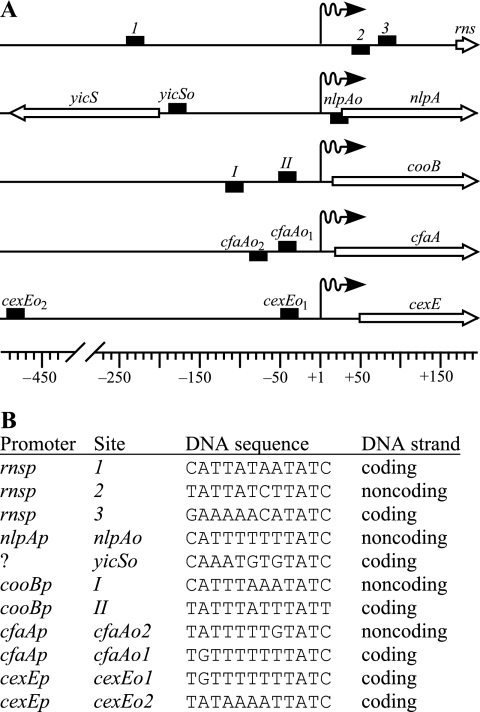
Positions and alignment of CfaD/Rns binding sites. (A) CfaD/Rns binding sites are represented as filled rectangles. The position of the rectangle above or below the line indicates whether the conserved sequence occurs on the coding or noncoding strand, respectively. Numbering is relative to the transcription start sites, which are represented by wavy arrows. ETEC promoters rnsp, cooBp (CS1 pilus), cfaAp (CFA/I pilus), and cexEp are activated by Rns or CfaD. In contrast, nlpA is common to both ETEC and K-12 strains and its promoter, nlpAp, is repressed by Rns or CfaD. It is not known if the occupancy of binding site yicSo affects expression from yicS. (B) Optimal alignment of the conserved core sequence of each CfaD/Rns binding site. Although CfaD and Rns may contact DNA beyond the nucleotides shown, the greatest sequence conservation occurs within this core of 12 bp.
FIG. 3.
FIG. 3.
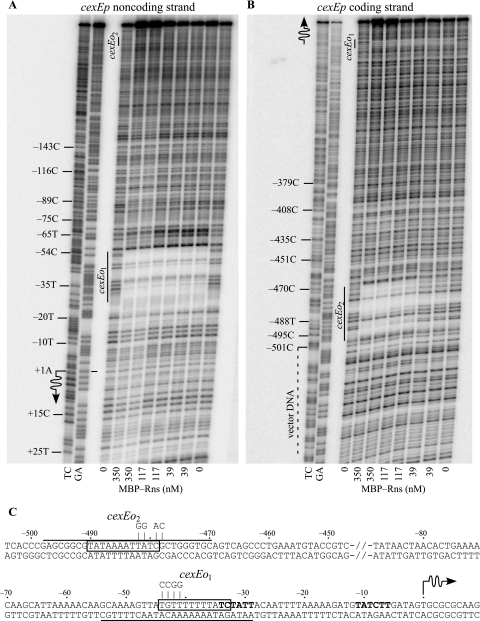
Locations of CfaD/Rns binding sites upstream of cexEp. Numbering is relative to the transcription start site of cexEp, whose location is indicated by a wavy arrow. DNase I protection of MBP-Rns bound to the (A) noncoding and (B) coding strands of cexEp. CfaD/Rns binding sites are indicated as cexEo1 and cexEo2. Lanes labeled GA and TC contain Maxam-Gilbert sequencing ladders. (C) Sequence of cexEp and upstream region. The underlined sequence indicates the extent of MBP-Rns DNase I footprints on the noncoding or coding strand. Boxed sequences indicate nucleotides that are conserved among various CfaD/Rns binding sites. Probable −35 and −10 hexamers are shown in boldface type. Point mutations, shown above each binding site, were introduced into cexEo1 and cexEo2 so that the function of each site could be evaluated in vivo.
FIG. 4.
FIG. 4.
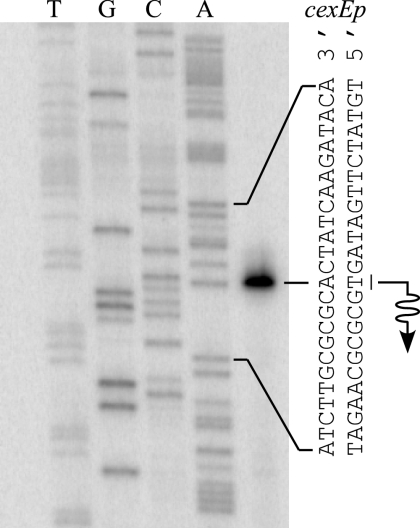
Transcription start site of cexEp. Primer extension was used to map the Rns-independent transcription start site of cexEp with reverse transcriptase and RNA harvested from strain GPM1070/ pGPMRns (Rns+) growing logarithmically in LB medium. A dideoxy chain-terminated sequencing ladder was generated with the same primer used for reverse transcription. The first nucleotide of the cexE mRNA is underlined, and the wavy arrow indicates the direction of transcription.
FIG. 5.
FIG. 5.
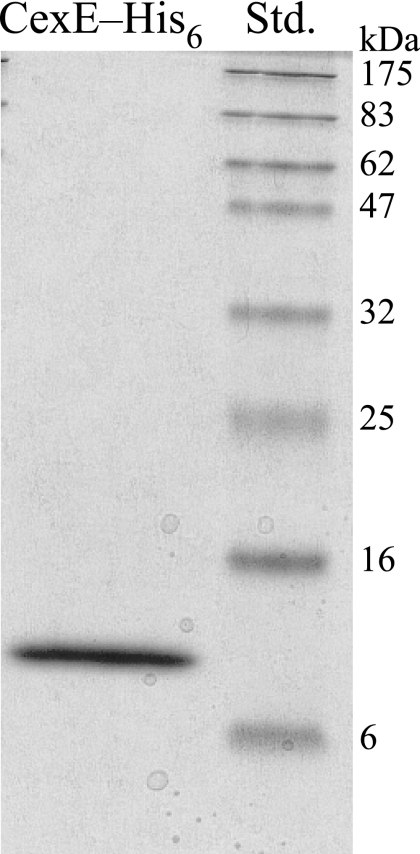
Coomassie-stained sodium dodecyl sulfate-polyacrylamide gel of purified CexE-His6. CexE-His6 was purified from the culture medium of an E. coli strain expressing the fusion protein by immobilized metal ion affinity chromatography. The amino terminus of the purified protein was determined to be “GGGNSERPPS” by Edman degradation, demonstrating that the amino terminus of CexE contains a signal peptide and that its first 19 amino acids are removed during translocation from the cytoplasm. The expected molecular mass of CexE-His6 after removal of its signal peptide is 11.7 kDa. Std., protein standards.

References

    1. Ames, G. F., C. Prody, and S. Kustu. 1984. Simple, rapid, and quantitative release of periplasmic proteins by chloroform. J. Bacteriol. 160:1181-1183. - PMC - PubMed
    1. Bendtsen, J. D., H. Nielsen, G. von Heijne, and S. Brunak. 2004. Improved prediction of signal peptides: SignalP 3.0. J. Mol. Biol. 340:783-795. - PubMed
    1. Bodero, M. D., M. C. Pilonieta, and G. P. Munson. 2007. Repression of the inner membrane lipoprotein NlpA by Rns in enterotoxigenic Escherichia coli. J. Bacteriol. 189:1627-1632. - PMC - PubMed
    1. Caron, J., L. M. Coffield, and J. R. Scott. 1989. A plasmid-encoded regulatory gene, rns, required for expression of the CS1 and CS2 adhesins of enterotoxigenic Escherichia coli. Proc. Natl. Acad. Sci. USA 86:963-967. - PMC - PubMed
    1. Caron, J., D. R. Maneval, J. B. Kaper, and J. R. Scott. 1990. Association of rns homologs with colonization factor antigens in clinical Escherichia coli isolates. Infect. Immun. 58:3442-3444. - PMC - PubMed

Publication types

MeSH terms

Associated data

LinkOut - more resources