


Matrices and scaffolds for drug delivery in dental, oral and craniofacial tissue engineering
- PMID: 17499385
- PMCID: PMC4035021
- DOI: 10.1016/j.addr.2007.03.019
Matrices and scaffolds for drug delivery in dental, oral and craniofacial tissue engineering
Abstract
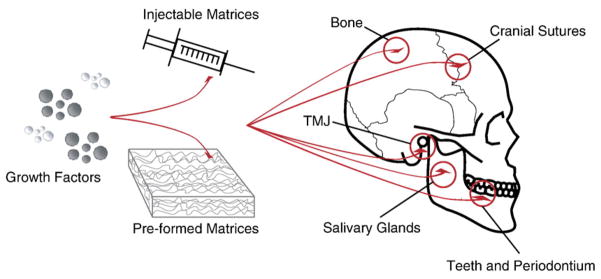
Current treatments for diseases and trauma of dental, oral and craniofacial (DOC) structures rely on durable materials such as amalgam and synthetic materials, or autologous tissue grafts. A paradigm shift has taken place to utilize tissue engineering and drug delivery approaches towards the regeneration of these structures. Several prototypes of DOC structures have been regenerated such as temporomandibular joint (TMJ) condyle, cranial sutures, tooth structures and periodontium components. However, many challenges remain when taking in consideration the high demand for esthetics of DOC structures, the complex environment and yet minimal scar formation in the oral cavity, and the need for accommodating multiple tissue phenotypes. This review highlights recent advances in the regeneration of DOC structures, including the tooth, periodontium, TMJ, cranial sutures and implant dentistry, with specific emphasis on controlled release of signaling cues for stem cells, biomaterial matrices and scaffolds, and integrated tissue engineering approaches.
Figures
References
-
- Rahaman MN, Mao JJ. Stem cell-based composite tissue constructs for regenerative medicine. Biotechnol Bioeng. 2005;91:261–284. - PubMed
-
- Alhadlaq A, Mao JJ. Tissue-engineered neogenesis of human-shaped mandibular condyle from rat mesenchymal stem cells. J Dent Res. 2003;82:951–956. - PubMed
-
- Alhadlaq A, Mao JJ. Tissue-engineered osteochondral constructs in the shape of an articular condyle. J Bone Joint Surg Am. 2005;87:936–944. - PubMed
-
- Yelick PC, Vacanti JP. Bioengineered teeth from tooth bud cells. Dent Clin North Am. 2006;50(2) - PubMed
Publication types
MeSH terms
Substances
Grants and funding
LinkOut - more resources
Full Text Sources
Other Literature Sources
Medical
