


Time course of semantic processes during sentence comprehension: an fMRI study
- PMID: 17500009
- PMCID: PMC1941617
- DOI: 10.1016/j.neuroimage.2007.03.059
Time course of semantic processes during sentence comprehension: an fMRI study
Abstract
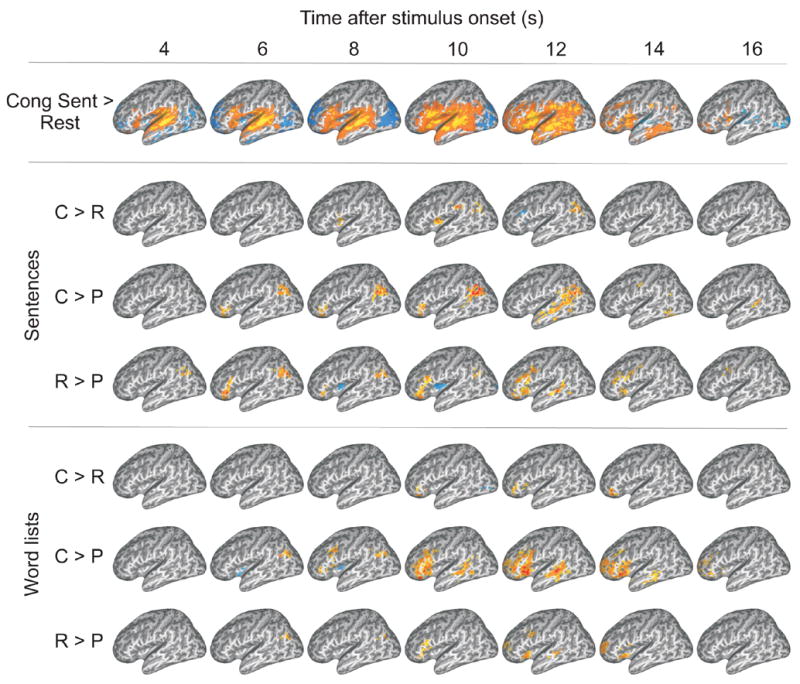
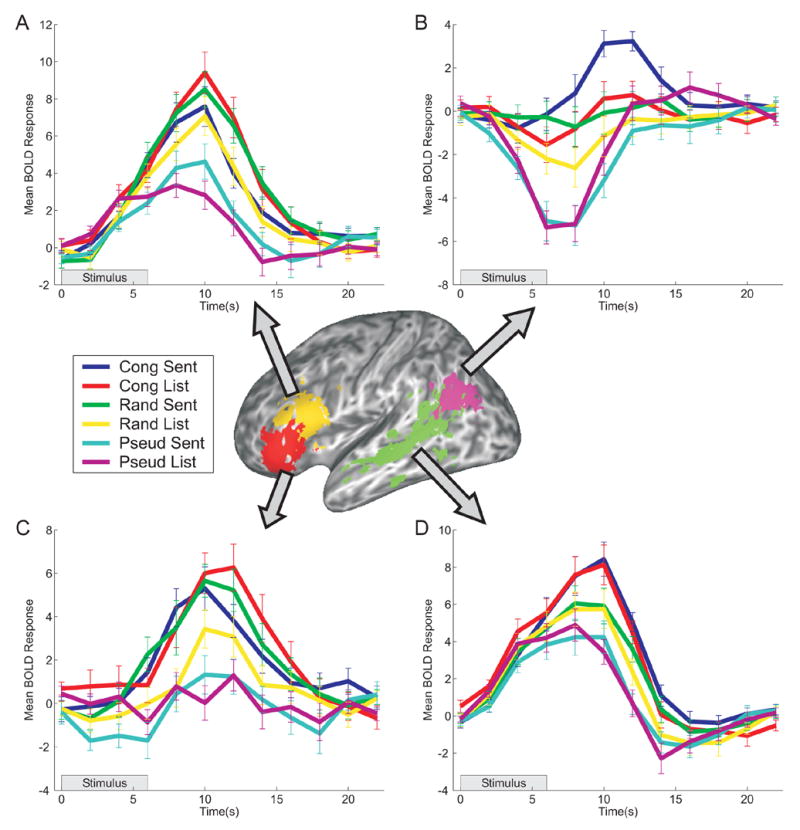
The ability to create new meanings from combinations of words is one important function of the language system. We investigated the neural correlates of combinatorial semantic processing using fMRI. During scanning, participants performed a rating task on auditory word or pseudoword strings that differed in the presence of combinatorial and word-level semantic information. Stimuli included normal sentences comprised of thematically related words that could be readily combined to produce a more complex meaning, semantically incongruent sentences in which content words were randomly replaced with other content words, pseudoword sentences, and versions of these three sentence types in which syntactic structure was removed by randomly re-ordering the words. Several regions showed greater BOLD signal for stimuli with words than for those with pseudowords, including the left angular gyrus, left superior temporal sulcus, and left inferior frontal gyrus, suggesting that these areas are involved in semantic access at the single word level. In the angular and inferior frontal gyri these differences emerged early in the course of the hemodynamic response. An effect of combinatorial semantic structure was observed in the left angular gyrus and left lateral temporal lobe, which showed greater activation for normal compared to semantically incongruent sentences. These effects appeared later in the time course of the hemodynamic response, beginning after the entire stimulus had been presented. The data indicate a complex spatiotemporal pattern of activity associated with computation of word and sentence-level semantic information, and suggest a particular role for the left angular gyrus in processing overall sentence meaning.
Figures
References
-
- Antrobus JS. Information theory and stimulus-independent thought. British Journal of Psychology. 1968;59(4):423–430.
-
- Antrobus JS, Singer JL, Greenberg S. Studies in the stream of consciousness: Experimental enhancement and suppression of spontaneous cognitive processes. Perceptual and Motor Skills. 1966;23:399–417.
-
- Badre D, Poldrack RA, Paré-Blagoev EJ, Insler RZ, Wagner AD. Dissociable controlled retrieval and generalized selection mechanisms in ventrolateral prefrontal cortex. Neuron. 2005;47:907–18. - PubMed
-
- Binder JR, Frost JA, Hammeke TA, Bellgowan PSF, Springer JA, Kaufman JN, Possing ET. Human temporal lobe activation by speech and nonspeech sounds. Cerebral Cortex. 2000;10:512–528. - PubMed
-
- Binder JR, Frost JA, Hammeke TA, Bellgowan PSF, Rao SM, Cox RW. Conceptual processing during the conscious resting state: a functional MRI study. Journal of Cognitive Neuroscience. 1999;11(1):80–93. - PubMed
Publication types
MeSH terms
Substances
Grants and funding
LinkOut - more resources
Full Text Sources
