. 2007 Jul;75(7):3394-405.
doi: 10.1128/IAI.01977-06. Epub 2007 May 14.

Eca1, a sarcoplasmic/endoplasmic reticulum Ca2+-ATPase, is involved in stress tolerance and virulence in Cryptococcus neoformans

Affiliations

Eca1, a sarcoplasmic/endoplasmic reticulum Ca2+-ATPase, is involved in stress tolerance and virulence in Cryptococcus neoformans

Weihua Fan et al. Infect Immun. 2007 Jul.

Abstract

The basidiomycetous fungal pathogen Cryptococcus neoformans is adapted to survive challenges in the soil and environment and within the unique setting of the mammalian host. A C. neoformans mutant was isolated with enhanced virulence in a soil amoeba model that nevertheless exhibits dramatically reduced growth at mammalian body temperature (37 degrees C). This mutant phenotype results from an insertion in the ECA1 gene, which encodes a sarcoplasmic/endoplasmic reticulum (ER) Ca2+-ATPase (SERCA)-type calcium pump. Infection in murine macrophages, amoebae (Acanthamoeba castellanii), nematodes (Caenorhabditis elegans), and wax moth (Galleria mellonella) larvae revealed that the eca1 mutants are virulent or hypervirulent at permissive growth temperatures but attenuated at 37 degrees C. Deletion mutants lacking the entire ECA1 gene were also hypersensitive to the calcineurin inhibitors cyclosporin and FK506 and to ER and osmotic stresses. An eca1Delta cna1Delta mutant lacking both Eca1 and the calcineurin catalytic subunit was more sensitive to high temperature and ER stresses than the single mutants and exhibited reduced survival in C. elegans and attenuated virulence towards wax moth larvae at temperatures that permit normal growth in vitro. Eca1 is likely involved in maintaining ER function, thus contributing to stress tolerance and virulence acting in parallel with Ca2+-calcineurin signaling.


Figures

FIG. 1.
FIG. 1.
eca1 mutation enhances virulence in the amoeba A. castellanii. Cryptococcal yeast cells of the wild type (WT), eca1 insertion mutant AI-5C9, and two independent eca1Δ deletion mutants (eca1-11 and eca1-26) were inoculated into amoeba cell culture at an MOI of 2:1 (left panels) or into amoeba-free medium (PYG; right panels), and were cultured at either 30°C (top panels) or 37°C. A total of 1 × 10⁶ cryptococcal cells were inoculated into amoebae or medium (gray bars), and fungal cells were isolated 24 h (white bars) or 48 h (hatched bars) after incubation, with growth measured by plating on YPD medium and counting CFU after culture at 30°C for 2 days. *, P < 0.05.
FIG. 2.
FIG. 2.
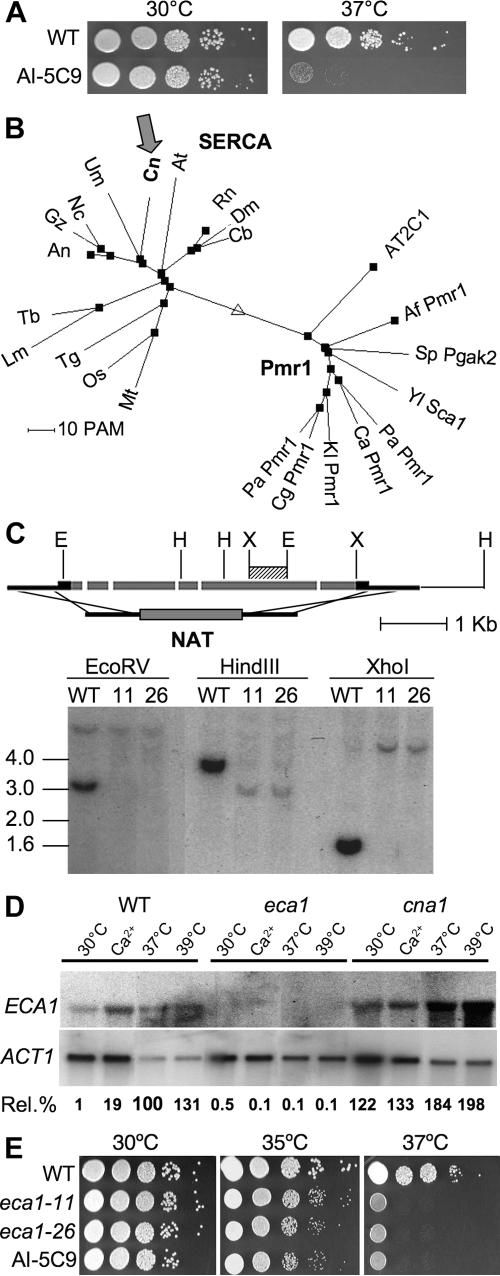
Characterization of C. neoformans Eca1. (A). Temperature-sensitive growth of eca1 insertion mutant AI-5C9. Ten-fold dilutions of AI-5C9 and the wild-type (WT) H99 cells were plated on YPD agar and cultured at 25°C or 37°C for 2 days. (B) Phylogenetic analysis of Eca1 and its homologs. Amino acid sequences of C. neoformans Eca1 (Cn) and P-type Ca2+ pumps from other organisms were aligned using the MultAlin program (17). A phylogenetic tree was deduced to depict the evolutionary relationships of the homologs. All of the SERCA-type pumps cluster at the left node (labeled SERCA), and the fungal Pmr1 or mammalian AT2C1 pumps cluster at the right node (labeled Pmr1). (C). Schematic diagram of the targeted deletion of the ECA1 gene. The genomic DNA structure of ECA1 is illustrated as gray boxes for the exons, and the entire coding region was replaced with a nourseothricin resistance cassette (NAT). Shown are the results of Southern analysis of genomic DNA from two independent isolates, the eca1-11 (lanes 11) and eca1-26 (lanes 26) mutants, and parental strain H99 (WT). Genomic DNA was digested with EcoRV, HindIII, or XhoI. The probe used is indicated by the hatched bar. (D) Northern blot analysis of ECA1 expression. Total RNAs were isolated from wild-type, eca1, and cna1 cells cultured at 30°C in YPD medium (30°C) or YPD medium supplemented with 20 mM of CaCl2 (Ca20) and cells cultured in YPD medium at 37°C (37°C), and the Northern blot was hybridized with 32P-labeled probes for actin (ACT1) and ECA1. The autoradiography images were analyzed with NIH Image software to quantify the expression levels. Transcription of ECA1 in each sample was normalized by the ACT1 gene and compared with the 37°C-treated wild-type sample, the value of which was set to 100%. The relative levels of ECA1 expression are listed below the images (Rel. %). (E). Deletion of ECA1 resulted in temperature-sensitive phenotypes identical to that of AI-5C9. Ten-fold serial dilutions of eca1-11, eca1-26, and wild-type strains were plated on YPD agar and cultured at 30°C, 35°C, or 37°C for 2 days.
FIG. 3.
FIG. 3.
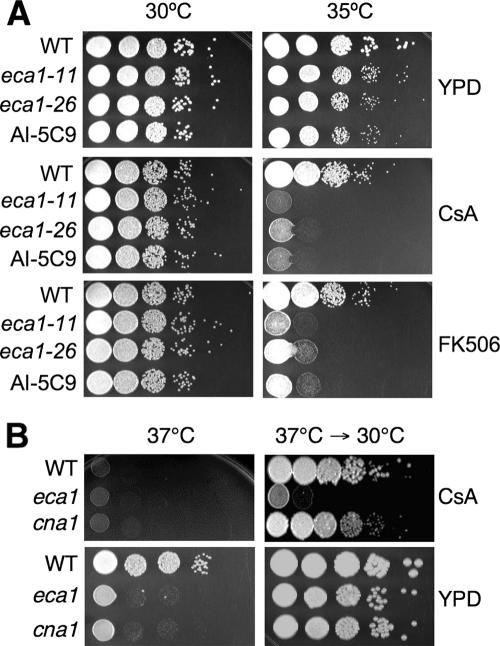
Growth and viability of the eca1 mutants are reduced by calcineurin inhibitors. (A). Ten-fold serial dilutions of eca1-11, eca1-26, the insertion mutant AI-5C9, and wild-type (WT) cells were plated on YPD agar or YPD medium supplemented with CsA or FK506 and cultured at 30°C or 35°C for 2 days. (B). Wild-type, eca1, or cna1 cells were plated on YPD medium or YPD medium supplemented with CsA and cultured at 37°C for 2 days before being transferred to 30°C and cultured for 2 more days.
FIG. 4.
FIG. 4.
Deletion of ECA1 results in hypersensitivity to multiple stresses. (A) Ten-fold dilutions of wild-type (WT), eca1, or cna1 cells were plated on YPD medium or YPD medium supplemented with 100 mM or 250 mM CaCl2, 10 mM EGTA, 0.1 μg/ml tunicamycin (Tm), or 1.5 M NaCl and cultured at 30°C or 35°C for 2 days. (B) Wild-type, eca1, or cna1 cells were cultured in RPMI medium (pH 7.0) containing 10-fold serial dilutions of fludioxonil and cultured at 30°C for 2 days. Growth was determined by measuring the optical density at 595 nm. The graph shows the percentage of growth relative to cells cultured in medium containing no fludioxonil.
FIG. 5.
FIG. 5.
Calcineurin mutation exacerbates eca1 mutant phenotypes. (A) Ten-fold serial dilutions of the wild-type (WT), eca1, cna1, and eca1 cna1 mutant cells were plated on YPD medium or YPD medium supplemented with EGTA (5 mM), tunicamycin (Tm; 0.1 μg/ml), CaCl2 (250 mM), or NaCl (1.5 M) and cultured at 30°C for 2 days. (B). Ten-fold serial dilutions of the wild-type or eca1, cna1, and eca1Δ cna1Δ mutant cells were plated on YPD medium and cultured at 37°C for 2 or 4 days.
FIG. 6.
FIG. 6.
The Eca1 SERCA pump is required for virulence in a murine macrophage model. Cryptococcal yeast cells of the wild type (WT), the eca1 insertion mutant (AI-5C9), and two eca1Δ deletion mutants (eca1-11 and eca1-26) were inoculated into macrophage J774A.1 cultured cells at an MOI of 2:1 (left panel) or into macrophage-free medium (DMEM; right panel). The cryptococcal strains were inoculated at 1 × 10⁶ cells (gray bars), and after 24 h (white bars) of incubation, growth was measured by plating on YPD and counting CFU after culture at 30°C for 2 days. *, P < 0.05.
FIG. 7.
FIG. 7.
Temperature influences the role of C. neoformans Eca1 SERCA pump and calcineurin in virulence in the wax moth G. mellonella. Ten wax moth larvae were injected with 1 × 10⁵ cells of the wild-type or eca1Δ, cna1Δ, or eca1Δ cna1Δ strains and incubated at 30 or 37°C, and survival was monitored daily.
FIG. 8.
FIG. 8.
Eca1 SERCA pump and calcineurin additively contribute to virulence in the nematode C. elegans. Micrographs of nematode intestines containing C. neoformans yeast cells. The grinder is to the right in each image. Bar = 20 μM. Shown is the generation of C. elegans progeny after exposure to C. neoformans strains (white bars). CFU are the average yeast colonies (± standard error) from individual C. elegans worms fed C. neoformans, with worms harvested from three plates (gray bars). The eca1 single and eca1 cna1 double mutants show statistically significant differences from the wild type. *, P < 0.05.

References

    1. Adamíková, L., A. Straube, I. Schulz, and G. Steinberg. 2004. Calcium signaling is involved in dynein-dependent microtubule organization. Mol. Biol. Cell 15:1969-1980. - PMC - PubMed
    1. Akhter, S., H. C. McDade, J. M. Gorlach, G. Heinrich, G. M. Cox, and J. R. Perfect. 2003. Role of alternative oxidase gene in pathogenesis of Cryptococcus neoformans. Infect. Immun. 71:5794-5802. - PMC - PubMed
    1. Alspaugh, J. A., L. M. Cavallo, J. R. Perfect, and J. Heitman. 2000. RAS1 regulates filamentation, mating and growth at high temperature of Cryptococcus neoformans. Mol. Microbiol. 36:352-365. - PubMed
    1. Bader, T., B. Bodendorfer, K. Schröppel, and J. Morschhäuser. 2003. Calcineurin is essential for virulence in Candida albicans. Infect. Immun. 71:5344-5354. - PMC - PubMed
    1. Bader, T., K. Schröppel, S. Bentink, N. Agabian, G. Köhler, and J. Morschhäuser. 2006. Role of calcineurin in stress resistance, morphogenesis, and virulence of a Candida albicans wild-type strain. Infect. Immun. 74:4366-4369. - PMC - PubMed

Publication types

MeSH terms

Substances

LinkOut - more resources