. 2007 Jun;80(6):1162-70.
doi: 10.1086/518047. Epub 2007 Apr 18.

RAB23 mutations in Carpenter syndrome imply an unexpected role for hedgehog signaling in cranial-suture development and obesity

Affiliations

RAB23 mutations in Carpenter syndrome imply an unexpected role for hedgehog signaling in cranial-suture development and obesity

Dagan Jenkins et al. Am J Hum Genet. 2007 Jun.

Erratum in

  • Am J Hum Genet. 2007 Nov;81(5):1114. Josifiova, Dragana [corrected to Josifova, Dragana]

Abstract

Carpenter syndrome is a pleiotropic disorder with autosomal recessive inheritance, the cardinal features of which include craniosynostosis, polysyndactyly, obesity, and cardiac defects. Using homozygosity mapping, we found linkage to chromosome 6p12.1-q12 and, in 15 independent families, identified five different mutations (four truncating and one missense) in RAB23, which encodes a member of the RAB guanosine triphosphatase (GTPase) family of vesicle transport proteins and acts as a negative regulator of hedgehog (HH) signaling. In 10 patients, the disease was caused by homozygosity for the same nonsense mutation, L145X, that resides on a common haplotype, indicative of a founder effect in patients of northern European descent. Surprisingly, nonsense mutations of Rab23 in open brain mice cause recessive embryonic lethality with neural-tube defects, suggesting a species difference in the requirement for RAB23 during early development. The discovery of RAB23 mutations in patients with Carpenter syndrome implicates HH signaling in cranial-suture biogenesis--an unexpected finding, given that craniosynostosis is not usually associated with mutations of other HH-pathway components--and provides a new molecular target for studies of obesity.


Figures
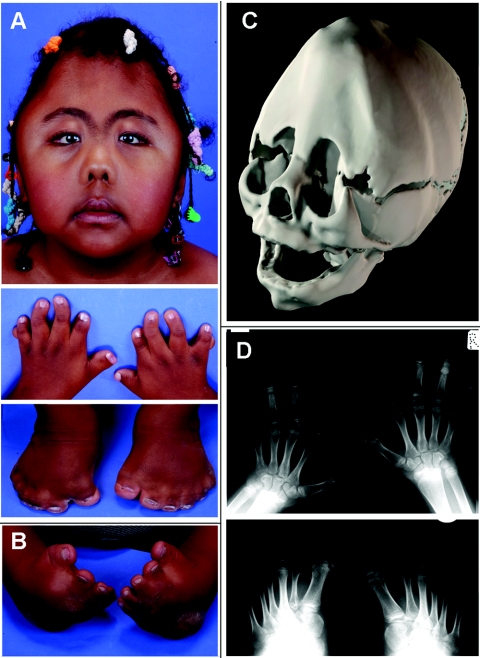
Figure  1.
Figure 1.
Clinical features of Carpenter syndrome. A, Affected sister of subject 4009, aged 6 years. Note metopic ridge and temporal bulging secondary to multisuture synostosis, arched eyebrows, epicanthic folds, anteverted nares, and broad thumbs and halluces with syndactyly, brachydactyly, clinodactyly, and polydactyly (postaxial in hands, central in feet). B, Severe bilateral clubfoot in subject 4009. C, Three-dimensional CT skull reconstruction of subject 3541, aged 4 wk, showing complete synostosis of the metopic, sagittal, and coronal sutures. D, Preoperative radiographs of the hands and feet of subject 3734, aged 11 years. Note characteristic longitudinally split epiphyses at bases of several proximal phalanges, central polydactyly of the feet, and biphalangeal digits II of the hands and II and III of the feet.
Figure  2.
Figure 2.
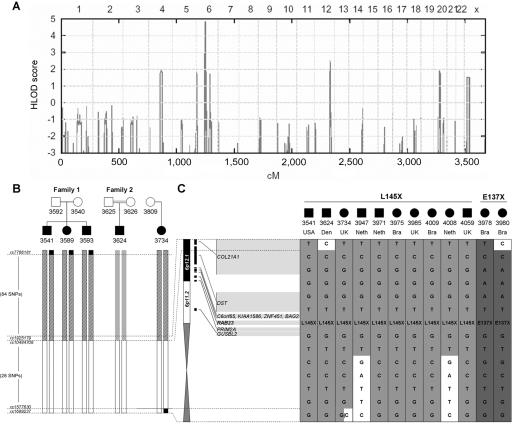
Linkage and haplotype mapping of Carpenter syndrome to chromosome 6p12.1. A, Genomewide HLOD scores from 50K microarray data for families 1 and 2 combined, with the assumption of a consanguineous loop (second-cousin parents) in family 1. HLOD scores are given along the Y-axis, relative to genomic position (cM) on the X-axis. Note the significant peak (HLOD 4.8) in the centromeric region of chromosome 6. B, Representation of 50K SNP haplotypes (vertical bars) for chromosomes of affected individuals in families 1 and 2 and an additional sporadic case (subject 3734), all of whom are homozygous for the 434T→A (L145X) mutation in RAB23. Distinct haplotypes are represented by different shaded bars. On the basis of homozygosity, the critical region on chromosome 6 is defined by heterozygosity for SNPs rs7766181 (family 1) and rs1689237 (subject 3734). Within this, a smaller region (white bars) is identical in all affected individuals for 30 consecutive SNPs, suggesting a common ancestral origin of the L145X mutation. C, Genotyping of 13 selected SNPs spanning this identical segment in 10 individuals homozygous for the L145X mutation and 2 individuals homozygous for E137X. At left, the position of these SNPs is shown in relation to RAB23 and 8 additional genes within the 6p12.1-q11 region. Note that all patients with the L145X mutation share a common haplotype for seven consecutive SNPs; this is interrupted proximally in two Dutch patients, probably because of a shared recombination. From top to bottom, the genotyped SNPs are rs1925179, rs2397214, rs9296842, rs1547625, rs6927258, rs6906792, rs3904827, rs6934928, rs1343391, rs1224703, rs1850417, rs2343013, and rs1689237. Bra=Brazil; Den=Denmark; Neth=The Netherlands.
Figure  3.
Figure 3.
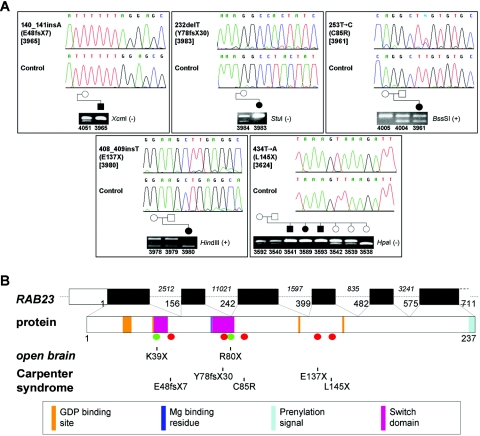
RAB23 mutations in Carpenter syndrome. A, Sequence chromatograms and confirmatory restriction digests for the five pathogenic mutations identified. Note that patient 3961 is a compound heterozygote for the C85R and L145X mutations. B, top, The exon/intron organization of RAB23, with the coding part of the cDNA (GenBank [accession number NM_183227.1]; Ensembl Genome Browser [reference OTTHUMG00000014918]) in black and the UTRs in white (alternatively spliced 5′ noncoding exons omitted). Plain numbering refers to the first nucleotide of each exon, starting from the initiation codon, and italic numbering indicates the length of introns. Bottom, Functional domains in the 237-aa protein,,, color coded, with the location of human mutations causing Carpenter syndrome and those found in open brain mice indicated by red and green dots, respectively. GDP=guanosine diphosphate.
Figure  4.
Figure 4.
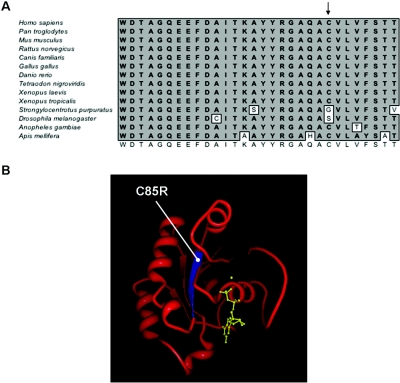
Sequence conservation and structural context of C85R substitution. A, Amino acid sequence comparison of the Switch 2 region of human RAB23 (top) with 13 other species. The consensus sequence is shown at the bottom, and the position of the mutated C85 residue is indicated with an arrow. B, Structure of human RAB23 (Protein Data Bank [number 1Z22]), showing the C85 residue located in a β-strand (blue) and completely buried in the core of the protein. The bound Mg-GDP is shown in yellow. The structure was modeled using the Protein Workshop tool (Protein Data Bank).

References

Web Resources

    1. dbSNP, http://www.ncbi.nlm.nih.gov/SNP/ (for SNPs, including rs1040461, rs1925179, rs2397214, rs9296842, rs1547625, rs6927258, rs6906792, rs3904827, rs6934928, rs1343391, rs1224703, rs1850417, rs2343013, and rs1689237)
    1. Ensembl Genome Browser, http://www.ensembl.org/ (for RAB23 [reference OTTHUMG00000014918])
    1. GenBank, http://www.ncbi.nlm.nih.gov/Genbank/ (for human RAB23 cDNA reference sequence [accession number NM_183227.1])
    1. International HapMap Project, http://hapmart.hapmap.org/BioMart/martview (for HapMart)
    1. MRC-Holland, http://www.mrc-holland.com/pages/indexpag.html (for information on MLPA reagents and methods)

References

    1. Carpenter G (1901) Two sisters showing malformations of the skull and other congenital abnormalities. Rep Soc Study Dis Child Lond 1:110–118
    1. Carpenter G (1909) Case of acrocephaly, with other congenital malformations. Proc Roy Soc Med 2:45–53 - PMC - PubMed
    1. Temtamy SA (1966) Carpenter’s syndrome: acrocephalopolysyndactyly. J Pediatr 69:111–120 10.1016/S0022-3476(66)80368-2 - DOI - PubMed
    1. Robinson LK, James HE, Mubarak SJ, Allen EJ, Jones KL (1985) Carpenter syndrome: natural history and clinical spectrum. Am J Med Genet 20:461–469 10.1002/ajmg.1320200307 - DOI - PubMed
    1. Cohen DM, Green JG, Miller J, Gorlin RJ, Reed JA (1987) Acrocephalopolysyndactyly type II—Carpenter syndrome: clinical spectrum and an attempt at unification with Goodman and Summit syndromes. Am J Med Genet 28:311–324 10.1002/ajmg.1320280208 - DOI - PubMed

Publication types