


A meta-analysis of the success rate of Helicobacter pylori therapy in Canada
- PMID: 17505565
- PMCID: PMC2657711
- DOI: 10.1155/2007/419784
A meta-analysis of the success rate of Helicobacter pylori therapy in Canada
Abstract
Background and aim: Helicobacter pylori treatment success rates have varied. A systematic review of the success rate of anti- H pylori therapy in Canada was performed.
Methods: All clinical trials containing Canadian data on the success rate of H pylori treatment were identified using MEDLINE searches, through review of references of retrieved studies and by contacting key investigators. Both randomized and open-label trials were included. Treatment effect size was calculated using a variation of Cochran's Q method.
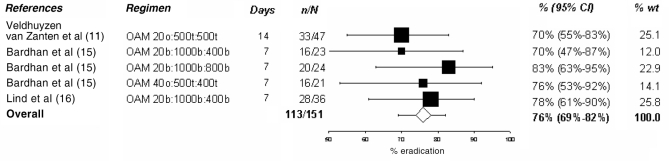
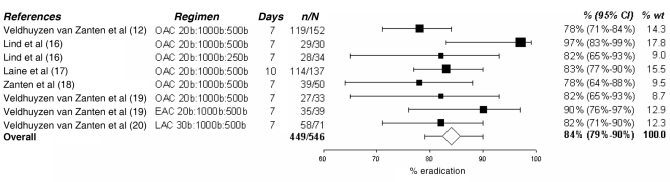
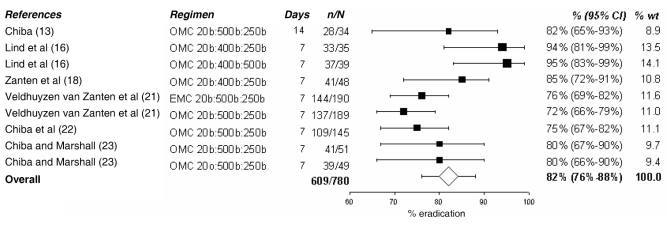
Results: Seventeen papers met the inclusion criteria. Both triple therapies consisting of a proton pump inhibitor (PPI), clarithromycin and either amoxicillin or metronidazole performed well, achieving a success rate of 84% and 82%, respectively. The cure rate of PPI-amoxicillin + metronidazole was 76%. Quadruple therapy consisting of a PPI, bismuth, metronidazole and tetracycline, given for seven to 10 days, achieved a success rate of 87%.
Conclusion: Both PPI-based triple therapy and quadruple therapy perform well in Canada for the treatment of H pylori infection.
HISTORIQUE ET BUT :: Les taux de réussite des traitements contre Helicobacter pylori ont varié. C’est pourquoi une revue systématique des taux de réussite des traitements anti-H. pylori au Canada a été réalisée.
MÉTHODES :: Tous les essais cliniques comprenant des données canadiennes sur les taux de réussite du traitement anti-H. pylori ont été recensés au moyen du réseau Medline, d’une revue des bibliographies des études et par contact avec les principaux investigateurs. Tant les essais randomisés que les essais ouverts ont été inclus. La taille de l’effet du traitement a été calculée à l’aide d'une version modifiée de la méthode Q de Cochran.
RÉSULTATS :: Dix-sept articles répondaient aux critères d’inclusion. Les trithérapies comportant un inhibiteur de la pompe à protons (IPP), la clarithromycine et soit l’amoxicilline, soit le métronidazole, ont donné de bons résultats avec un taux de réussite de 84 % et de 82 %, respectivement. Le taux de guérison obtenu avec IPP-amoxicilline + métronidazole a été de 76 %. La quadrithérapie comportant un IPP, du bismuth, du métronidazole et de la tétracycline administrée pendant sept à dix jours a donné lieu à un taux de réussite de 87 %.
CONCLUSION :: La trithérapie et la quadrithérapie à base d’IPP ont donné de bons résultats au Canada pour le traitement de l'infection à H. pylori.
Figures

References
-
- Huang JQ, Sridhar S, Chen Y, Hunt RH. Meta-analysis of the relationship between Helicobacter pylori seropositivity and gastric cancer. Gastroenterology. 1998;114:1169–79. - PubMed
-
- Moayyedi P, Soo S, Deeks J, et al. Eradication of Helicobacter pylori for non-ulcer dyspepsia. Cochrane Database Syst Rev. 2006;(2):CD002096. - PubMed
-
- Malfertheiner P, Megraud F, O’Morain C, et al. European Helicobacter Pylori Study Group (EHPSG) Current concepts in the management of Helicobacter pylori infection – the Maastricht 2–2000 Consensus Report. Aliment Pharmacol Ther. 2002;16:167–80. - PubMed
-
- Hunt R, Fallone C, Veldhuyzen van Zanten S, et al. CHSG 2004 participants Canadian Helicobacter Study Group Consensus Conference: Update on the management of Helicobacter pylori –an evidence-based evaluation of six topics relevant to clinical outcomes in patients evaluated for H pylori infection. Can J Gastroenterol. 2004;18:547–54. - PubMed
Publication types
MeSH terms
Substances
LinkOut - more resources
Full Text Sources
Medical
Miscellaneous