. 2007 Jun;45(6):391-5.
doi: 10.1002/dvg.20284.

Generation of a floxed allele of the mouse Endoglin gene

Affiliations

Generation of a floxed allele of the mouse Endoglin gene

Kathleen R Allinson et al. Genesis. 2007 Jun.

Abstract

Endoglin is an auxiliary receptor for TGFbeta signalling. Heterozygous germline Endoglin mutations have been identified in patients with the vascular abnormality, Hereditary Haemorrhagic Telangiectasia. Endoglin is upregulated in endothelial cells during angiogenesis and loss of Endoglin in the mouse results in embryonic lethality at mid-gestation. This phenotype points to an important role of Endoglin in new blood vessel formation but precludes analysis at later stages in development and in postnatal life. To bypass this limitation and allow further investigations of the function of Endoglin we have generated a floxed Endoglin allele in which loxP sites flank exons 5 and 6. Mice homozygous for this allele are normal and in the presence of appropriate Cre lines will allow time and cell specific Endoglin deletion for in vivo analysis of function in cardiovascular development and disease.


Figures

FIG. 1
FIG. 1
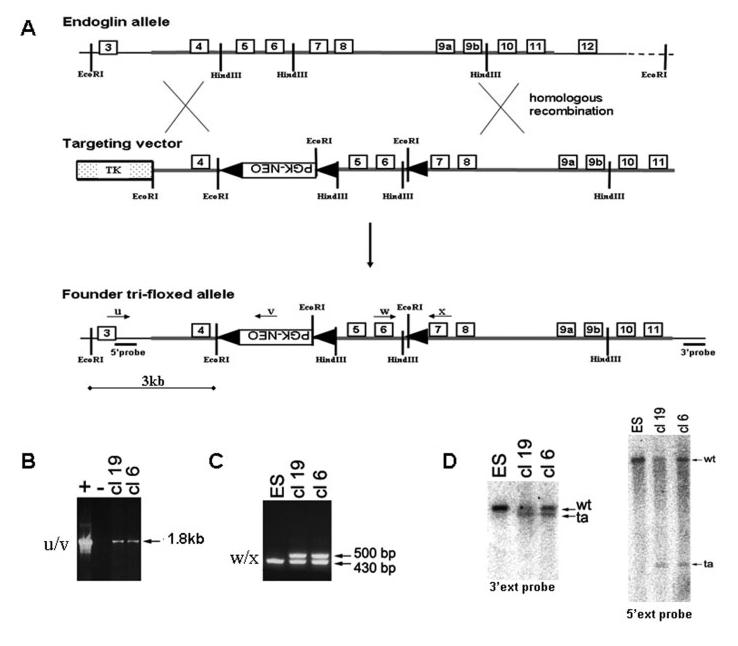
Generation of founder tri-floxed endoglin mice. (A) Targeting the endoglin gene with trifloxed (3fl) eng vector by homologous recombination in ES cells. Endoglin exons 5 and 6 and a PGK-neo selection cassette are flanked by loxP sites (black arrowheads). The DNA used in the targeting vector is drawn as a thick line and carries 1.3 and 5.7 kb homologous sequences in the left and right arm, respectively. (B–D) Two successfully targeted ES clones (cl-6 and cl-19) were recognized by genomic PCR using primers u and v to amplify a 1.8 kb product (B) and (C) primers w and x to amplify a 500 bp product. Successful targeting was confirmed by Southern Blotting using EcoRI digested genomic DNA hybridized with radiolabelled 3′ and 5′ external probes. The wild type (WT) EcoRI fragment (∼16 kb) is reduced in the targeted allele (ta) to 3 kb at the 5′ end and ∼13 kb at the 3′ end.
FIG. 2
FIG. 2
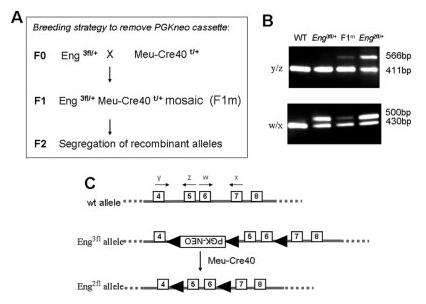
Removing the floxed neo cassette in vivo to generate bifloxed endoglin mice. (A) Breeding strategy showing how the neo cassette was removed from the trifloxed mice using the Meu-Cre40 transgenic line. (B) The bifloxed endoglin allele - with the neo cassette removed- was recognized by PCR for a 566 bp product with primers y and z and readily discriminated from the 411 bp product corresponding to the WT allele (upper panel). (The presence of the 1.8 kb neo cassette in the tri-floxed allele precludes the formation of a detectable PCR product.) The lower panel shows PCR products amplified with primers w and x to produce a 500 bp product from all alleles with a loxP site in intron 6. PCR products corresponding to the bifloxed allele can be seen at low levels in the mosaic (F1m) mouse, but increase to ∼50% in the F2 Eng2fl/+ mouse. (C) Diagram summarizing conversion of the trifloxed allele (Eng3fl) to the required bifloxed allele (Eng2fl), including position of diagnostic primers.
FIG. 3
FIG. 3
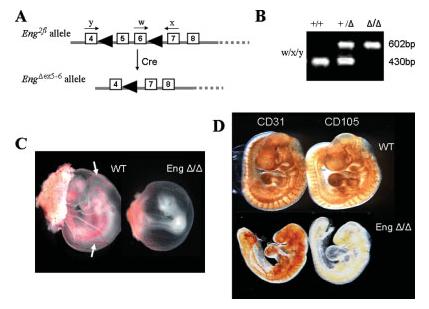
Mice homozygous for the Eng Δex5-6 allele have an embryonic lethal phenotype and do not express endoglin protein. (A) Diagram showing generation of the Eng Δex5-6 allele following deletion of exons 5 and 6 in the presence of Cre, and position of primers w, x, and y. (B) Multiplex PCR using primers w, x, and y produce a 602 bp product from the Eng Δex5-6 allele and a 430 bp product from the wildtype allele. (C) EngΔ/Δ embryos at 9.5 dpc show angiogenesis defects in the yolk sac compared with normal vessels (arrows) in their wild type littermates. (D) Wholemount immunohistochemistry of wild type and EngΔ/Δ showing CD31 and endoglin expression. There is clear evidence of CD31 positive endothelial cells in the EngΔ/Δembryos but endoglin protein was not detected.

References

    1. Arthur HM, Ure J, Smith AJ, Renforth G, Wilson DI, Torsney E, Charlton R, Parums DV, Jowett T, Marchuk DA, Burn J, Diamond AG. Endoglin, an ancillary TGFβ receptor, is required for extra-embryonic angiogenesis and plays a key role in heart development. Dev Biol. 2000;217:42–53. - PubMed
    1. Bourdeau A, Dumont DJ, Letarte M. A murine model of hereditary hemorrhagic telangiectasia. J Clin Invest. 1999;104:1343–1351. - PMC - PubMed
    1. Bourdeau A, Faughnan ME, McDonald ML, Paterson AD, Wanless IR, Letarte M. Potential role of modifier genes influencing transforming growth factor-β1 levels in the development of vascular defects in endoglin heterozygous mice with hereditary hemorrhagic telangiectasia. Am J Pathol. 2001;158:2011–2020. - PMC - PubMed
    1. Carvalho RL, Jonker L, Goumans MJ, Larsson J, Bouwman P, Karlsson S, Dijke PT, Arthur HM, Mummery CL. Defective paracrine signalling by TGFβ in yolk sac vasculature of endoglin mutant mice: a paradigm for hereditary haemorrhagic telangiectasia. Development. 2004;131:6237–6247. - PubMed
    1. David L, Mallet C, Mazerbourg S, Feige JJ, Bailly S. Identification of BMP9 and BMP10 as functional activators of the orphan activin receptor-like kinase 1 (ALK1) endothelial cells. Blood. 2007;109(5):1953–1961. - PubMed

Publication types

Substances

LinkOut - more resources